
Structure-Centric Graph Foundation Model via Geometric Bases
Abstract
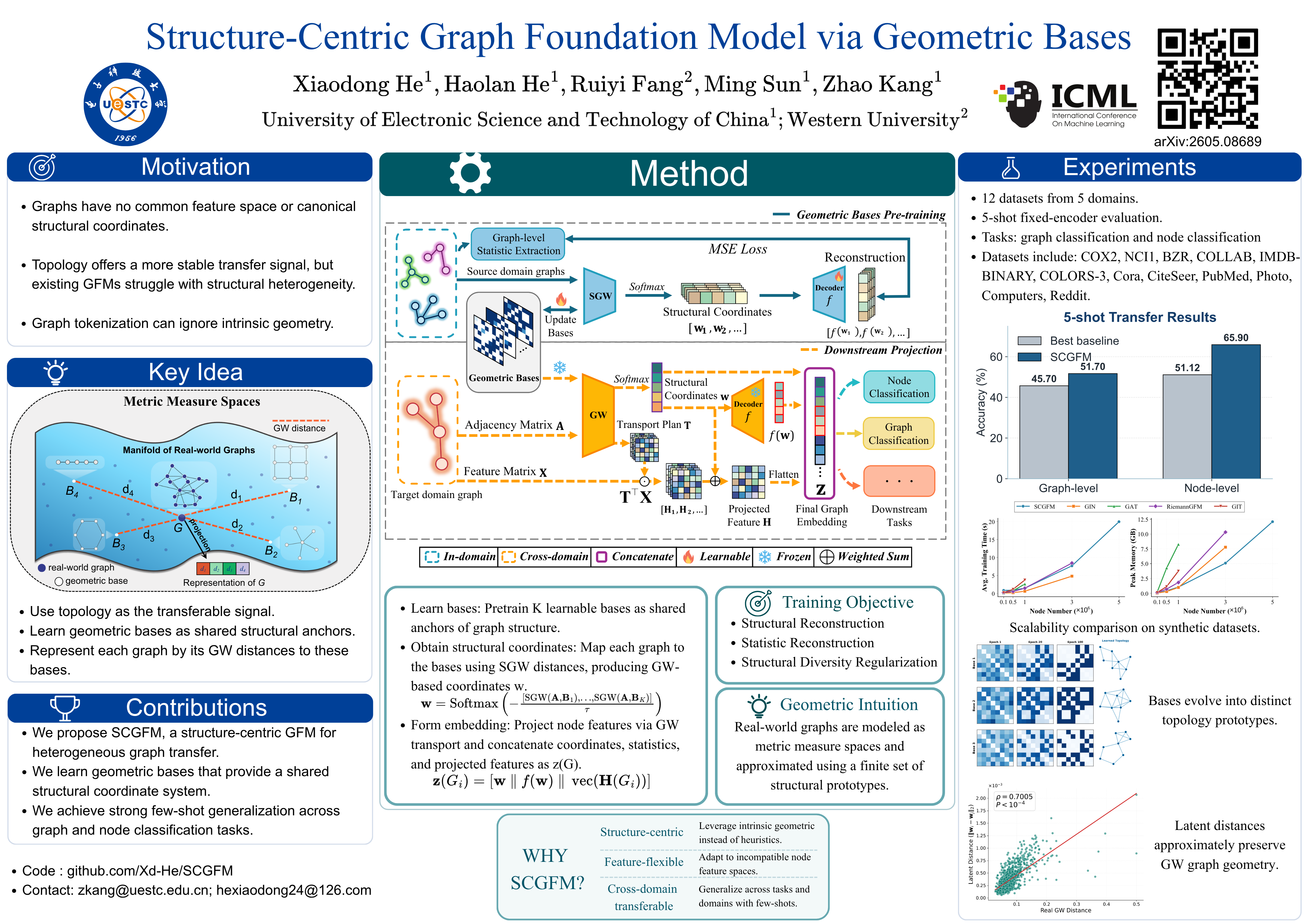
Graph foundation models (GFMs) seek transferable representations across graph domains but are limited by structural heterogeneity and incompatible node feature spaces. We propose Structure-Centric Graph Foundation Models (SCGFM), which treat graph topology as the primary source of transferable knowledge. Modeling graphs as metric measure spaces, SCGFM introduces learnable geometric bases that define a shared structural coordinate system. Graphs are aligned to these bases via Gromov–Wasserstein distances, yielding structure-aligned latent representations that accommodate heterogeneous graph topologies. To address feature incompatibility, SCGFM employs a structure-aware feature re-encoding mechanism that unifies node representations without assuming a fixed feature dimensionality or requiring dataset-specific preprocessing. Experiments on graph- and node-level tasks demonstrate strong in-domain and cross-domain generalization, outperforming existing GFM approaches.
Lay Summary
Many kinds of data can be seen as networks of points and links: atoms in a molecule, people in a social network, or papers in a citation network. A major challenge is that these networks can look very different, so an AI system trained on one type of network often struggles on another, especially when only a few labeled examples are available. We built SCGFM, a method that helps AI compare networks by focusing first on their shape rather than on domain-specific details. The idea is similar to describing a city by its distances to a few landmarks: each network is described by how it relates to a small set of learned reference patterns. This gives different kinds of networks a common language, while still allowing the model to use useful information attached to each point. In our experiments, SCGFM improved classification across different types of networks using only a small number of labels. It also made it easier to search for networks that are similar to a given example. This could help apply network-based AI in chemistry, biology, social analysis, and recommendation systems, where labeled data is often scarce.