
Inducing Overthink: Hierarchical Genetic Algorithm-based DoS Attack on Black-Box Large Language Reasoning Models
Abstract
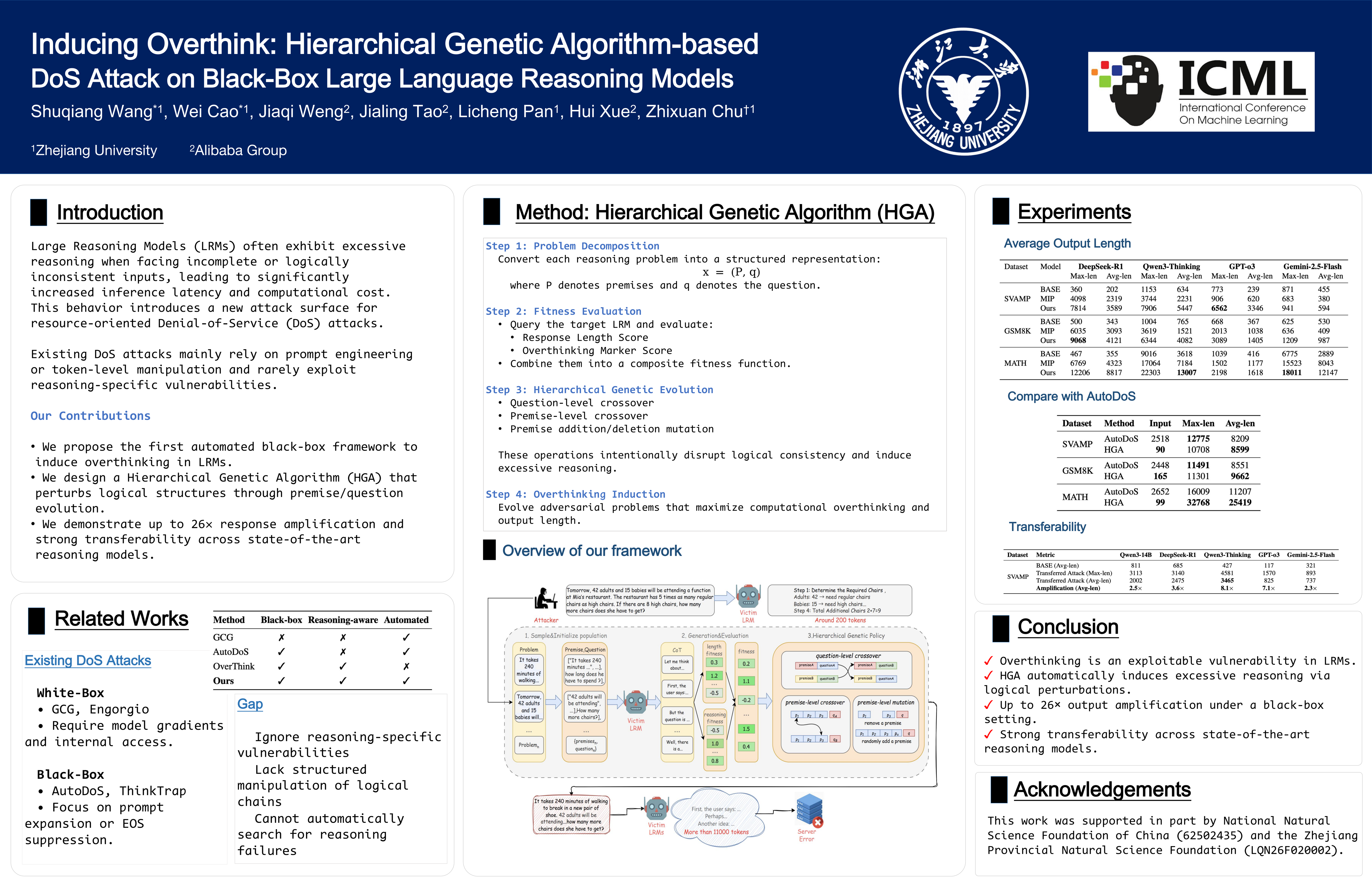
Large Reasoning Models (LRMs) are increasingly integrated into systems requiring reliable multi-step inference, yet this growing dependence exposes new vulnerabilities related to computational availability. In particular, LRMs exhibit a tendency to “overthink’’—producing excessively long and redundant reasoning traces—when confronted with incomplete or logically inconsistent inputs. This behavior significantly increases inference latency and energy consumption, forming a potential vector for denial-of-service (DoS) style resource exhaustion. In this work, we investigate this attack surface and propose an automated black-box framework that induces overthinking in LRMs by systematically perturbing the logical structure of input problems. Our method employs a hierarchical genetic algorithm (HGA) operating on structured problem decompositions, and optimizes a composite fitness function designed to maximize both response length and reflective overthinking markers. Across four state-of-the-art reasoning models, the proposed method substantially amplifies output length, achieving up to a 26.1× increase on the MATH benchmark and consistently outperforming benign and manually crafted missing-premise baselines. We further demonstrate strong transferability, showing that adversarial inputs evolved using a small proxy model retain high effectiveness against large commercial LRMs. These findings highlight overthinking as a shared and exploitable vulnerability in modern reasoning systems, underscoring the need for more robust defenses.
Lay Summary
Large reasoning models are increasingly used to solve complex problems, but they can sometimes “overthink” when given confusing, incomplete, or logically inconsistent inputs. Instead of stopping or asking for clarification, these models may produce extremely long responses, which can increase computing cost, slow down services, and potentially create a denial-of-service risk. In this work, we study this vulnerability and propose an automated method for finding inputs that trigger excessive reasoning. Our method breaks a problem into its basic parts, such as premises and questions, and then uses an evolutionary search process to rearrange, remove, or mix these parts in ways that confuse the model’s reasoning. The search favors inputs that make the model produce longer answers and show signs of repeated self-correction. Experiments on several modern reasoning models show that these inputs can greatly increase output length, sometimes by more than 26 times. These findings suggest that overthinking is a shared weakness of current reasoning models and highlight the need for defenses that help models recognize confusing inputs and avoid unnecessary reasoning loops.