
Towards a Unified Generative Model for Scarce Time Series with Domain Experts
Abstract
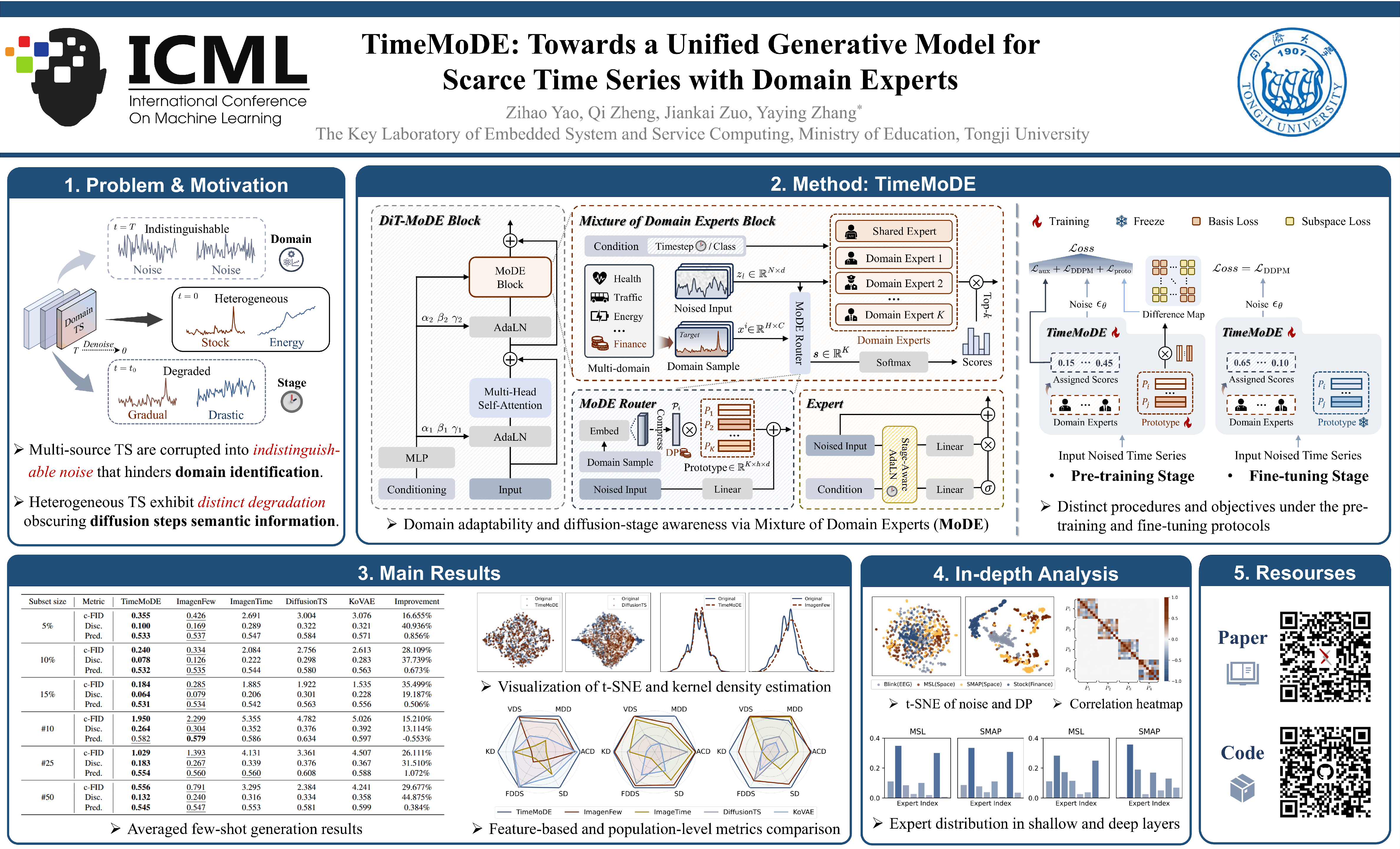
Synthesizing realistic time series with generative models has wide-ranging applications in real-world scenarios. Despite recent progress, most existing methods are trained under the assumption of abundant training data, which substantially limits their effectiveness in data-scarce settings. In this paper, we propose TimeMoDE, a novel framework that integrates Diffusion Transformers with Mixture-of-Experts to exploit both domain adaptability and diffusion-stage awareness for time series generation under data scarcity. It is pre-trained on a large-scale collection of multi-domain datasets to extract domain-agnostic temporal representations and domain-specific information benefiting generalization during fine-tuning. We propose Domain Prompts to condition expert assignment for indistinguishable noised tokens, mitigating the limitations of capturing inter-dataset relationships. Moreover, we incorporate diffusion timestep signals to equip the experts with awareness of time series degradation variations, facilitating adaptive calibrate to stage-dependent denoising requirements. Extensive experiments demonstrate that TimeMoDE outperforms existing methods under diverse low-data settings. It establishes an innovative paradigm for advanced time series few-shot generation.
Lay Summary
Time series data is widely used in real-world applications, but many scenarios suffer from limited data, making model training difficult. Consequently, we propose a unified model that learns general patterns from large-scale time series to generate realistic synthetic data to alleviate scarcity problem. Since pretraining and downstream time series may come from different domains with distinct characteristics (e.g., periodic traffic vs. non-periodic stock data), we design a module composed of multiple subnetworks which specialize in different temporal patterns. The model further uses source time series as prompts to guide the selection of the most matching subnetwork for modeling the target domain. In addition, we observe that different stages in time series generation have varying degradation level. Based on this insight, we incorporate stage-level information into subnetworks to improve generation quality. This work effectively addresses a gap in existing research which often assumes that sufficient data is available to train time series generative models. The proposed model, TimeMoDE, enables users to generate rich high-fidelity time series in scenarios where data is required but limited.