
Does Reasoning Improve Seeing? Understanding When Vision-Language Models Benefit from Thinking
Abstract
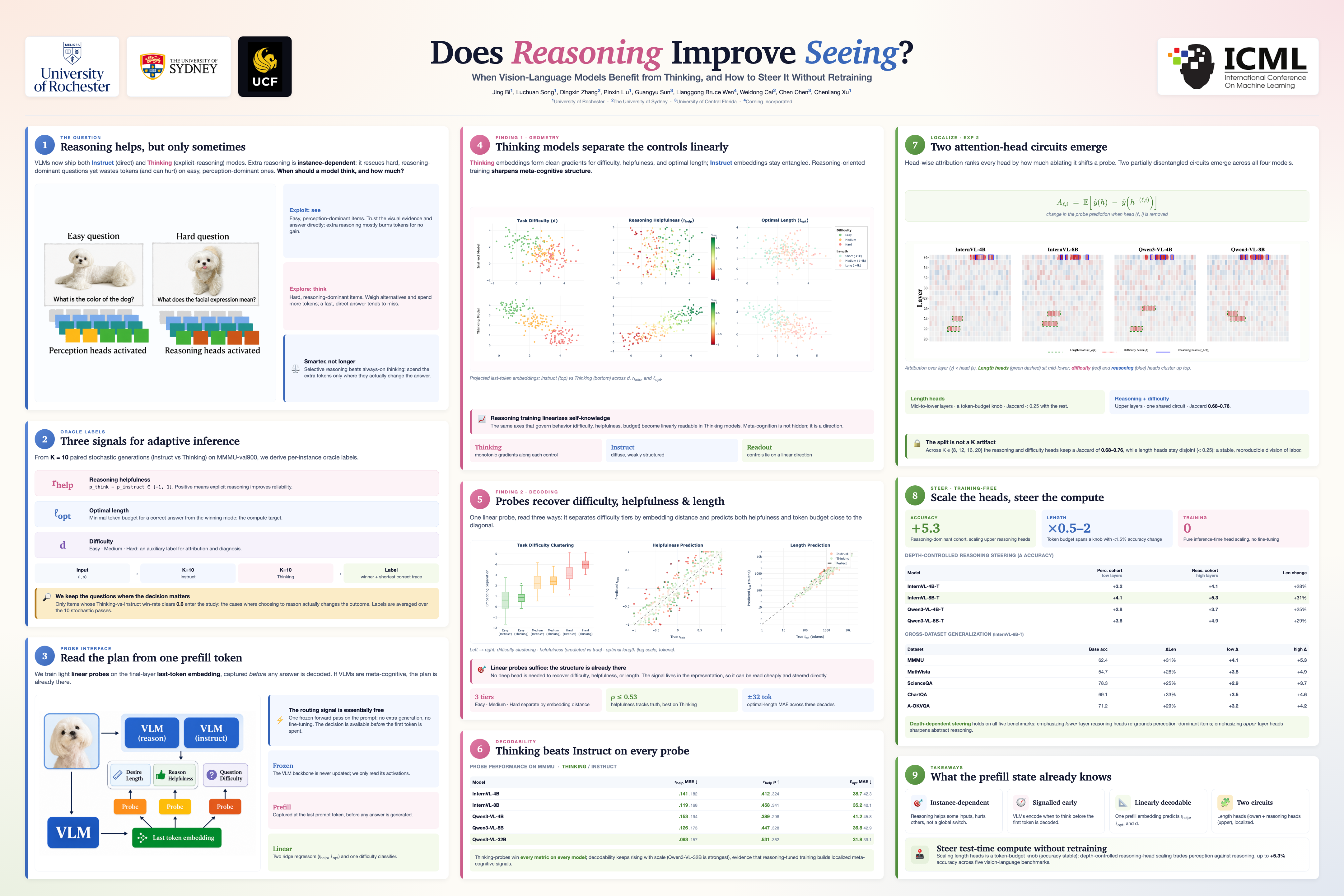
Vision-language models (VLMs) now support both direct Instruct and explicit-reasoning Thinking modes, yet practitioners still lack principled ways to decide when reasoning actually improves performance, or how much computation to spend at test time, so we investigate whether VLMs encode meta-cognitive signals for adaptive inference. We derive oracle labels for two properties: (1) reasoning helpfulness, namely whether explicit reasoning improves accuracy, and (2) desired generation length, the minimal token budget needed for a correct answer. Probing final-layer representations in InternVL and Qwen3-VL models, we find Thinking models encode these signals more linearly than Instruct models, suggesting that reasoning-oriented training enhances meta-cognitive structure. Head-wise attribution reveals two circuits: length-control heads in lower layers and reasoning/difficulty heads in higher layers. Causal interventions confirm these roles across benchmarks: scaling length heads controls output length with minimal accuracy loss, while scaling reasoning heads enables a perception-reasoning trade-off, improving accuracy by up to 5.3\%. Our results demonstrate that reasoning-tuned VLMs develop localized, manipulable circuits for meta-cognitive control, enabling test-time steering of computation and reasoning without retraining.
Lay Summary
Modern AI systems that look at images and answer questions can now work in two ways: they can answer right away, or they can "think out loud," writing out their reasoning step by step before answering. Surprisingly, thinking longer does not always help. Sometimes the model talks itself out of the right answer or loses track of what is actually in the picture. We asked a simple question: before it starts answering, does the model already "know" whether thinking will help, and how much it should say? By reading the patterns of activity inside the model with a lightweight statistical tool, we found that the answer is often yes, and that models trained to reason carry this self-knowledge especially clearly. We then traced these signals to a small set of internal components and showed we could turn them up or down like dials, nudging the model to think more, think less, or shift between careful looking and abstract reasoning, all without retraining. This means an AI can spend extra effort only when a question truly needs it, pointing toward models that are cheaper to run, more reliable, and easier to control.