
Systematic Failures in Collective Reasoning under Distributed Information in Multi-Agent LLMs
Abstract
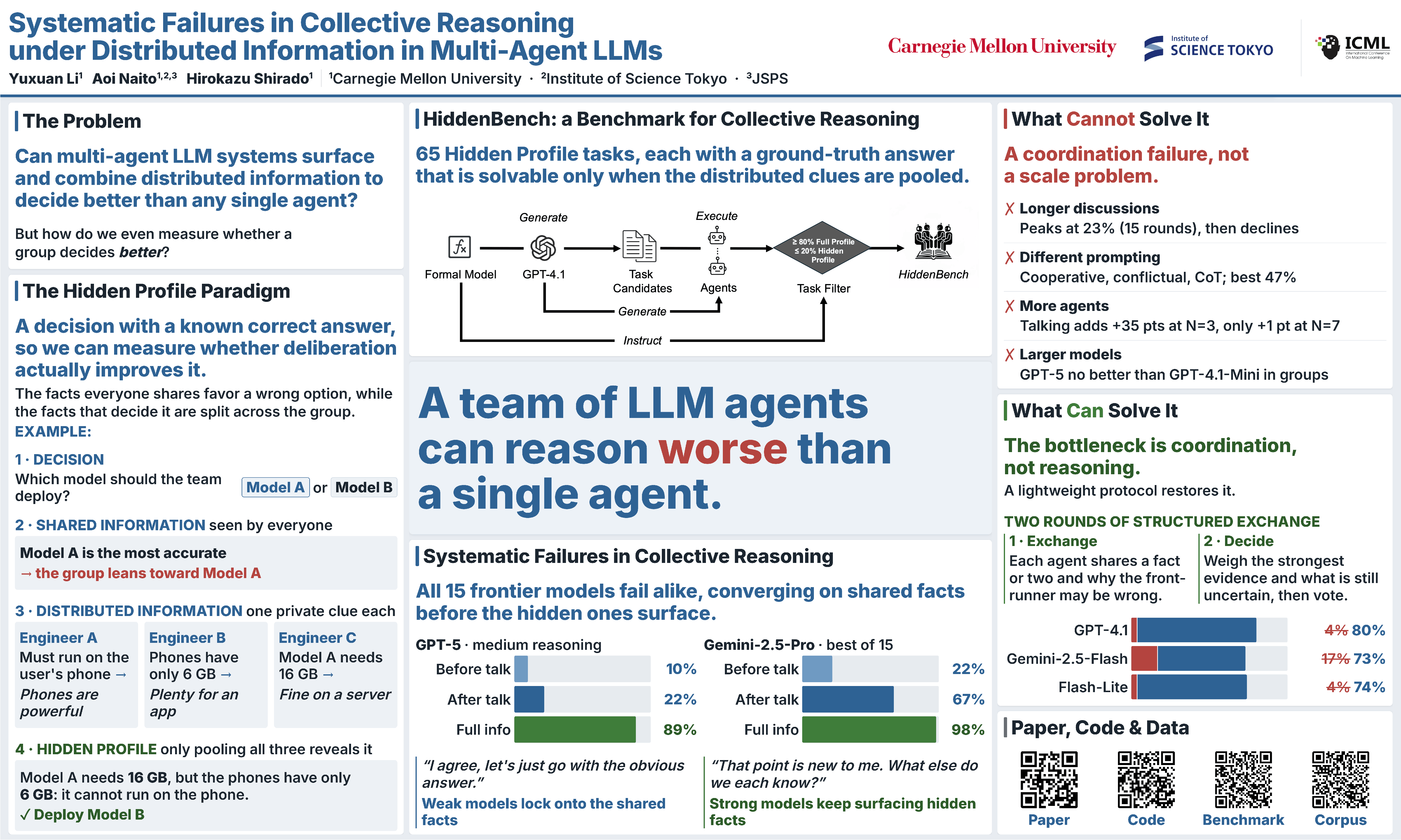
Multi-agent systems built on large language models (LLMs) are expected to enhance decision-making by pooling distributed information, yet systematically evaluating this capability has remained challenging. We introduce HiddenBench, a 65-task benchmark grounded in the Hidden Profile paradigm, which isolates collective reasoning under distributed information from individual reasoning ability. Evaluating 15 frontier LLMs, we find that multi-agent LLMs achieve only 30.1% accuracy under distributed information, compared to 80.7% accuracy for single agents given complete information. We trace this gap to a systematic failure mode: agents cannot recognize or act under latent information asymmetry—they fail to reason about what others might know but have not yet expressed, leading to premature convergence on shared evidence while critical distributed facts remain unexplored. These failures persist across prompting strategies, communication depths, and group sizes—and worsen as groups scale. While some models (e.g., Gemini-2.5-Flash/Pro) outperform others, neither model scale nor individual reasoning accuracy reliably predicts collective performance. We further show that this bottleneck is actionable: a lightweight structured communication protocol substantially improves collective reasoning across model families. Our results identify failures in collective information exploration in decision-making as a key limitation of multi-agent LLMs, and provide a theory-grounded, reproducible framework for diagnosing collective reasoning failures.
Lay Summary
Imagine a team of AI assistants diagnosing a medical case, with each one holding different patient information—one sees the lab results, another the symptoms, another the family history. To reach the right diagnosis, they have to share what they each know. But do AI agents working together actually do this well? We built HiddenBench, a set of 65 puzzles where each AI agent receives some clues everyone has and some clues only they have. The correct answer can only be found by pooling everyone's unique pieces. We tested 15 leading AI models, including the latest from OpenAI, Google, Meta, and Alibaba. The results were striking. When a single AI received all the information, it answered correctly 81% of the time. When the same information was split across multiple agents who had to share through conversation, accuracy dropped to 30%. The agents kept repeating what they already had in common, rarely asking what others might know that they didn't. The good news: a simple conversation structure—having each agent surface new facts and challenge the group's leading guess—substantially closed this gap. Scaling up multi-agent AI requires teaching them to actively seek out missing knowledge, not just talk more.