
Easier to Judge than to Find: Predicting In-Context Learning Success for Demonstration Selection
Abstract
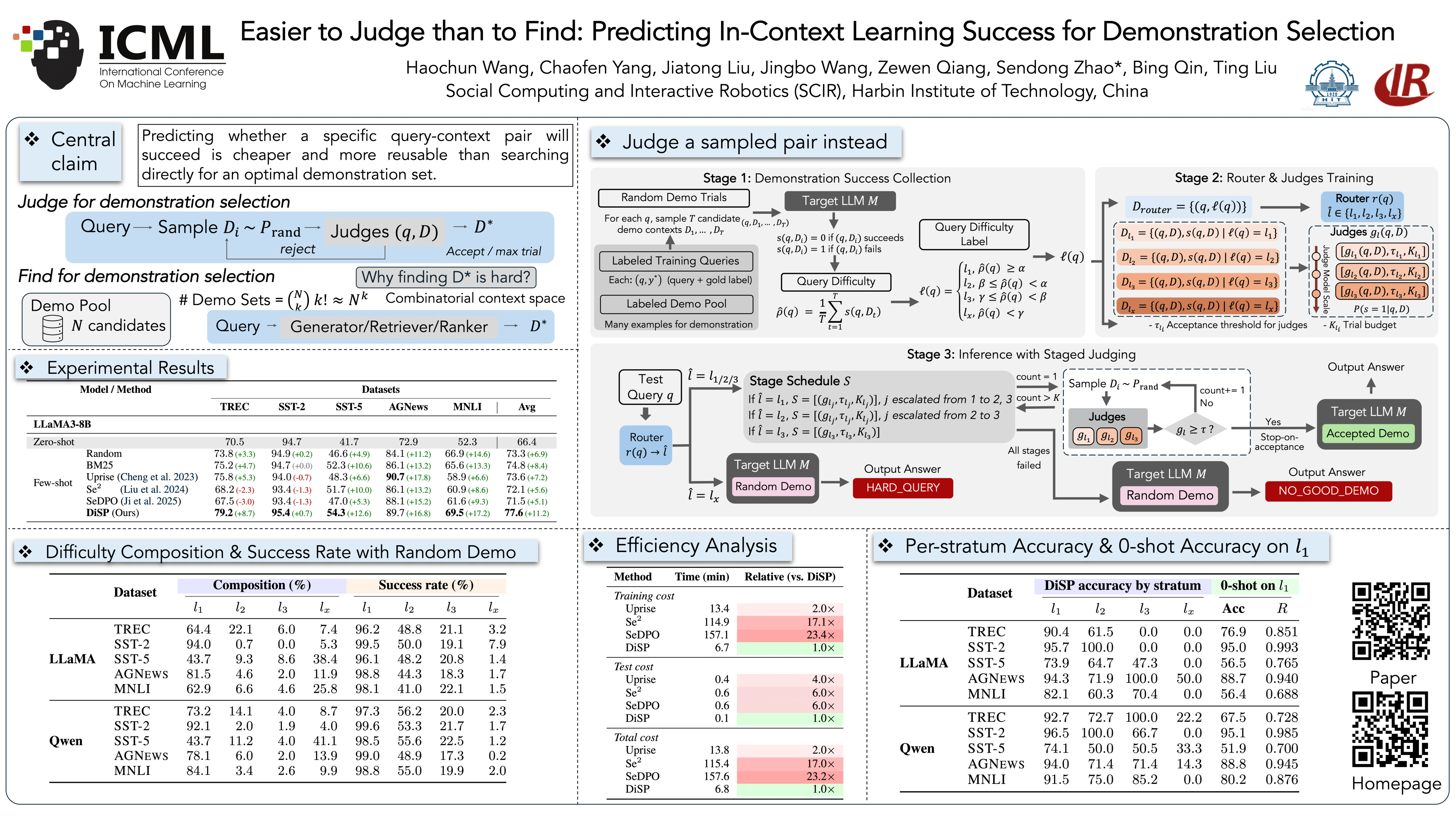
Lay Summary
When people use a large language model for a new task, they often give it a few example questions and answers to imitate. Which examples are chosen can strongly affect whether the model answers correctly, but searching through possible example sets is slow and expensive. This paper asks a simpler question: instead of trying to find the perfect examples, can we quickly judge whether a sampled set is good enough? We introduce DiSP, a method that first estimates how difficult a question is, then tests random example sets with helper models that predict whether the large model is likely to succeed. If a set looks promising, DiSP stops searching and sends it to the large model; if none look reliable within the budget, it falls back and marks the case as risky. This makes the cost of using examples more predictable and avoids wasting computation on questions where extra examples are unlikely to help. On five text classification tasks, DiSP improved average accuracy over strong example-selection methods while reducing total running time by up to 23 times. The work suggests that practical language-model systems can benefit more from quickly judging candidate examples than from exhaustively searching for the best ones.