
Probabilistic Robustness Certificates against Adversarial Attacks
Sara Taheri ⋅ Majid Zamani
Abstract
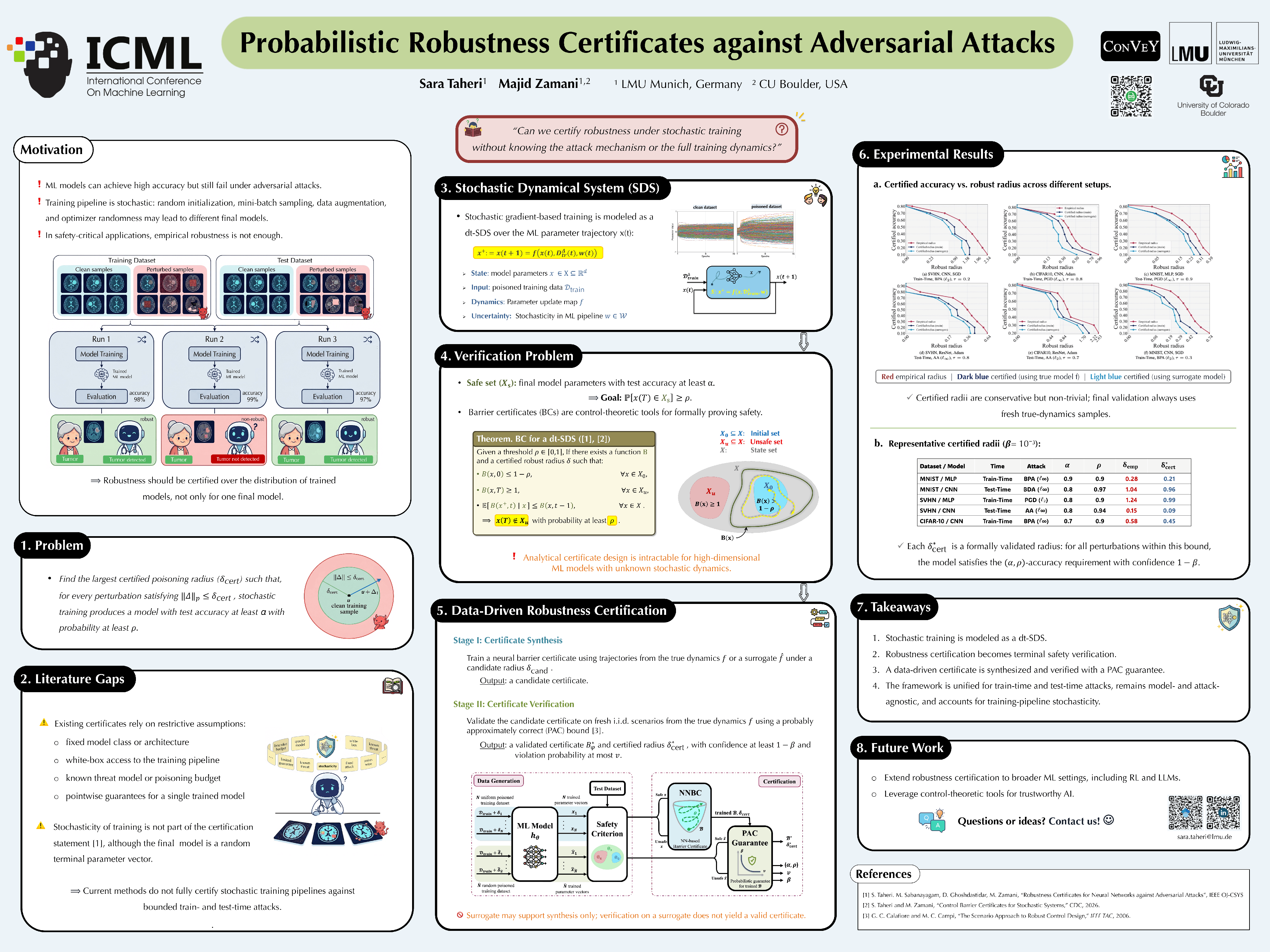
The growing use of machine learning in safety-critical settings heightens vulnerability to *adversarial attacks*. Existing defense mechanisms typically either lack formal guarantees or depend on restrictive assumptions about the model family, the threat model, or the poisoning budget, and many only offer point-wise certification. Importantly, they often overlook the inherent stochasticity of modern training pipelines, which undermines their practical reliability. We introduce a probabilistic framework that views gradient-based training as a *discrete-time stochastic dynamical system* and formulates poisoning robustness as a safety verification task. Leveraging *barrier certificates* (BCs), we derive sufficient conditions to probabilistically certify a robust radius against worst-case ${\ell}_p$-bounded poisoning, guaranteeing that the final model parameters remain within a safe set. For tractable computation, we represent BCs with neural networks and obtain *probably approximately correct* (PAC) guarantees through a *scenario convex problem*. Our method identifies the largest certified radius for which the trained model is probabilistically accurate with a specified confidence level. Experiments on MNIST, SVHN, and CIFAR-10 show that our framework offers formal robustness guarantees under stochastic training, while being model-agnostic and not requiring prior knowledge of the attack strategy.
Lay Summary
The growing use of machine learning in safety-critical settings heightens vulnerability to adversarial attacks. Existing defense mechanisms typically either lack formal guarantees or depend on restrictive assumptions about the model family, the threat model, or the poisoning budget, and many only offer point-wise certification. Importantly, they often overlook the inherent stochasticity of modern training pipelines, which undermines their practical reliability. We introduce a probabilistic framework that views gradient-based training as a discrete-time stochastic dynamical system and formulates poisoning robustness as a safety verification task. Leveraging barrier certificates (BCs), we derive sufficient conditions to probabilistically certify a robust radius against worst-case ${\ell}_p$-bounded poisoning, guaranteeing that the final model parameters remain within a safe set. For tractable computation, we represent BCs with neural networks and obtain probably approximately correct (PAC) guarantees through a scenario convex problem. Our method identifies the largest certified radius for which the trained model is probabilistically accurate with a specified confidence level. Experiments on MNIST, SVHN, and CIFAR-10 show that our framework offers formal robustness guarantees under stochastic training, while being model-agnostic and not requiring prior knowledge of the attack strategy.
Video
Chat is not available.
Successful Page Load