
Is Spurious Correlation Removal Always Learnable?
Abstract
Lay Summary
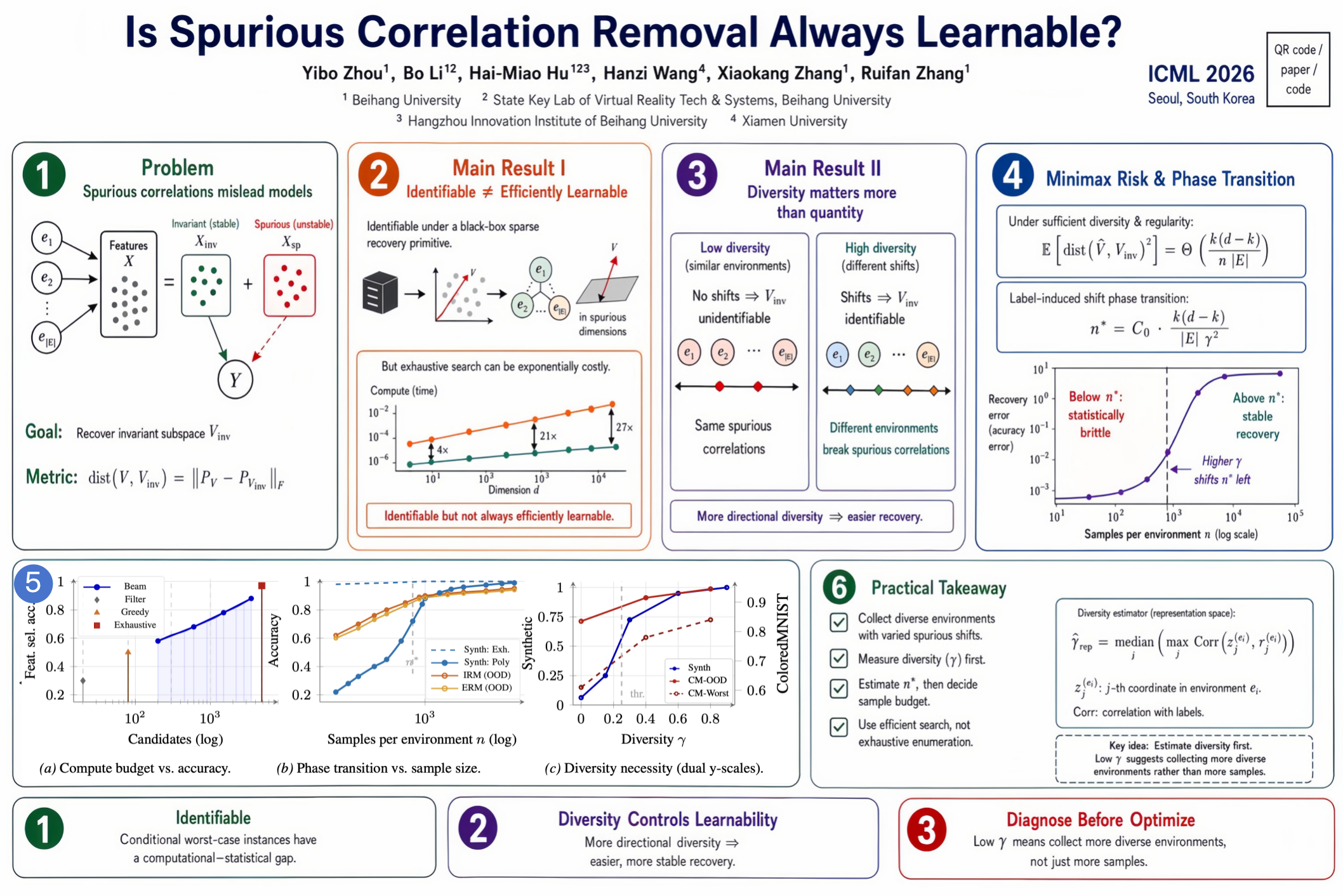
Machine learning systems often learn shortcuts that work in the training data but fail in the real world. For example, an image classifier may learn to associate birds with particular backgrounds instead of learning the shape of the bird itself. Researchers try to avoid this by training models on data from multiple environments, hoping to find patterns that stay reliable across settings. This paper asks whether such reliable patterns are always easy to learn when they exist. We show that, in some carefully constructed cases, the answer may be no: the correct stable feature can be identifiable with enough data, but finding it efficiently can still be computationally difficult. We also study when multiple environments are actually useful. Our results suggest that what matters is not just the number of environments, but how differently they expose misleading correlations. These findings help explain why methods for removing spurious correlations sometimes work well and sometimes fail. They also suggest a practical lesson: before blaming an algorithm, practitioners should check whether their environments are diverse enough to reveal the right stable features.