
Temporal Weighted Encoding: Towards Maximal-Capacity Spike Coding for ANN–SNN Conversion
Abstract
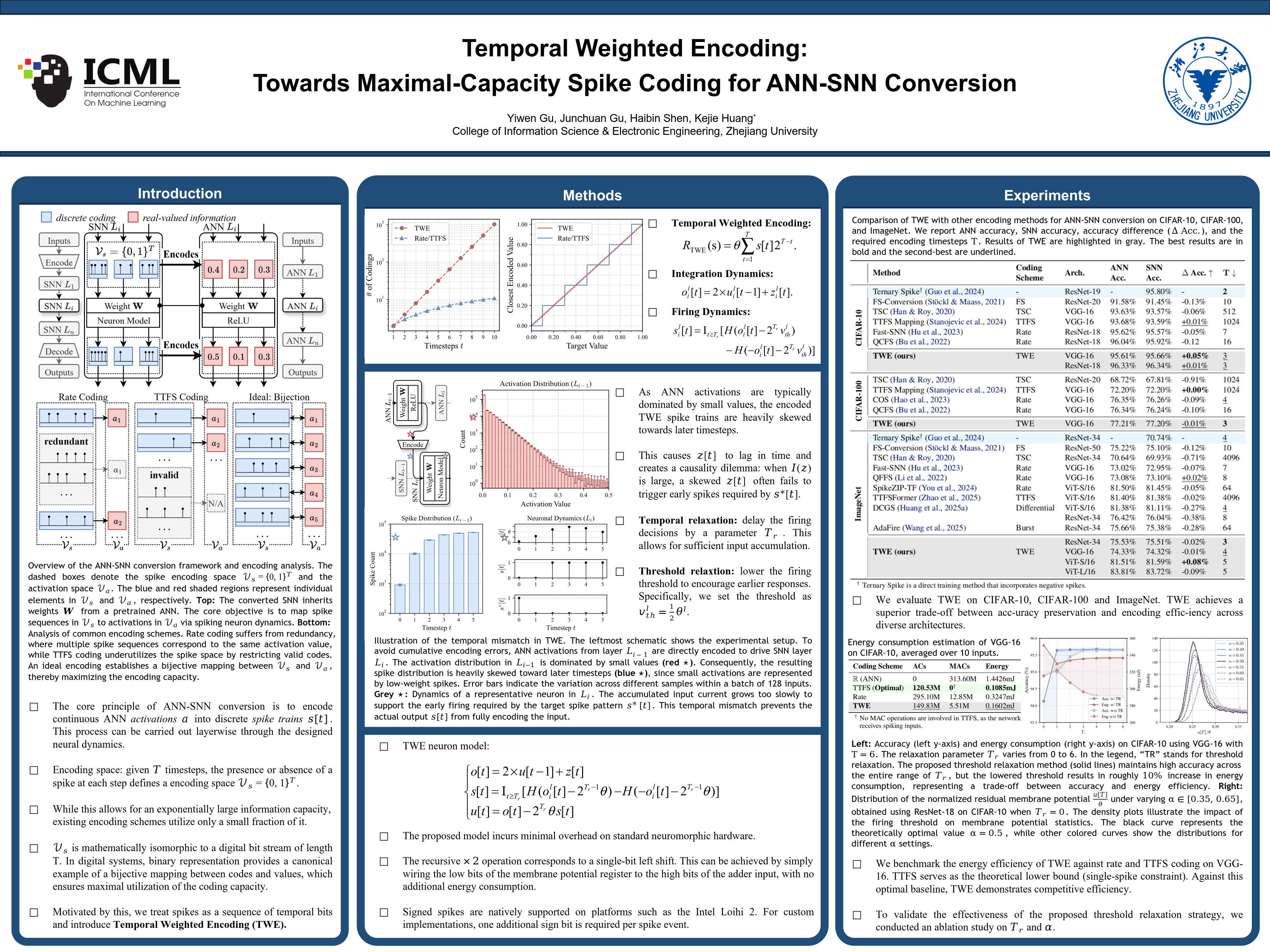
Spiking Neural Networks (SNNs) emulate the spiking behavior of biological neurons and are promising for energy-efficient neuromorphic computing. A widely used strategy to train SNNs is to convert pretrained Artificial Neural Networks (ANNs), where the accuracy and efficiency are determined by the spike encoding scheme. Traditional methods based on spike count or timing severely underutilize the available encoding space, leading to large accuracy degradation under low-timestep constraints. More expressive alternatives involve complex dynamics, which hinder scalability and practical deployment. To address these challenges, we propose Temporal Weighted Encoding (TWE). Spikes are implicitly assigned exponentially decaying weights through a recursive integration, drawing an analogy to a temporal bit sequence. We systematically analyze the temporal mismatch caused by this weight pattern and propose temporal relaxation and threshold relaxation to resolve this issue, enabling fast and accurate activation encoding. Extensive experiments demonstrate that TWE achieves negligible conversion loss with significantly fewer timesteps, offering a scalable and efficient solution for SNN deployment.
Lay Summary
Our work addresses a key bottleneck in energy-efficient neural networks called Spiking Neural Networks (SNNs). A popular way to build SNNs is by converting conventional Artificial Neural Networks (ANNs), but existing methods for encoding information into spikes waste much of the available capacity, forcing a trade-off between speed and accuracy. We propose Temporal Weighted Encoding (TWE), which treats a sequence of spikes like a binary number: early spikes carry larger weights and late spikes smaller ones, enabled by simple recursive integration. To handle a key timing challenge, we introduce two relaxation techniques that allow neurons to fire earlier without losing precision. Experiments show TWE achieves near-lossless conversion using far fewer time steps, making SNNs more practical for real-world low-power deployment.