
Evolving Quantitative Reasoning through Self-Play in Digital Twin Markets
Abstract
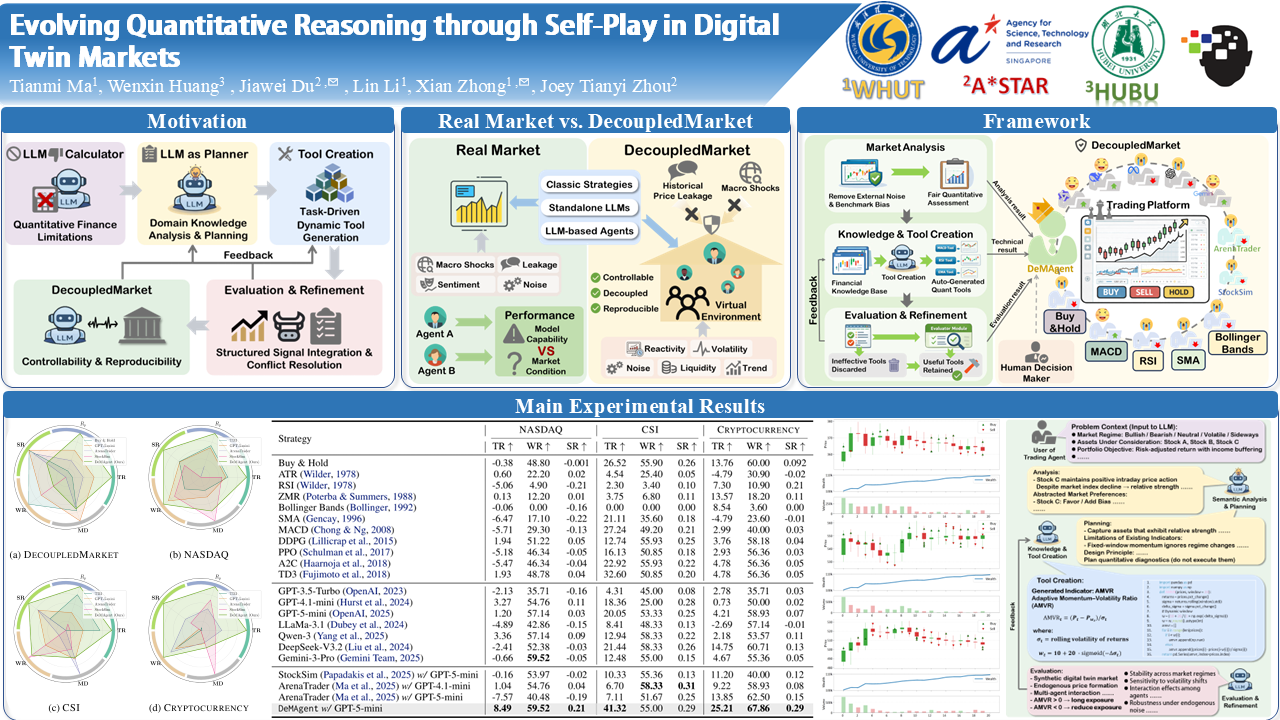
Large language models (LLMs) demonstrate strong capabilities in high-level semantic reasoning and strategic planning, making them appealing for complex decision-making tasks; however, their quantitative reasoning remains unreliable despite recent progress in tool-augmented and structured inference. To address this limitation, we decouple reasoning from computation by assigning LLMs to planning, analysis, and result interpretation, while delegating numerical computation and statistical inference to specialized external tools. Rather than being hard-coded, these tools are constructed in a constrained and structured manner during planning as explicit intermediate reasoning artifacts, enabling adaptive and scenario-dependent quantitative reasoning. LLMs iteratively analyze tool outputs under diverse market conditions and leverage performance-based feedback to refine subsequent tool selection and construction, thereby forming a bounded self-evolving loop. We instantiate this process through self-play in a controllable digital twin market, DecoupledMarket, where LLM agents continuously test, compare, and adapt their strategies. By coupling high-level planning with robust quantitative execution, the proposed framework enhances the quantitative reliability of LLM-driven decision-making. All code and data are available at https://github.com/MTMQuantAI/Agent-Trading-Arena.git.
Lay Summary
Large language models can write, reason, and make plans, but they often make mistakes when doing precise numerical calculations. This is a problem for decision-making tasks such as financial trading, where accurate numbers are essential. Our work addresses this issue by giving language models a clearer division of labor: the model decides what needs to be analyzed and how to use the results, while specialized tools perform the actual calculations. The key idea is that the tools are not fixed in advance. Instead, the language model creates structured calculation steps for each situation, uses their outputs to evaluate different choices, and learns from feedback over repeated trials. We test this framework in a simulated market environment where AI agents can repeatedly compete, compare strategies, and adjust their behavior. This study shows that language models can become more reliable decision-makers when their reasoning ability is combined with dependable numerical tools. The approach could be useful for many complex tasks that require both human-like planning and accurate quantitative analysis.