
Mirror Descent Under Generalized Smoothness
Abstract
Lay Summary
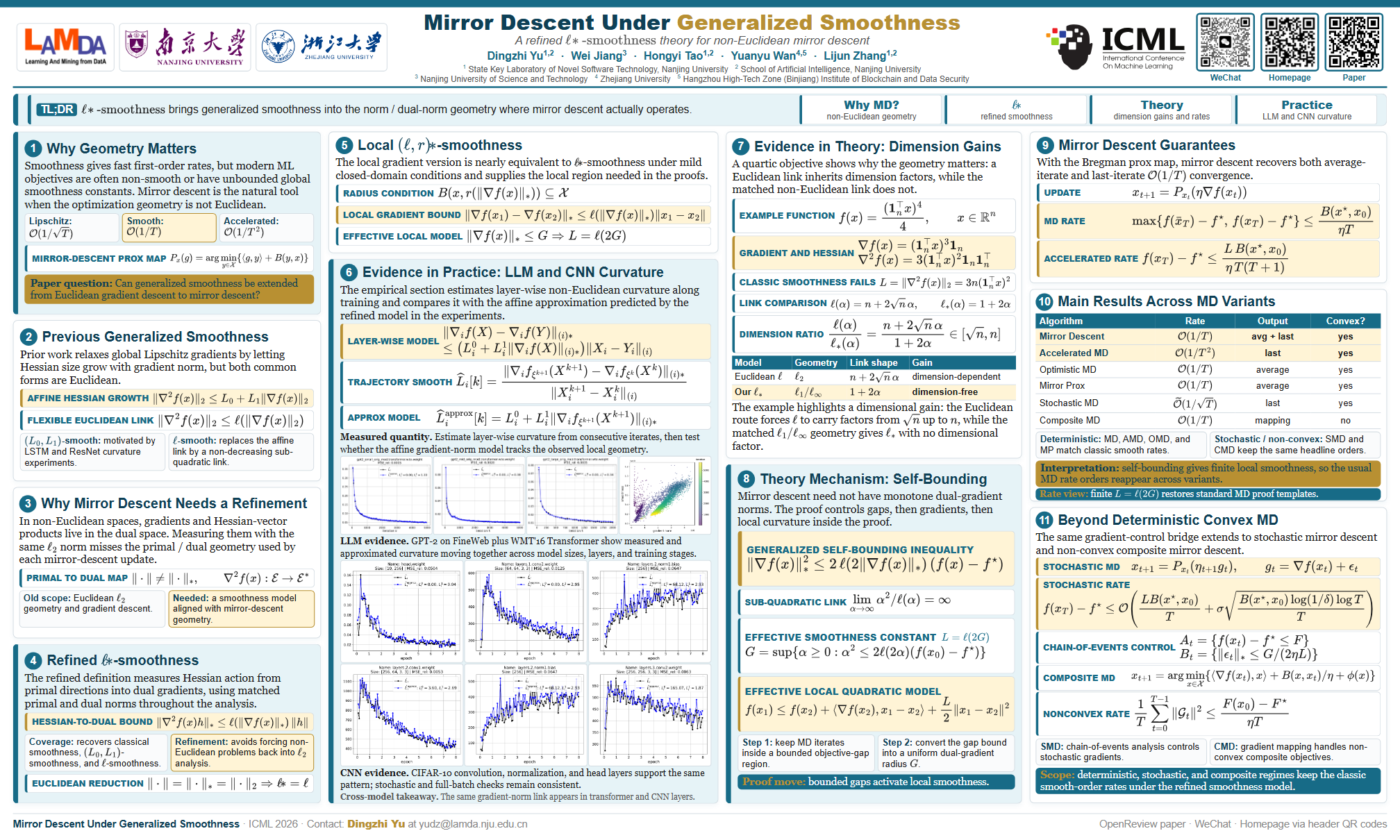
How can we analyze optimization methods when the problem’s natural geometry is not Euclidean? Mirror descent is a classical method designed for such settings: instead of moving according to ordinary Euclidean distance, it adapts its updates to the geometry of the problem. This flexibility makes mirror descent useful in many areas of machine learning. At the same time, modern machine learning objectives often do not satisfy classical smoothness assumptions. Recent generalized smoothness theories address this issue, but they mainly apply to Euclidean gradient descent. As a result, there has been a gap between geometry-aware algorithms and generalized smoothness theory. Our paper bridges this gap. We introduce ℓ∗-smoothness, a generalized smoothness notion compatible with non-Euclidean geometries, and prove that mirror descent and several variants retain their standard convergence rates under this broader condition. Our results provide a unified theoretical basis for geometry-aware optimization under realistic smoothness assumptions, with supporting evidence from LLMs and CNNs.