
Plug-and-Play Diffusion Meets ADMM: Dual-Variable Coupling for Robust Medical Image Reconstruction
Abstract
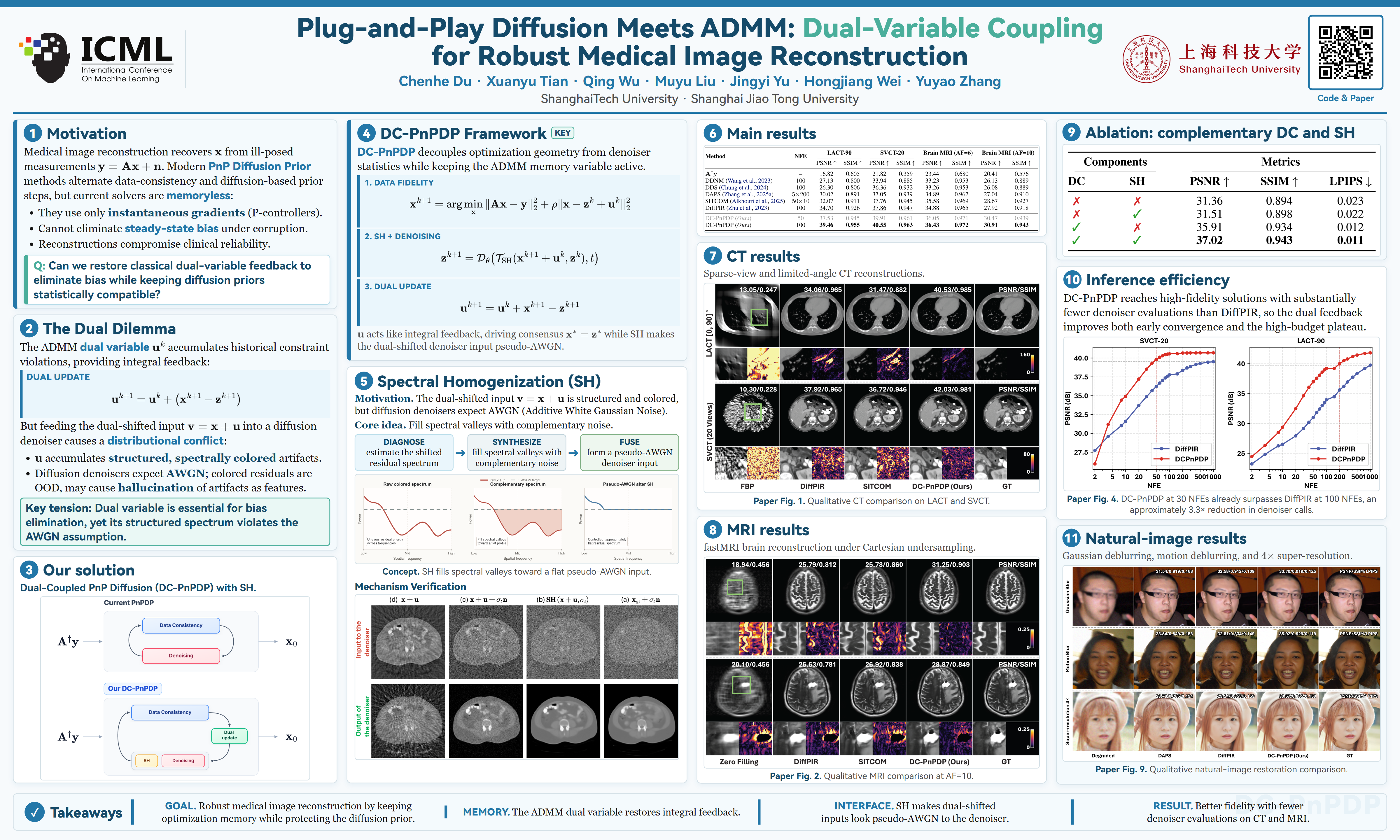
Plug-and-Play diffusion prior (PnPDP) frameworks have emerged as a powerful paradigm for solving imaging inverse problems by treating pretrained generative models as modular priors. However, we identify a critical flaw in prevailing PnP solvers (e.g., based on HQS or Proximal Gradient): they function as memoryless operators, updating estimates solely based on instantaneous gradients. This lack of historical tracking inevitably leads to non-vanishing steady-state bias, where the reconstruction fails to strictly satisfy physical measurements under heavy corruption. To resolve this, we propose Dual-Coupled PnP Diffusion (DC-PnPDP), which restores the classical dual variable to provide integral feedback, progressively enforce agreement between the data-consistency and prior. However, this rigorous geometric coupling introduces a secondary challenge: the accumulated dual residuals exhibit spectrally colored, structured artifacts that violate the Additive White Gaussian Noise (AWGN) assumption of diffusion priors, causing severe hallucinations. To bridge this gap, we introduce Spectral Homogenization (SH), a frequency-domain adaptation mechanism that modulates these structured residuals into statistically compliant pseudo-AWGN inputs. This effectively aligns the solver's rigorous optimization trajectory with the denoiser's valid statistical manifold. Extensive experiments on CT and MRI reconstruction demonstrate that our approach resolves the bias-hallucination trade-off, achieving state-of-the-art fidelity with significantly accelerated convergence. The code is available at https://github.com/duchenhe/DC-PnPDP.
Lay Summary
Medical scans such as CT and MRI are essential for diagnosis, but collecting high-quality scan data can be slow, expensive, or expose patients to radiation. To reduce scan time or radiation dose, hospitals may collect less data, but this makes it harder to reconstruct a clear and faithful image. Recent AI methods can help fill in missing information, yet they can also make a difficult trade-off: they may produce images that look clean while still disagreeing with the actual scanner measurements. This is risky in medical imaging, where small details can matter. Our work introduces a reconstruction method that gives the AI system a form of memory. Instead of correcting each image only from the current error, the method keeps track of past disagreements between the image and the measured data, and uses this history to guide future corrections. We also add a lightweight step that reshapes these corrections into a form that the pretrained AI model can handle reliably, reducing the chance of misleading image details. In experiments on CT and MRI reconstruction, the method produced more accurate images than strong existing approaches and often needed fewer repeated AI model calls. This could help make advanced medical image reconstruction more reliable and efficient when scan data are limited.