
Stability and Generalization of Nonconvex Optimization with Heavy-Tailed Noise
Abstract
Lay Summary
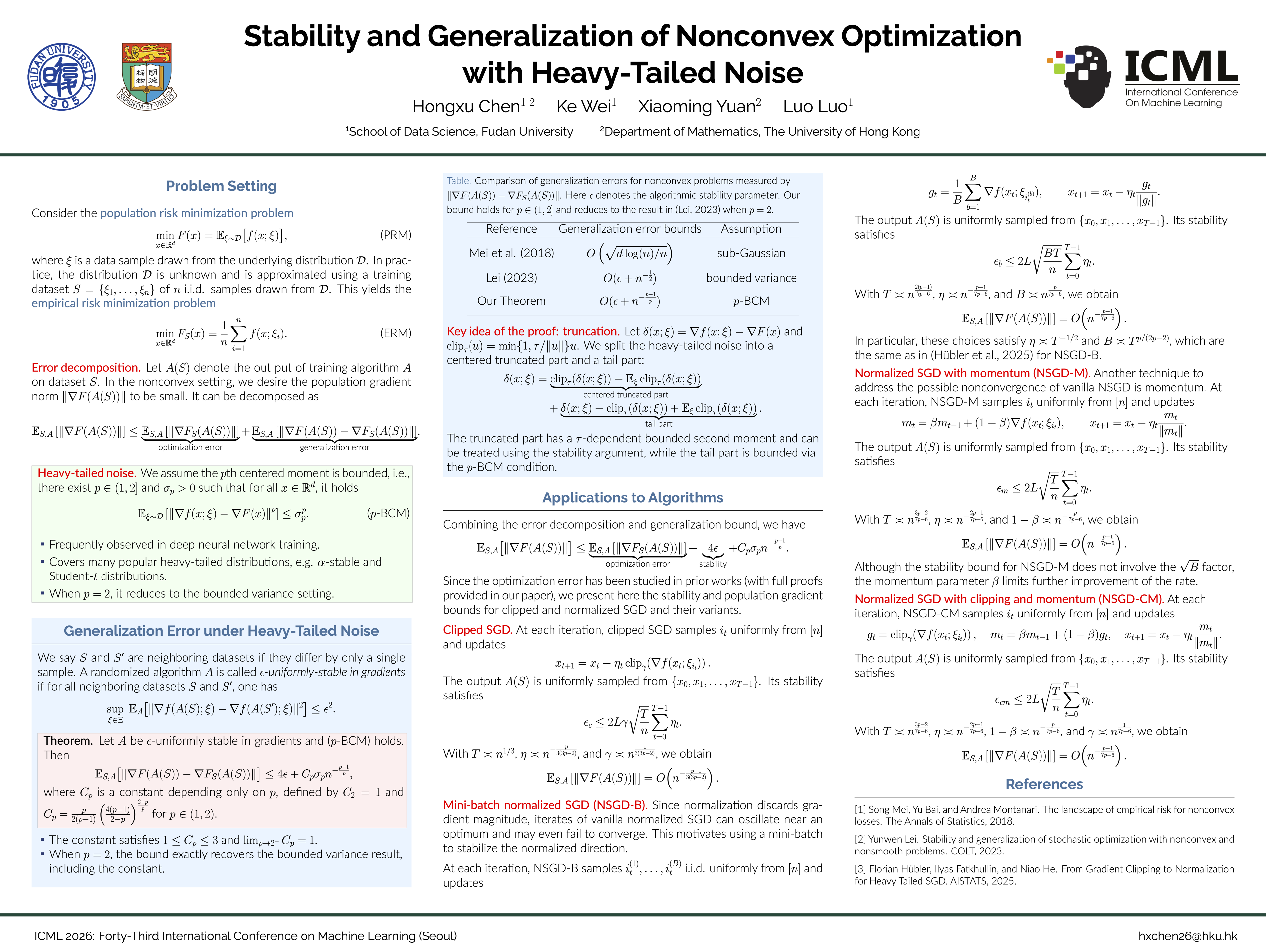
When machine learning models are trained on large datasets, they are often updated using only a small random part of the data at each step. This makes training efficient, but it also makes the update direction noisy. Recent evidence suggests that this noise may be heavy-tailed, meaning that large deviations occur more often than standard theory assumes. Many studies have examined whether algorithms can still optimize the training objective under heavy-tailed noise. However, much less is known about whether the guarantees obtained from the training data can still reflect the behavior on the underlying data distribution. We develop a general framework for proving such generalization guarantees. Our approach combines algorithmic stability, which measures sensitivity to changing one training example, with a truncation technique that controls large noisy gradients. We apply the framework to clipped and normalized SGD, including mini-batch and momentum variants. Our results help explain when these methods can remain stable and generalize under heavy-tailed noise, providing theoretical guidance for analyzing and designing stochastic training algorithms.