
DiffThinker: Towards Generative Multimodal Reasoning with Diffusion Models
Abstract
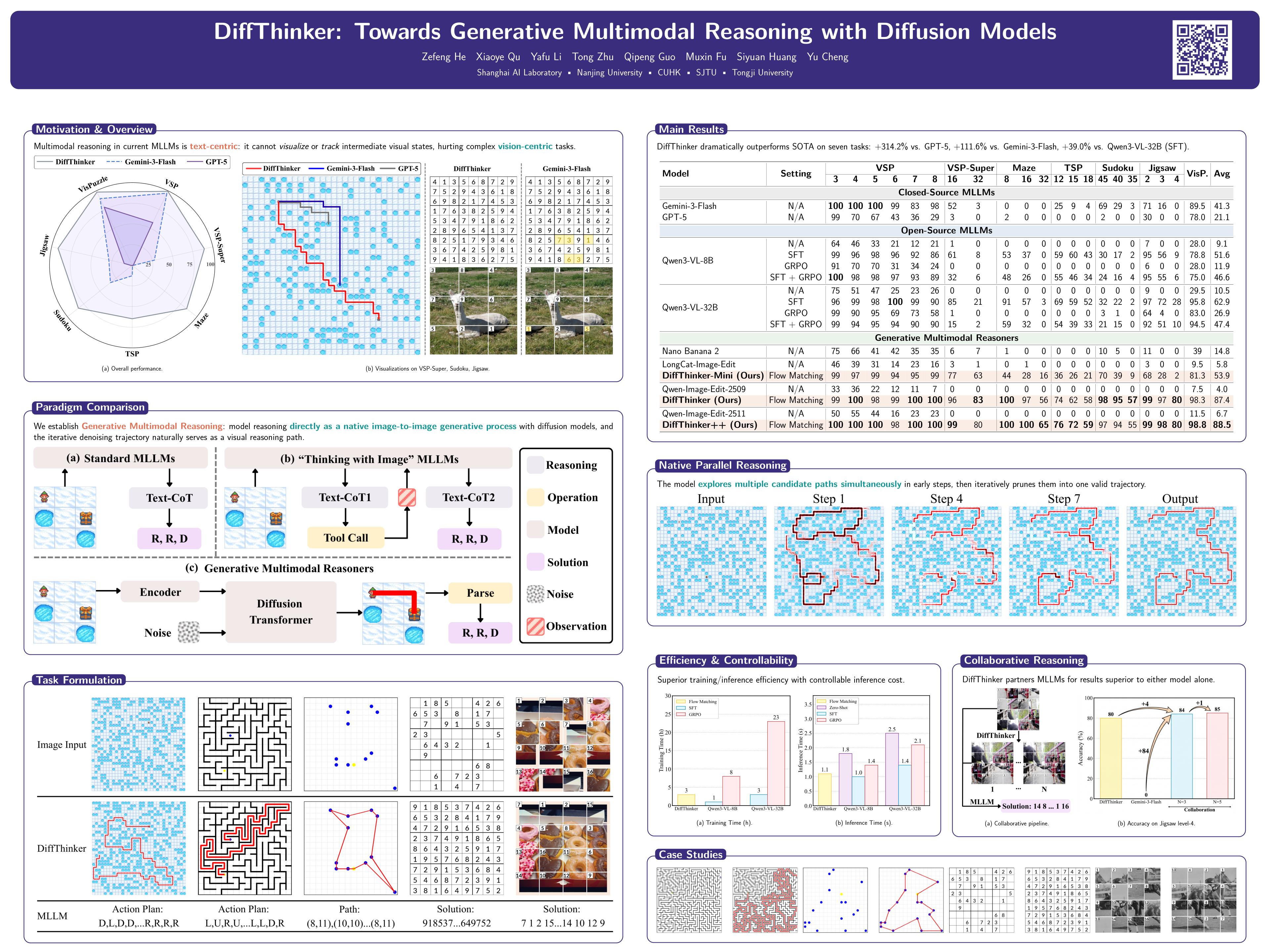
While recent Multimodal Large Language Models (MLLMs) have attained significant strides in multimodal reasoning, their reasoning processes remain predominantly text-centric and fail to visualize and track intermediate visual states during the reasoning process, leading to suboptimal performance in complex long-horizon, vision-centric tasks. Moving beyond the constraints of text-centric reasoning, we establish Generative Multimodal Reasoning as a novel paradigm and introduce DiffThinker, a diffusion-based reasoning framework. Conceptually, DiffThinker reformulates multimodal reasoning as a native generative image-to-image task, where the iterative denoising trajectory naturally serves as a visual reasoning path. This enables the model to track the evolution of visual information throughout the reasoning process. We perform a systematic comparison between DiffThinker and MLLMs, providing the first in-depth investigation into the intrinsic characteristics of this paradigm, revealing four core properties: efficiency, controllability, native parallelism, and collaboration. Extensive experiments across seven tasks demonstrate that DiffThinker significantly outperforms leading closed-source models, including GPT-5 (+314.2%) and Gemini-3-Flash (+111.6%), as well as the fine-tuned Qwen3-VL-32B baseline (+39.0%), highlighting Generative Multimodal Reasoning as a promising approach for vision-centric reasoning.
Lay Summary
Today's AI systems can see images and read text, but when solving visual problems, like finding a path through a maze or arranging objects in a room, they reason almost entirely in words. This often fails on tasks that are inherently visual. We propose DiffThinker, which lets AI think directly in pictures by gradually sketching its way to a solution, much like a person drawing on scratch paper. On seven visual tasks, it substantially outperforms top systems such as GPT-5 and Gemini-3-Flash.