
Open-o3-Video: Grounded Video Reasoning with Explicit Spatio-Temporal Evidence
Abstract
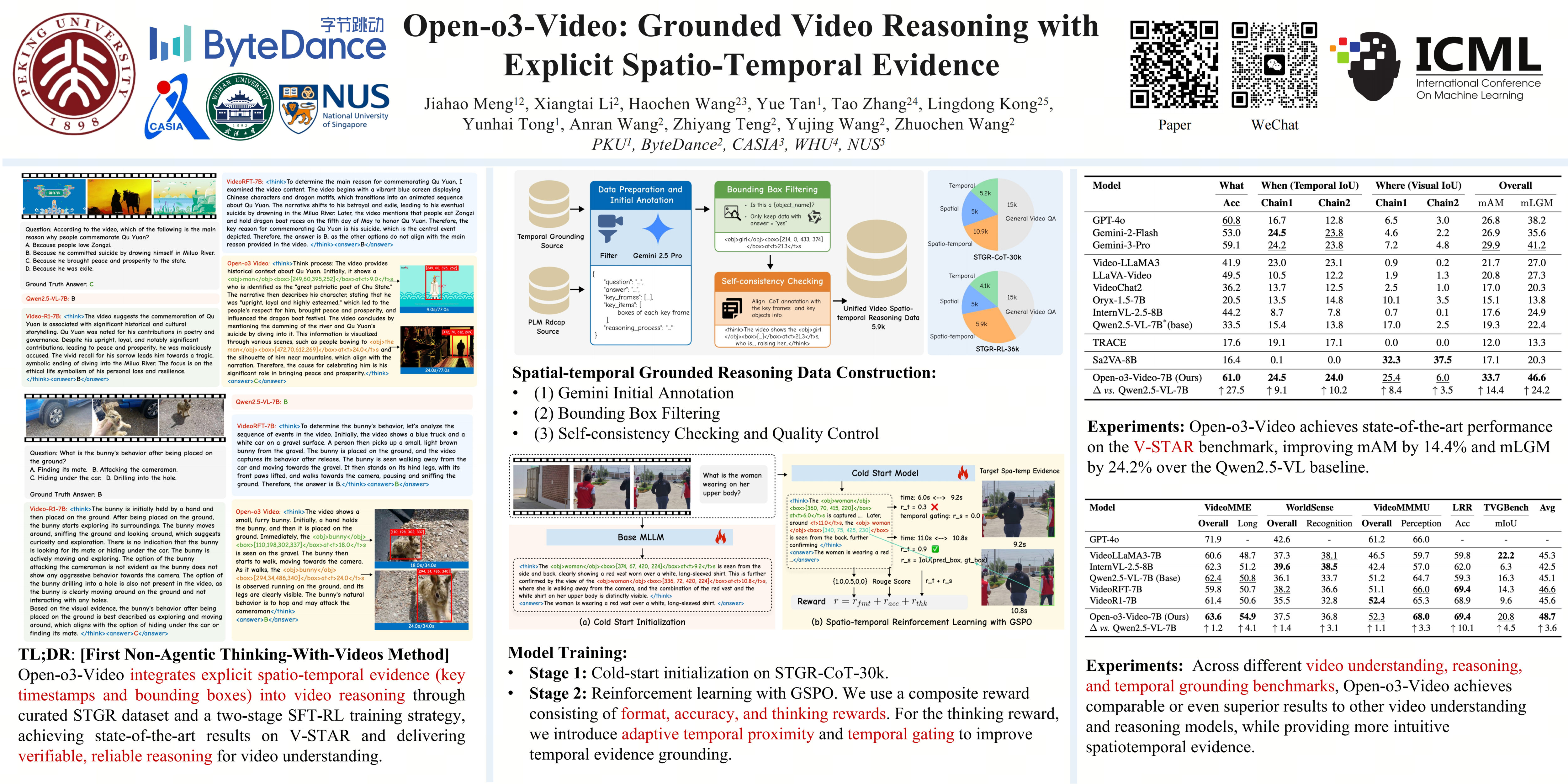
Most video reasoning models only generate textual reasoning traces without indicating when and where key evidence appears. Recent models such as OpenAI-o3 have sparked wide interest in evidence-centered reasoning for images, yet extending this ability to videos is more challenging due to the need for joint temporal tracking and spatial localization across dynamic scenes. We introduce Open-o3-Video, a non-agent framework that integrates explicit spatio-temporal evidence into video reasoning by highlighting key timestamps, objects, and bounding boxes, making the reasoning process traceable and verifiable. To enable this capability, we first construct high-quality datasets STGR that provide unified spatio-temporal supervision, which is absent in existing resources. We further adopt a cold-start reinforcement learning strategy with specially designed rewards that jointly encourage answer accuracy, temporal alignment, and spatial precision. On the V-STAR benchmark, Open-o3-Video achieves state-of-the-art performance, improving mAM by 14.4% and mLGM by 24.2% over the Qwen2.5-VL baseline, and shows consistent gains across a range of video understanding benchmarks. Beyond accuracy, the grounded reasoning traces produced by Open-o3-Video support confidence-aware test-time scaling, improving answer reliability. The code, model and datasets are publicly available at https://marinero4972.github.io/projects/Open-o3-Video/.
Lay Summary
Many AI systems can answer questions about videos, but they often do not show which moment or visual detail supports their answer. This makes their reasoning hard to trust, especially when a video is long, crowded, or contains fast-moving events. In this work, we build Open-o3-Video, a video reasoning model that not only gives an answer, but also points to the relevant time, object, and region in the video. For example, instead of simply saying what happened, the model can indicate when it happened and highlight the person or object that supports its answer. To teach this ability, we create new training data that connects questions, answers, important video moments, object boxes, and explanations. We also design a training method that rewards the model for being correct, choosing the right time, and locating the right visual evidence. Our experiments show that this makes the model better at video reasoning. More importantly, the model’s answers become easier for people to inspect, because its reasoning is grounded in visible evidence rather than hidden text alone.