
Singularity-aware Optimization via Randomized Geometric Probing: Towards Stable Non-smooth Optimization
Ruoran Xu ⋅ Borong She ⋅ Xiaobo Jin ⋅ Qiufeng Wang
Abstract
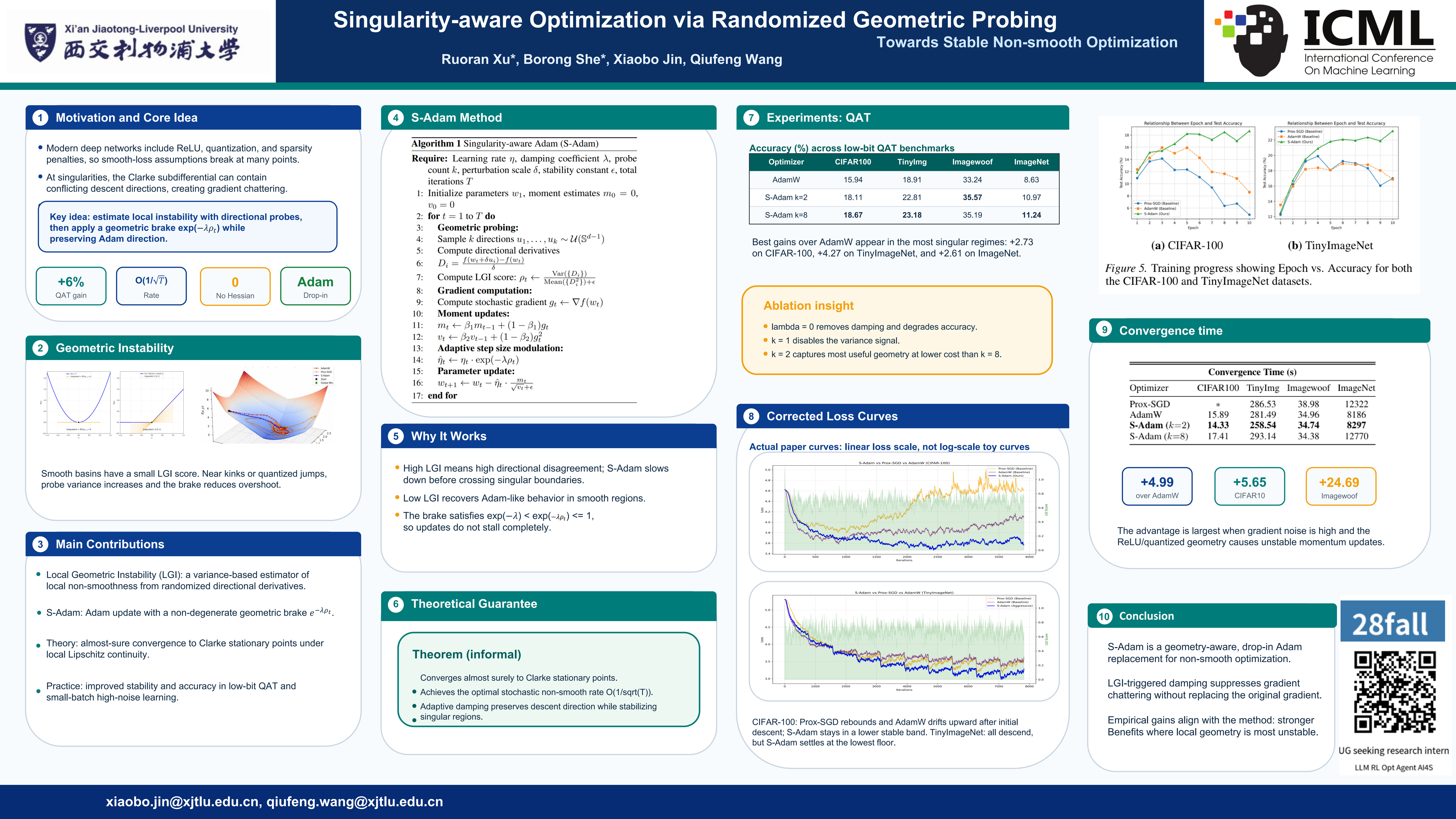
Deep learning optimization relies heavily on the assumption of smooth loss landscapes, a condition systematically violated by modern architectures due to non-smooth components like ReLU activations and quantization operators. In such non-smooth regimes, adaptive optimizers such as Adam suffer from **gradient chattering**—violent oscillations caused by conflicting signals within the Clarke subdifferential—leading to poor convergence and suboptimal generalization. To address this, we introduce **Singularity-aware Adam (S-Adam)**, a novel optimizer that stabilizes training by dynamically modulating step sizes based on local geometric instability. Our key contribution is the **Local Geometric Instability (LGI)** metric, a computationally efficient estimator of the Clarke subdifferential diameter derived from the variance of randomized directional derivatives. S-Adam incorporates an adaptive damping mechanism $\exp(-\lambda \rho_t)$ that decelerates updates in high-instability regions while preserving fast convergence in smooth basins. We provide a rigorous convergence analysis using differential inclusions, proving that S-Adam converges almost surely to $(\delta, \epsilon)$-Clarke stationary points at the optimal $\mathcal{O}(1/\sqrt{T})$ rate. Empirical evaluations on Quantization-Aware Training (QAT) and high-noise small-batch learning demonstrate that S-Adam consistently outperforms AdamW and Prox-SGD, achieving accuracy gains of up to +4.54% on CIFAR-100 and +4.27% on TinyImageNet while effectively mitigating gradient oscillations.
Lay Summary
Standard AI training tools struggle to work well when model components create erratic training patterns, causing unstable updates and lower final performance. We developed an improved training tool called S-Adam that automatically adjusts its update pace based on local training conditions. It slows down in tricky, unstable areas while keeping progress fast in stable ones. Across common AI training tasks, our new tool delivers more reliable training and noticeably better results than widely used existing methods.
Video
Chat is not available.
Successful Page Load