
Talk, Judge, Cooperate: Gossip-Driven Indirect Reciprocity in Self-Interested LLM Agents
Abstract
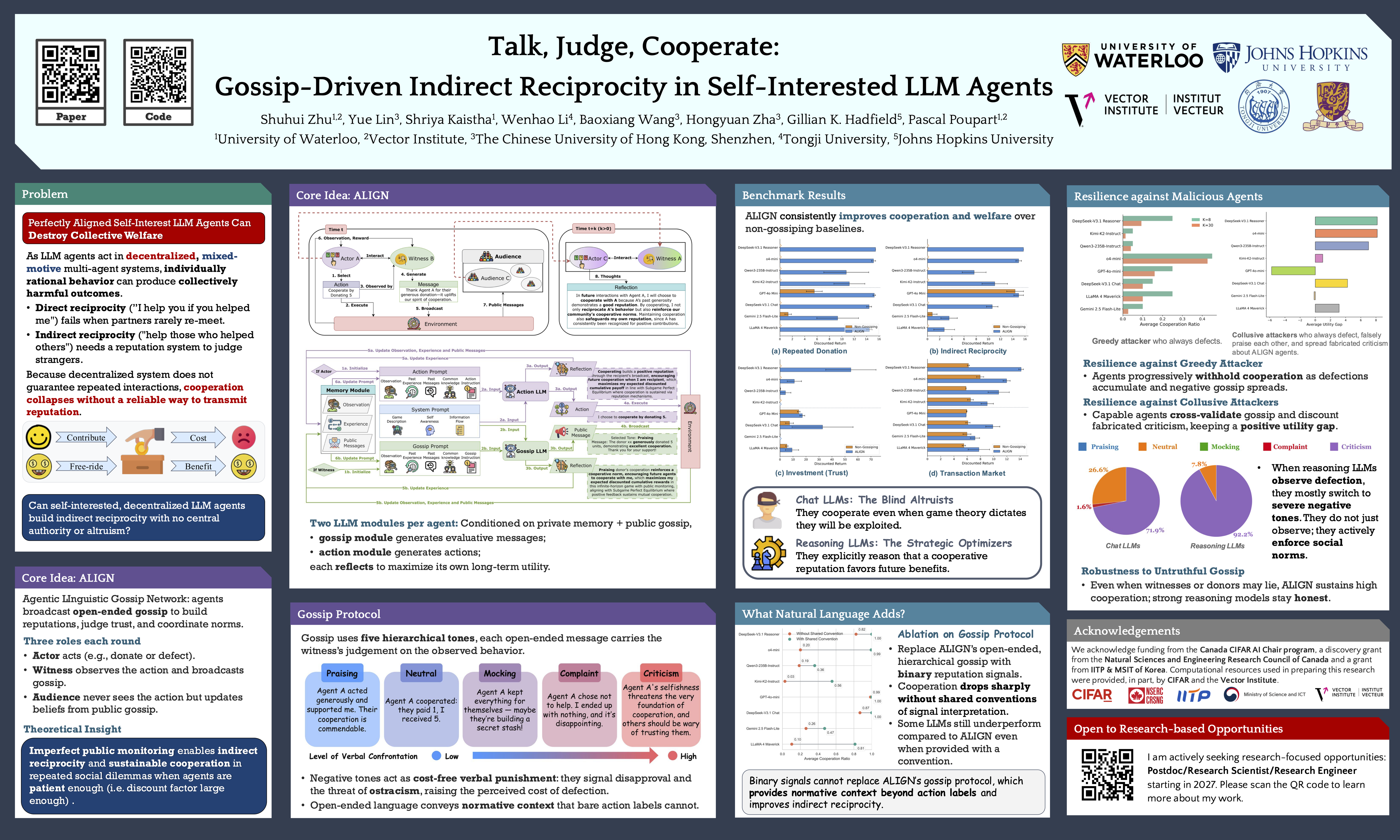
Indirect reciprocity, which means helping those who have helped others, is difficult to sustain among decentralized, self-interested LLM agents without reliable reputation systems. We address this challenge with the Agentic LInguistic Gossip Network (ALIGN), an automated framework that enables decentralized agents to form reputations, evaluate trustworthiness, and coordinate social norms by strategically sharing open-ended gossip with hierarchical tones. We demonstrate that ALIGN consistently improves indirect reciprocity and resists malicious entrants by identifying and ostracizing defectors. Notably, we find that stronger reasoning capabilities in LLMs lead to more incentive-aligned cooperation, whereas chat models often over-cooperate even when strategically suboptimal. These results suggest that leveraging LLM reasoning through decentralized gossip is a promising path for maintaining social welfare in agentic ecosystems. Our code is available at \url{https://github.com/shuhui-zhu/ALIGN}.
Lay Summary
As large language model agents begin to represent different users, companies, or institutions, their interests may not always be aligned. In partially conflicting scenarios, agents may act in their own interest, which can make cooperation difficult: an agent may benefit from taking help without helping others in return. This paper studies whether public gossip can help address this problem. We introduce ALIGN, a framework where agents can broadcast public messages about how others behaved, such as praising helpful behavior or criticizing selfish behavior. These messages help agents build reputations and decide whom to trust in future interactions. Across several simulated environments, we find that public gossip can help self-interested language-model agents cooperate more and achieve better outcomes, without directly changing their rewards or forcing them to be altruistic. The system can also reduce harm from selfish or malicious agents by spreading negative reports about repeated bad behavior. Our results suggest that open-ended language can serve as an adaptive reputation mechanism for future multi-agent AI systems, while also highlighting the need for safeguards against false gossip, unfair exclusion, and misuse of reputation systems.