
When to Think, When to Speak: Learning Disclosure Policies for LLM Reasoning
Abstract
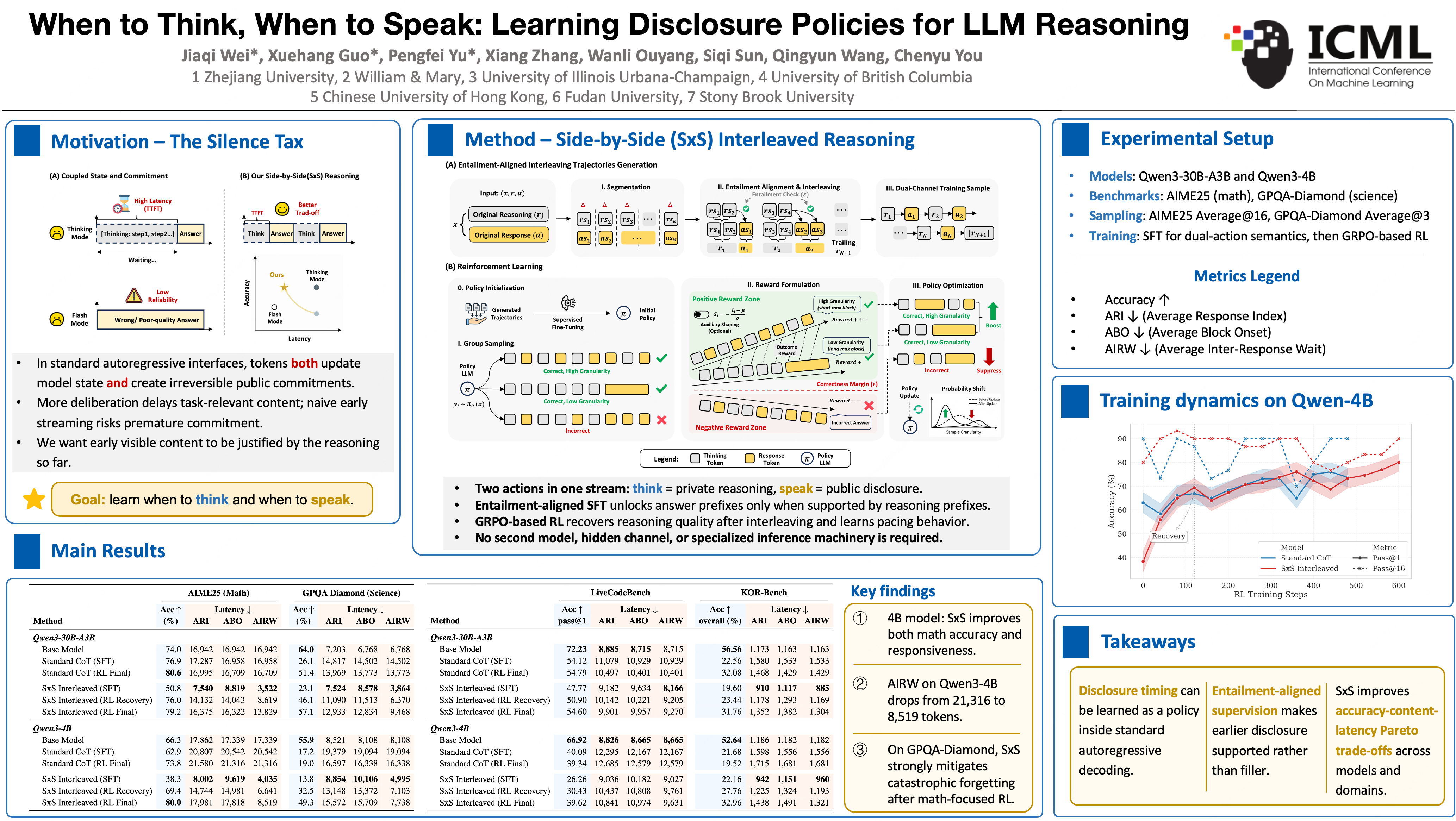
In single-stream autoregressive interfaces, the same tokens both update the model state and constitute an irreversible public commitment. This coupling creates a \emph{silence tax}: additional deliberation postpones the first \emph{task-relevant} content, while naive early streaming risks premature commitments that bias subsequent generations. We introduce \textbf{\emph{Side-by-Side (SxS)}} Interleaved Reasoning, which makes \emph{disclosure timing} a controllable decision within standard autoregressive generation. SxS interleaves partial disclosures with continued private reasoning in the same context, but releases content only when it is \emph{supported} by the reasoning so far. To learn such pacing without incentivizing filler, we construct entailment-aligned interleaved trajectories by matching answer prefixes to supporting reasoning prefixes, then train with SFT to acquire the dual-action semantics and RL to recover reasoning performance under the new format. Across two Qwen3 architectures/scales (MoE \textbf{Qwen3-30B-A3B}, dense \textbf{Qwen3-4B}) and both in-domain (AIME25) and out-of-domain (GPQA-Diamond) benchmarks, SxS improves accuracy--\emph{content-latency} Pareto trade-offs under token-level proxies (e.g., inter-update waiting).
Lay Summary
Many AI systems generate answers one word at a time. This creates a difficult trade-off: if the system thinks for longer before saying anything, users have to wait; but if it starts answering too early, it may commit to an incomplete or wrong direction and then continue building on that mistake. This paper studies how an AI system can reveal useful parts of its answer while it is still working through the problem. We introduce Side-by-Side Interleaved Reasoning, a method that lets the model alternate between internal problem-solving and partial answer updates. The key idea is that the model should only show an update when that update is already supported by what it has figured out so far, instead of filling the screen with premature or unhelpful text. We train models to learn this behavior by teaching them when a partial answer is justified by earlier reasoning, and then further improve them so they keep strong problem-solving ability under this new format. Experiments on challenging math and science question-answering benchmarks show that our method can give users meaningful progress updates earlier while maintaining, and in some cases improving, final answer accuracy.