
LLM Self-Recognition: Steering and Retrieving Activation Signatures
Abstract
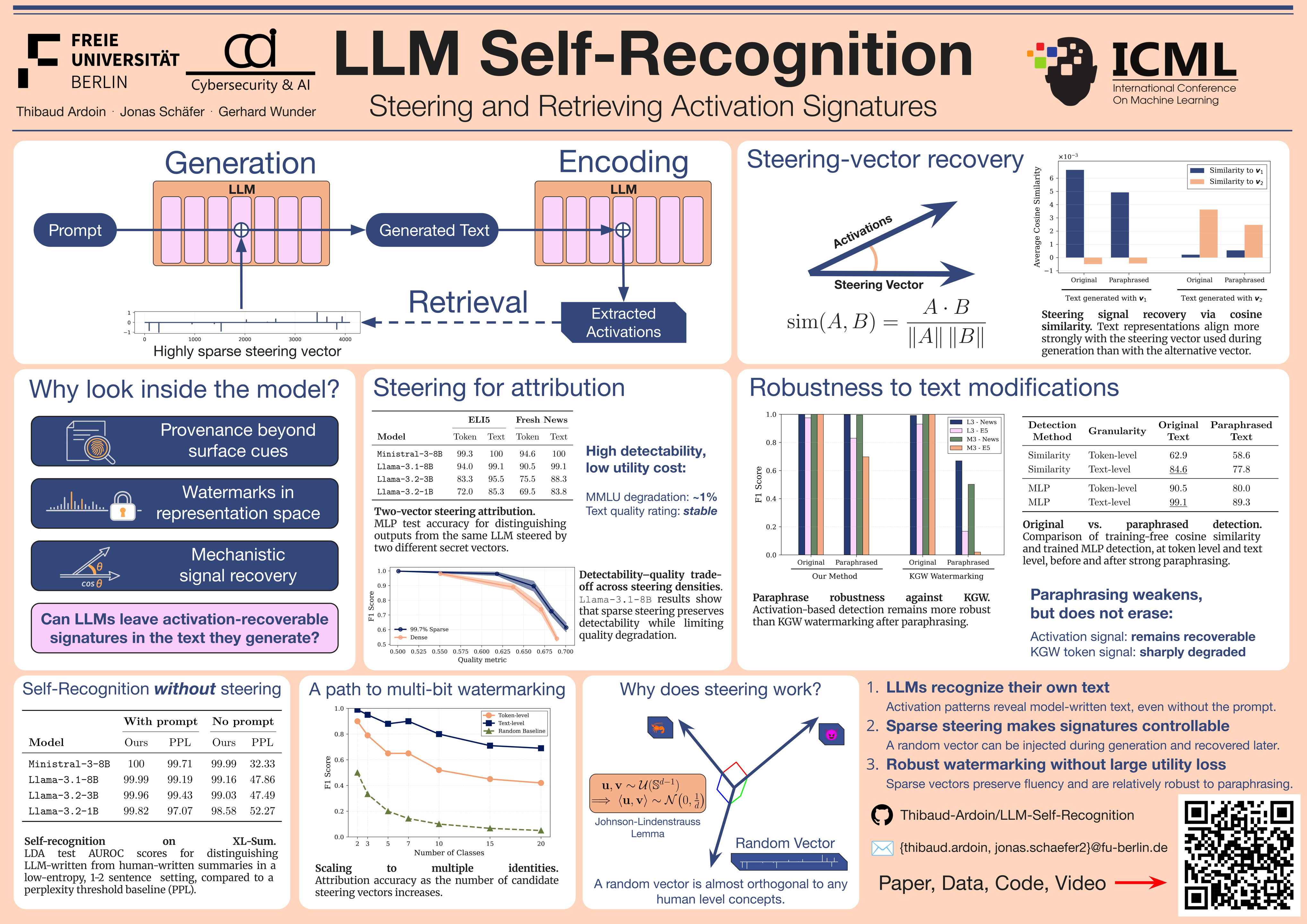
Recent advances in interpretability suggest that large language models (LLMs) implicitly encode signals in their generated text that enable self-recognition of their outputs. We demonstrate that this capability is reliable, even in low-entropy scenarios, and that it can be amplified through targeted intervention. By steering the internal residual stream during generation with a random sparse vector, we create a detectable fingerprint that enables attribution of a given text to a specific LLM. This signal is recoverable from the activations of an LLM used as a detector, achieving over 98% accuracy across multiple detection settings while preserving the quality of generated text. As AI-generated content proliferates, this approach offers a practical alternative to traditional detectors, by leveraging the model's natural representation structure for attribution rather than embedding a signal externally. Our contributions include: (i) establishing reliable self-recognition capabilities in LLMs, (ii) a simple steering mechanism enabling multi-LLM identification with no quality degradation, (iii) demonstrating that activation spaces contain exploitable structure for encoding signals without semantic interference.
Lay Summary
As AI-generated text becomes more common online, it's getting harder to tell whether something was written by a human or a machine. Existing tools to detect AI writing often struggle, they can be fooled, and they don't work well in all situations. We needed a better way to "sign" AI-generated content so it can be reliably identified. We discovered that AI models naturally leave subtle traces in the text they produce, almost like a fingerprint. We then developed a way to make that signature stronger and more distinctive, without changing how the text reads or sounds. Think of it like adding an invisible watermark to a document: the text looks completely normal to any reader, but a trained eye (or in this case, another AI) can spot it. Our method can correctly identify whether a piece of text was generated by a specific AI model over 98% of the time. It works quietly in the background, doesn't affect writing quality, and can even tell multiple AI models apart from one another. Unlike older detection tools that look for surface-level clues, ours works by reading deeper structural patterns that are much harder to fake or remove. This is a practical step toward making AI-generated content accountable, helping platforms, researchers, and policymakers track the origin of machine-written text as it spreads across the internet.