
When Tabular Foundation Models Meet Strategic Tabular Data: A Prior Alignment Approach
Abstract
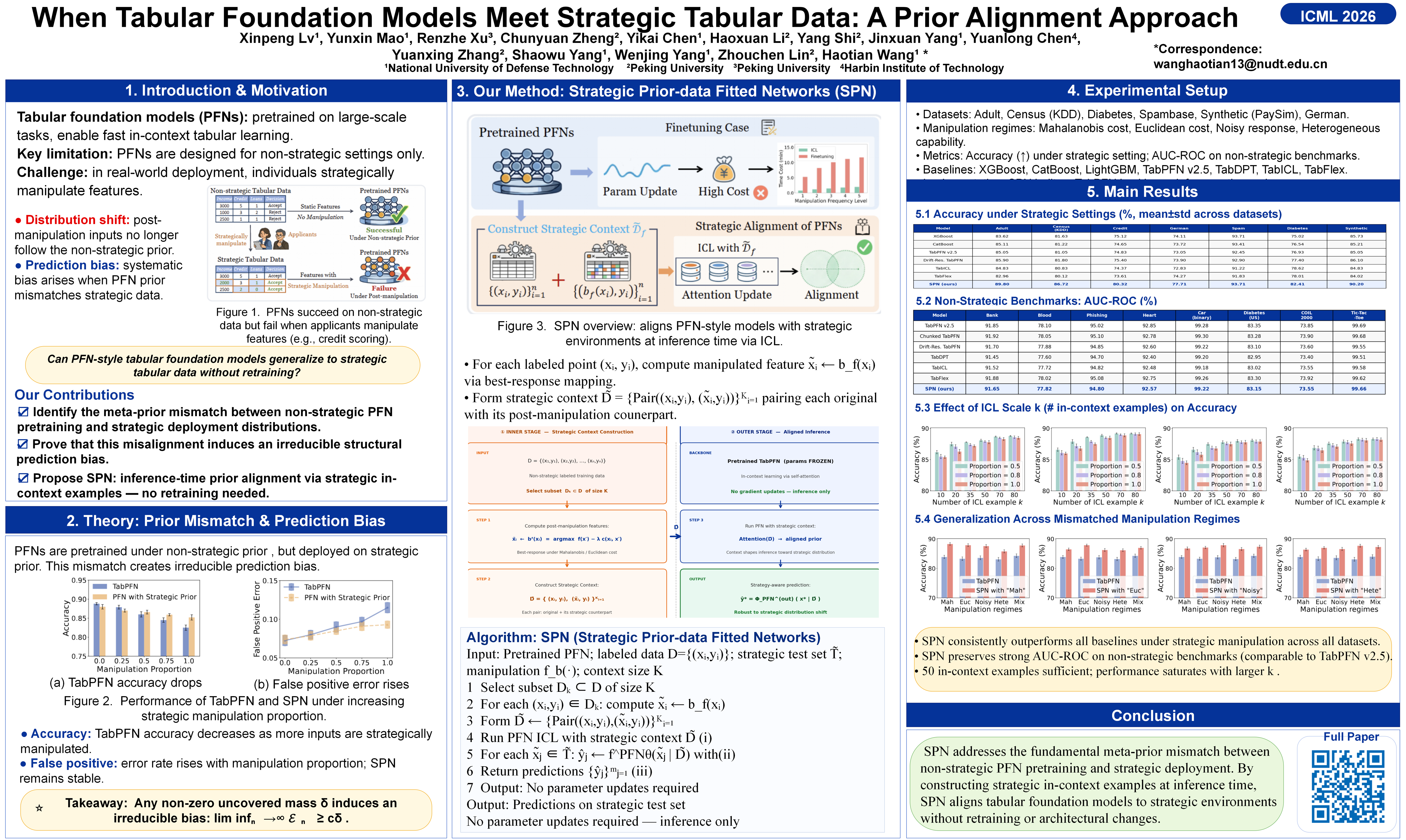
Tabular foundation models based on pretrained prior-data fitted networks (PFNs) have shown strong generalization on diverse tabular tasks, but they are typically designed for non-strategic settings where data distributions are independent of deployed classifiers. In many real-world decision scenarios, however, individuals may strategically modify their features after deployment to obtain favorable outcomes, inducing a post-deployment distribution shift. This paper studies whether PFN-style tabular foundation models can generalize to such strategic tabular data. We show that strategic manipulation creates a fundamental mismatch between the non-strategic prior learned during pretraining and the post-manipulation strategic prior encountered at deployment, which leads to an irreducible structural prediction bias. To address this issue, we propose the Strategic Prior-data Fitted Network (SPN), an inference-time strategy-aware framework that adapts tabular foundation models to strategic environments without retraining or architectural modification. SPN constructs strategic in-context examples to approximate post-manipulation inputs and aligns PFN predictions with the induced strategic distribution via in-context learning, with theoretical guarantees on bias reduction. Experiments on real-world and synthetic tabular datasets show that SPN consistently improves robustness and predictive performance under strategic manipulation compared with both tabular foundation models and classical tabular methods.
Lay Summary
Many important decisions in areas such as lending, healthcare, and public services are made using data stored in tables. Recent AI models can make strong predictions from such tabular data, but they usually assume that people’s information stays the same after the model is deployed. In real life, this is often not true. Once people know or guess how a decision system works, they may change some of their reported or observable information to receive a better outcome. This paper studies how these changes can affect modern AI models for tabular data. We show that when people strategically adjust their information, existing models can become less reliable because the data they see after deployment no longer matches the data patterns they were designed for. To address this problem, we propose SPN, a method that helps these models consider possible post-deployment changes without retraining them. Experiments show that SPN improves prediction reliability when people strategically modify their information.