
Credit-assigned Policy Gradient for Early Stage Retrieval in Two-stage Ranking
Abstract
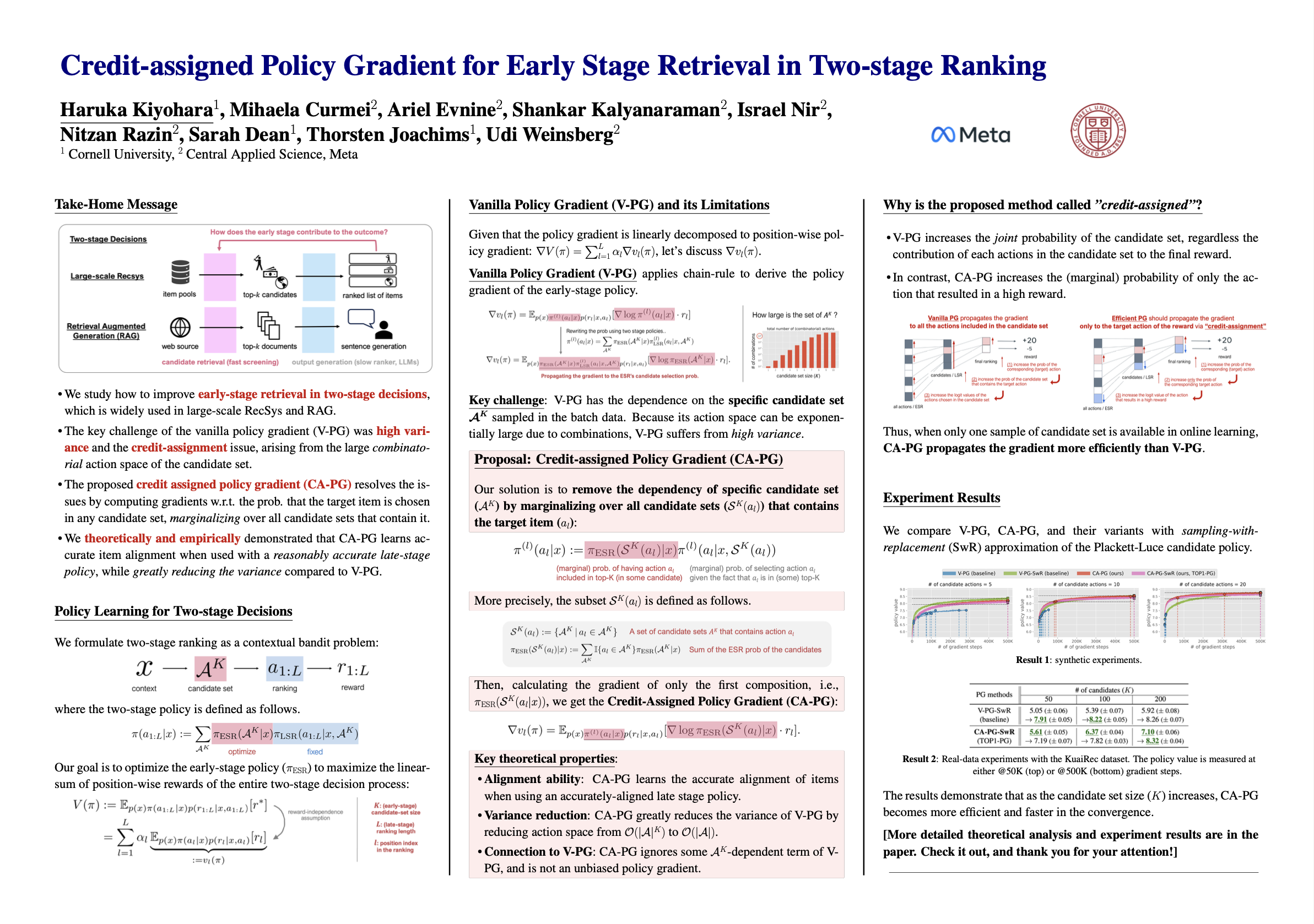
Large-scale search, recommendation, and retrieval-augmented generation (RAG) systems typically employ a two-stage architecture: an early-stage ranker (ESR) generates a candidate set, which is subsequently re-ranked by a late-stage ranker (LSR). While there are many reinforcement learning (RL) methods for training the LSR, end-to-end training of the ESR has proven challenging. In particular, naive application of "vanilla" policy gradient (V-PG) is not scalable for candidate-set sizes relevant for practical use due to exploding variance. This issue arises because V-PG propagates the gradient to the joint probability of the candidate sets, ignoring the contribution of each specific item in the candidate set to the reward. To mitigate this issue, we propose a novel "credit-assigned" policy gradient (CA-PG), which computes gradients with respect to the probability that the target item is chosen in any candidate set, i.e. marginalizing over all candidate sets that contain it. Our theoretical analysis reveals that CA-PG significantly reduces the variance of V-PG by marginalizing over the specific composition of the candidate set, while preserving the ability to learn the correct ranking of items under a reasonably aligned LSR policy. Experiments on both synthetic and real-world data demonstrate that CA-PG improves the convergence speed and training stability for ESRs utilizing the canonical Plackett-Luce model, especially when the candidate-set size is large.
Lay Summary
Large-scale search, recommendation, and retrieval-augmented generation (RAG) systems typically employ a two-stage architecture to process a massive volume of items at web latency, where an early-stage ranker (ESR) generates a candidate set, which is subsequently re-ranked by a late-stage ranker (LSR). While there are many reinforcement learning (RL) methods for training the late-stage ranker (LSR), end-to-end training of the early-stage ranker (ESR) has proven challenging, particularly due to variance. We propose an efficient RL method called "credit-assigned" policy gradient to resolve this issue, and demonstrate its benefits regarding training stability and convergence speed in both theoretical and empirical ways.