
The Silent Thought: Modeling Internal Cognition in Full-Duplex Spoken Dialogue Models via Latent Reasoning
Abstract
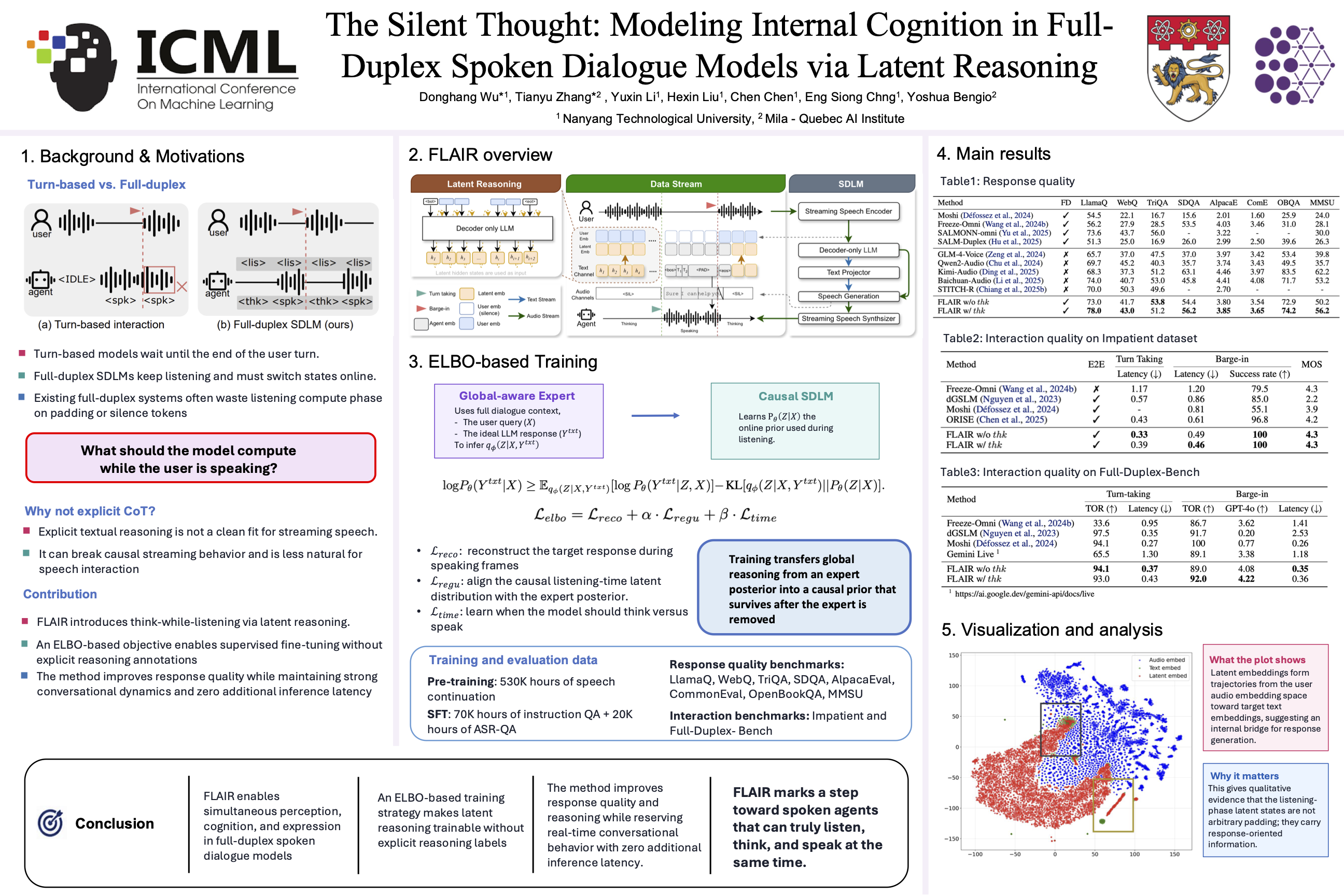
During conversational interactions, humans subconsciously engage in concurrent thinking while listening to a speaker. Although this internal cognitive processing may not always manifest as explicit linguistic structures, it is instrumental in formulating high-quality responses. Inspired by this cognitive phenomenon, we propose a novel Full-duplex LAtent and Internal Reasoning method named FLAIR that conducts latent thinking simultaneously with speech perception. Unlike conventional "thinking" mechanisms in NLP, which require post-hoc generation, our approach aligns seamlessly with spoken dialogue systems: during the user’s speaking phase, it recursively feeds the latent embedding output from the previous step into the next step, enabling continuous reasoning that strictly adheres to causality without introducing additional latency. To enable this latent reasoning, we design an Evidence Lower Bound-based objective that supports efficient supervised finetuning via teacher forcing, circumventing the need for explicit reasoning annotations. Experiments demonstrate the effectiveness of this think-while-listening design, which achieves competitive results on a range of speech benchmarks. Furthermore, FLAIR robustly handles conversational dynamics and attains competitive performance on full-duplex interaction metrics.
Lay Summary
When humans have a conversation, we subconsciously think about our reply while the other person is still speaking. Current AI voice assistants struggle to replicate this; they either wait sequentially like text-based models, or they simply remain idle while listening to continuous speech. If engineers try to force the AI to plan its thoughts using explicit words, it causes lag and system confusion the moment a user interrupts or changes the topic. To solve this, we developed FLAIR, a method that enables the AI to perform latent reasoning. Instead of thinking in discrete words, our system thinks implicitly using continuous internal signals while the user is still talking. This allows the AI to silently build up its understanding in the background without causing any delay. Ultimately, this research matters because it enables voice assistants to deliver smarter answers and handle natural conversational interruptions perfectly, bringing us a step closer to machines that can truly listen, think, and speak simultaneously