
Meta-learning Structure-Preserving Dynamics
Abstract
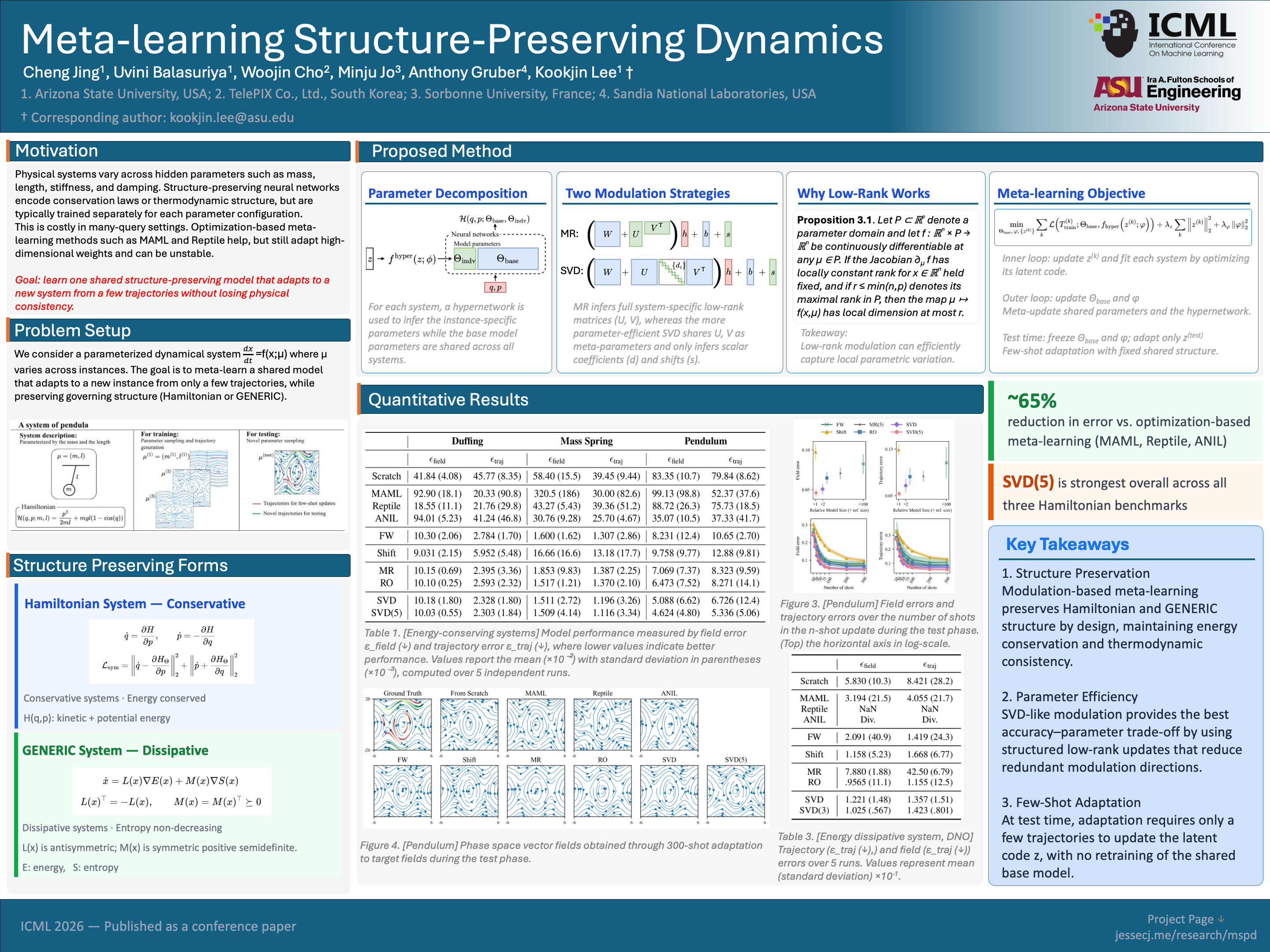
Structure-preserving approaches to dynamics discovery have demonstrated great potential for modeling physical systems due to their use of strong inductive biases, which enforce key features such as conservation laws and dissipative behavior. However, these models are typically trained on a per-configuration basis, requiring explicit knowledge of system parameters and costly retraining when these parameters vary. While meta-learning provides a potential remedy, optimization-based approaches can suffer from limited generalizability. Motivated by recent advances in modulation-based learning aimed at mitigating these drawbacks, we systematically investigate the use of modulation techniques in learning conservative dynamical systems. We study a range of existing modulation strategies alongside newly proposed variants, integrating them into a Hamiltonian learning framework without requiring an explicit system parameterization. Through extensive experiments on benchmark problems, we demonstrate that modulation-based meta-learning enables accurate few-shot adaptation, achieving robust generalization across parameter space without compromising the conservation of key invariants responsible for the dynamics.
Lay Summary
Predicting how physical systems move over time is important in science and engineering, but machine-learning models can make unrealistic predictions when the system changes. This paper introduces a method that learns from many related physical systems and quickly adapts to a new one, such as a pendulum or spring with different properties. Rather than training a separate model for every new case, the method reuses shared knowledge and only adjusts a small part of the model. Our experiments show that this leads to accurate predictions from limited data while keeping the results more consistent with the real behavior of the system.