
TABX: A High-Throughput Sandbox Battle Simulator for Multi-Agent Reinforcement Learning
Abstract
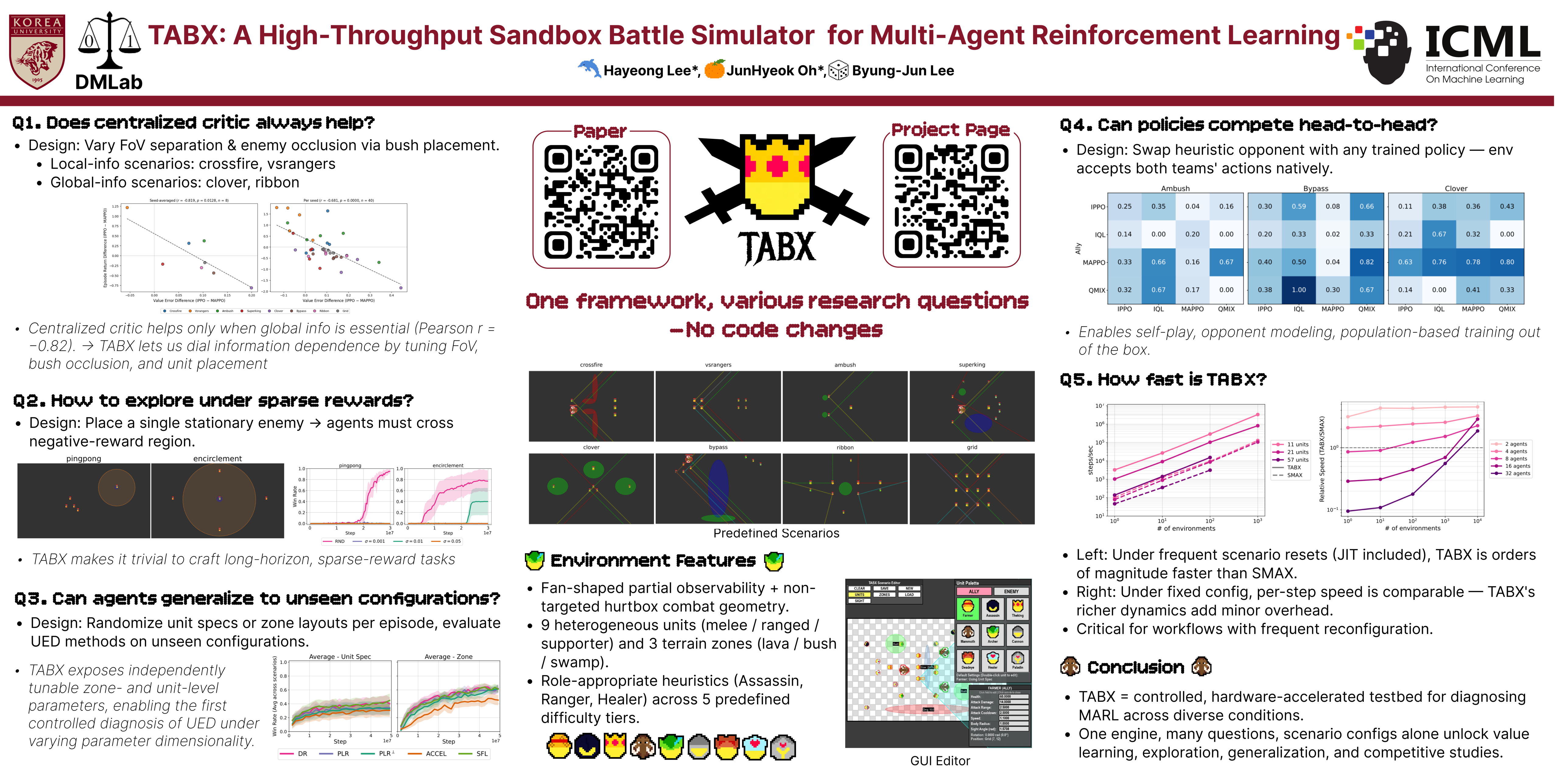
The design of environments plays a critical role in shaping the development and evaluation of cooperative multi-agent reinforcement learning (MARL) algorithms. While existing benchmarks highlight critical challenges, they often lack the modularity required to design custom evaluation scenarios. We introduce the Totally Accelerated Battle Simulator in JAX (TABX), a high-throughput sandbox designed for reconfigurable multi-agent tasks. TABX provides granular control over environmental parameters, permitting a systematic investigation into emergent agent behaviors and algorithmic trade-offs across a diverse spectrum of task complexities. Leveraging JAX for hardware-accelerated execution on GPUs, TABX enables massive parallelization and significantly reduces computational overhead. By providing a fast, extensible, and easily customized framework, TABX facilitates the study of MARL agents in complex structured domains and serves as a scalable foundation for future research. Our code is available at: https://anonymous.4open.science/r/TABX-00CA.
Lay Summary
To design artificial intelligence systems that can cooperate as a team, researchers need virtual playgrounds to test them. However, existing testing environments are often rigid and slow. This makes it difficult for scientists to customize scenarios or study how specific team behaviors change when the rules of the game are tweaked. We developed TABX, a highly customizable, high-throughput digital sandbox for multi-agent team-based AI. TABX gives researchers total control over the simulation rules, letting them easily build tailored tasks. Because it is powered by modern graphics cards, TABX can run thousands of these virtual scenarios at the exact same time. This massive speedup drastically cuts down the time and computing power required to train AI. Ultimately, TABX provides a fast, accessible foundation that helps scientists better understand how complex teams of AI systems learn to coordinate, communicate, and solve difficult problems together.