
SAGE-NAS: Synergizing LLM-Based Semantic Agent with Graph-Based Evaluator for Neural Architecture Search
Abstract
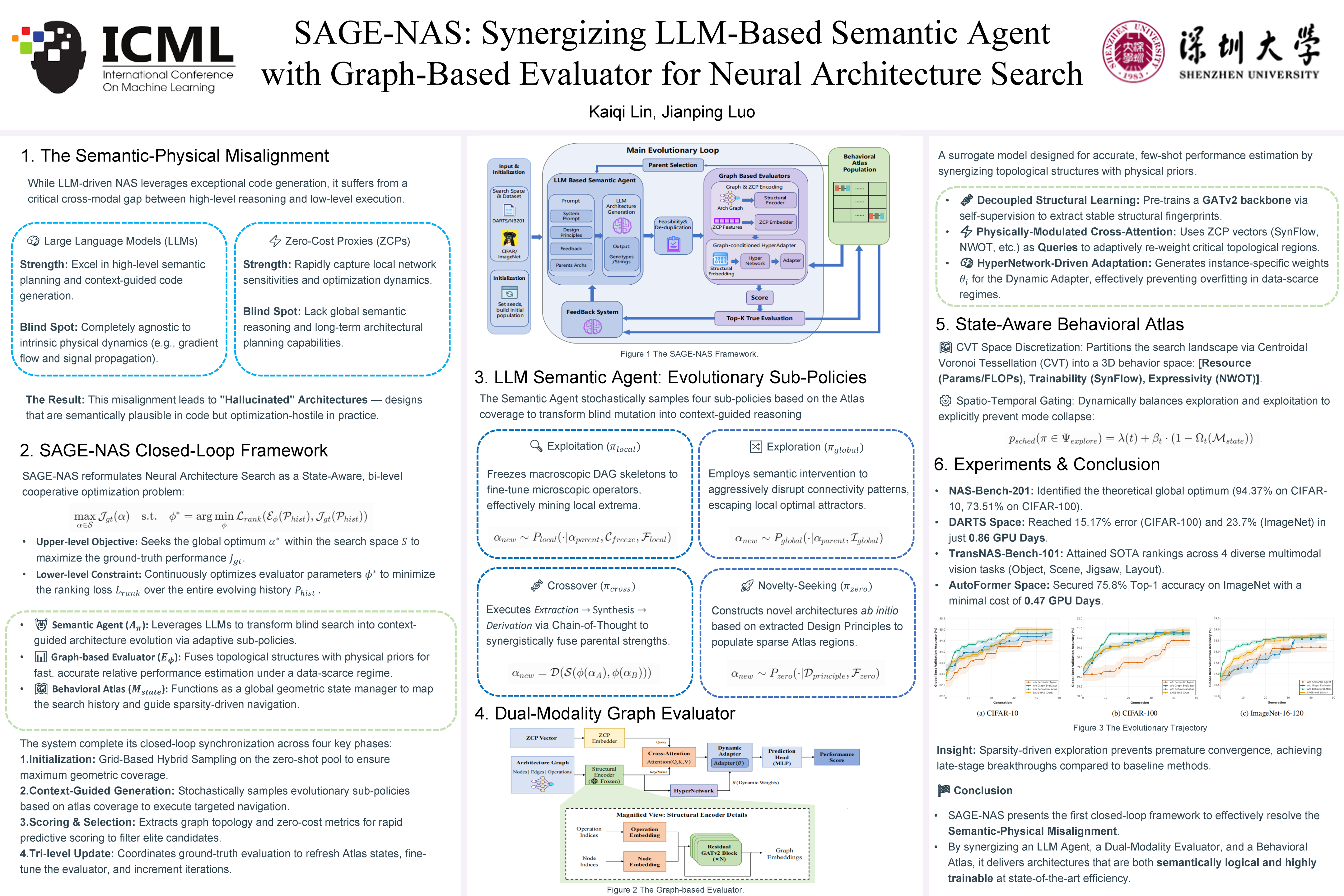
While LLM-driven Neural Architecture Search (NAS) leverages exceptional code generation and reasoning, it suffers from a critical "Semantic-Physical Misalignment": LLMs prioritize high-level semantic plausibility but are agnostic to intrinsic physical dynamics such as gradient flow, whereas Zero-Cost Proxies (ZCPs) capture these local sensitivities but lack global semantic planning. To bridge this gap, we propose SAGE-NAS, a closed-loop evolutionary framework that synergizes an LLM-Based Semantic Agent with a Graph-Based Evaluator. Specifically, SAGE-NAS coordinates an LLM-driven Semantic Agent to construct candidate architectures by dynamically scheduling complementary sub-policies that balance exploitation with exploration. Furthermore, the framework integrates a Dual-Modality Graph Evaluator that serves as a rapid performance predictor by fusing ZCP statistics with topological features, and a State-Aware Behavioral Atlas that guides sparsity-driven exploration to escape local optima. Experiments demonstrate that SAGE-NAS achieves state-of-the-art performance across multiple mainstream search spaces and downstream tasks, exhibiting a superior balance between search efficiency, model accuracy, and cross-task generalization capability.
Lay Summary
Designing the internal structure of Artificial Intelligence (AI) models is a highly complex process. Recently, scientists have started using advanced AI language models to automatically write the code for new AI designs. However, this creates a mismatch: while language models are highly creative "architects" that can write plausible blueprints, they do not understand the underlying "physics" of how the resulting AI will actually learn from data. On the other hand, quick mathematical estimation tools understand these learning dynamics perfectly, but they lack the intelligence to plan the overall structure. To solve this, we introduce SAGE-NAS. Our system seamlessly pairs the creative language model with a strict, mathematical "engineer." The language model proposes new AI designs, and our specialized evaluator rapidly checks if they are structurally sound and capable of learning effectively. To prevent the system from getting stuck on repetitive ideas, we also provide a behavioral "map" that guides it to explore completely new design territories. Our experiments show that this teamwork approach discovers highly accurate and adaptable AI models much faster than previous methods.