
LoPhyDA: Low-Rank Tensor and Physics Gradient Guided Diffusion for Atmospheric Data Assimilation
Abstract
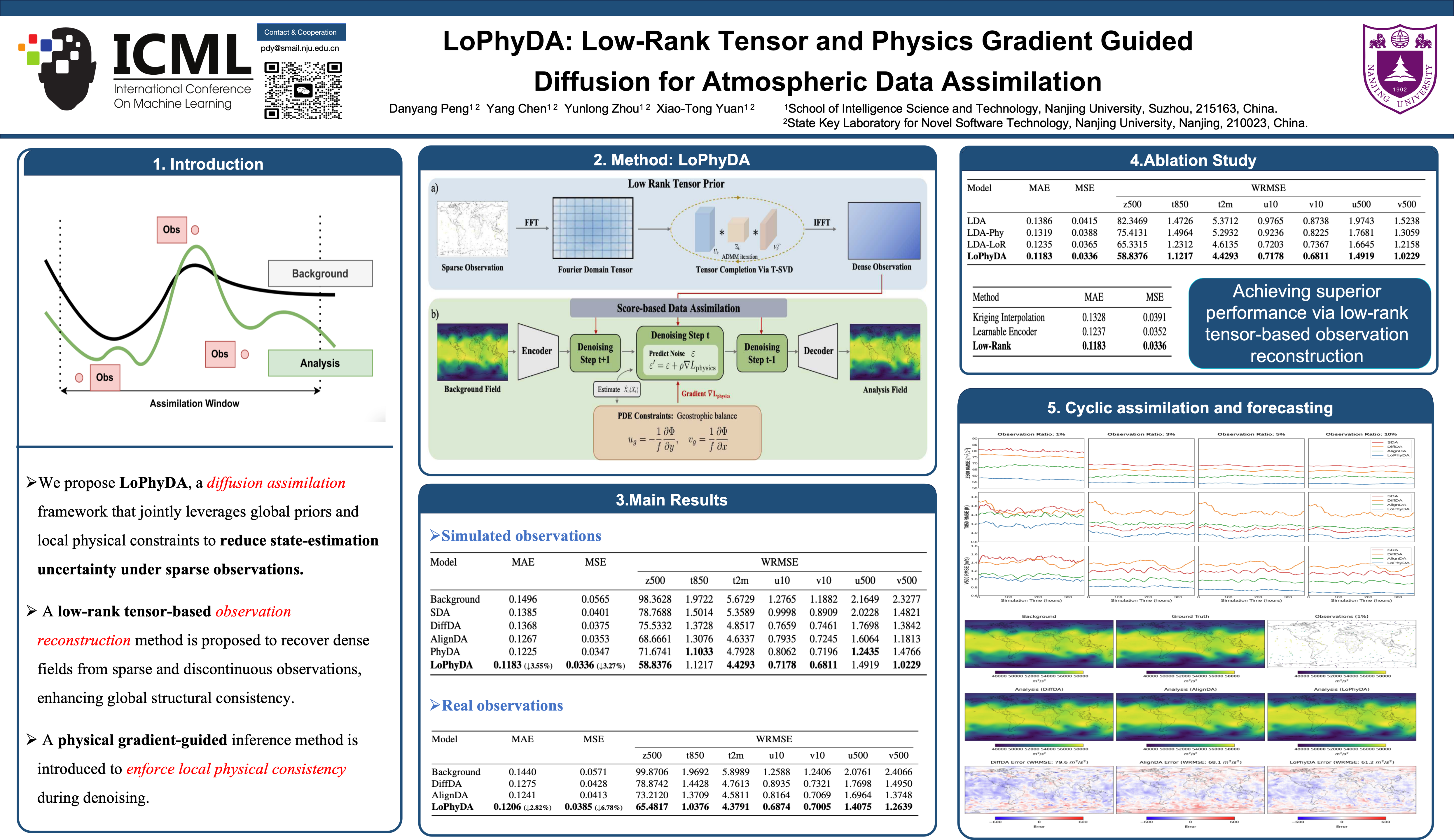
Data Assimilation (DA) aims to integrate observations with model forecasts to estimate the state of dynamical systems. Despite the widespread application of diffusion-based assimilation methods, they remain constrained by the high dimensionality of atmospheric states and the reliance on imperfect state-observation mappings. This leaves regions lacking observations spatially unconstrained, leading to severe error accumulation and physical inconsistency.. In this paper, we propose LoPhyDA, a diffusion assimilation algorithm dual-guided by low-rank tensor and physical gradients. By leveraging the low-rank property of meteorological field, we employ tensor completion to exploit spatial continuity and dynamic correlations, reconstructing a globally informative dense field from sparse observations to serve as a global prior. This approach mitigates the information deficit inherent in sparse settings. The framework further incorporates physical constraints into the iterative denoising process, utilizing Partial Differential Equation (PDE) residual gradients to rectify the generative trajectory in real-time. Experimental results demonstrate that LoPhyDA outperforms state-of-the-art generative assimilation models in global weather prediction. It achieves robust and physically consistent assimilation, significantly reducing error accumulation in regions lacking observations.
Lay Summary
Weather prediction often needs to combine model forecasts with real observations. However, observations are usually sparse and unevenly distributed. In areas with few observations, existing methods may fail to correct forecast errors, causing errors to accumulate and producing results that do not follow physical laws. This paper proposes LoPhyDA, a method for data assimilation with sparse observations. LoPhyDA uses the spatial structure of weather fields to reconstruct a denser observation field from limited measurements. This provides useful information for regions without direct observations. It then uses physical constraints during the generation process to reduce physically inconsistent results. Experiments show that LoPhyDA improves assimilation accuracy compared with existing generative methods. It is especially effective in regions with missing observations and helps produce more physically consistent weather estimates.