
Robust Federated Learning Against Adaptive Compression
Abstract
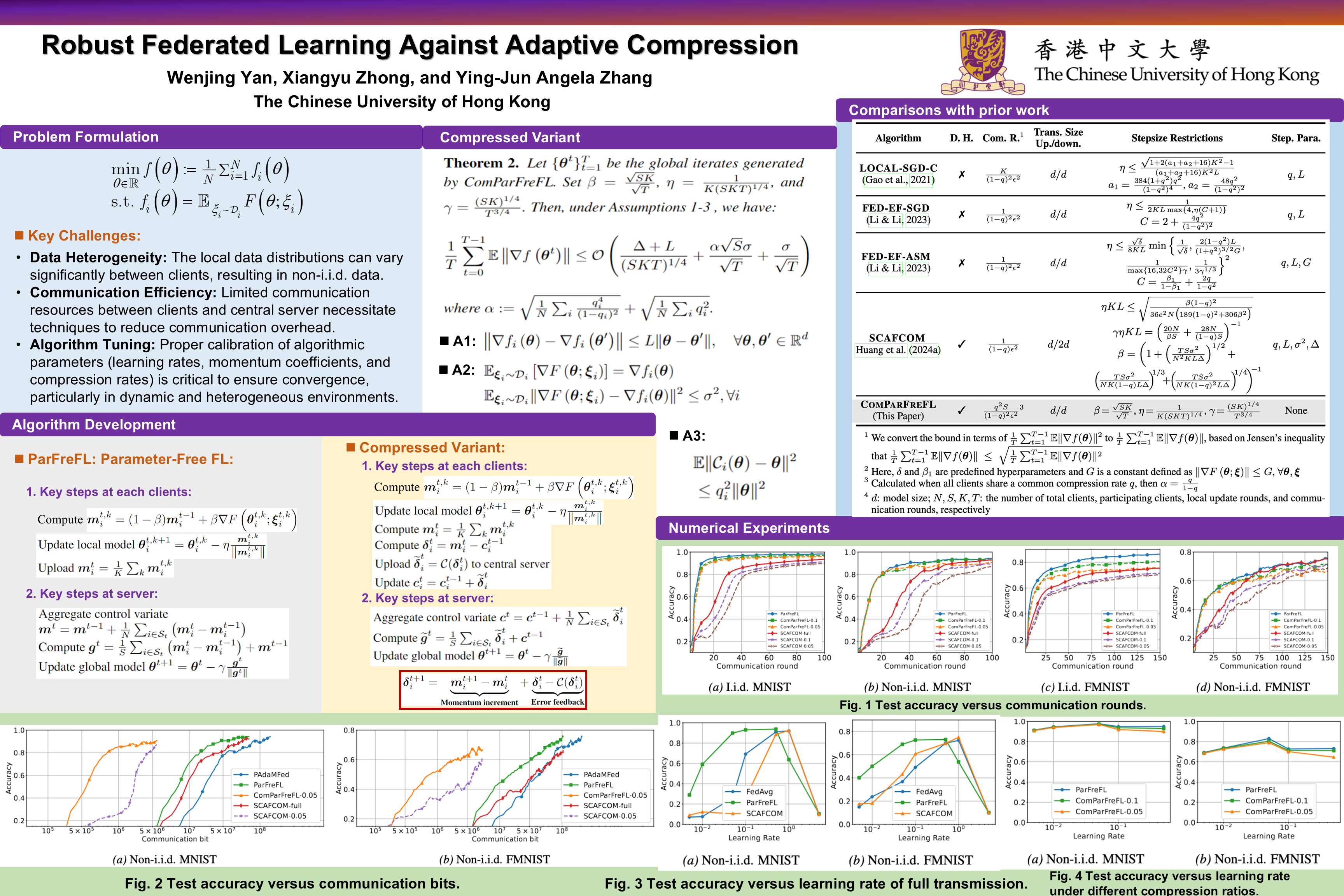
This paper addresses the critical challenges of hyperparameter tuning and communication efficiency in federated learning (FL). Despite recent advancements in parameter-free FL algorithms such as PAdaMFed, significant communication overhead remains a major obstacle to their practical deployment. To tackle these challenges, we propose a novel communication-efficient parameter-free FL algorithm ParFreFL that halves the communication requirements of PAdaMFed while preserving its parameter-free property. Building on this foundation, we introduce a compressed variant, ComParFreFL, which unifies the momentum increment and error feedback into a single parameter, effectively handling biased compression while maintaining the minimal communication cost. Notably, ComParFreFL also operates independent of the compression ratio, representing the first instance of such robustness in the compressed FL literature to our knowledge. Theoretically, our methods are proven to handle arbitrary data heterogeneity, partial client participation, and achieve linear speedup with respect to both local updates and participating clients. Extensive empirical evaluations demonstrate that our approaches match or slightly surpass the performance of carefully tuned alternatives while significantly reducing communication overhead, making FL more accessible and deployable in dynamic, resource-constrained environments.
Lay Summary
Federated learning enables multiple devices to collaboratively train machine learning models while keeping data private and local. However, current methods require extensive communication between devices and careful tuning of technical parameters by experts, limiting practical deployment. This paper introduces ParFreFL and ComParFreFL, two algorithms that address both challenges. ParFreFL automatically adjusts its own parameters, eliminating the need for expert configuration. ComParFreFL extends this approach to support compressed communication, where devices transmit only 5-10% of the data while maintaining performance. Crucially, both methods adapt automatically to different data distributions and compression ratios without manual intervention. Our experiments demonstrate that these parameter-free algorithms match or exceed the performance of carefully tuned existing methods. By removing the need for expert knowledge and reducing communication overhead, our approach makes federated learning more practical for privacy-preserving applications in healthcare, finance, and mobile services.