
TexEditor: Structure-Preserving Text-Driven Texture Editing
Abstract
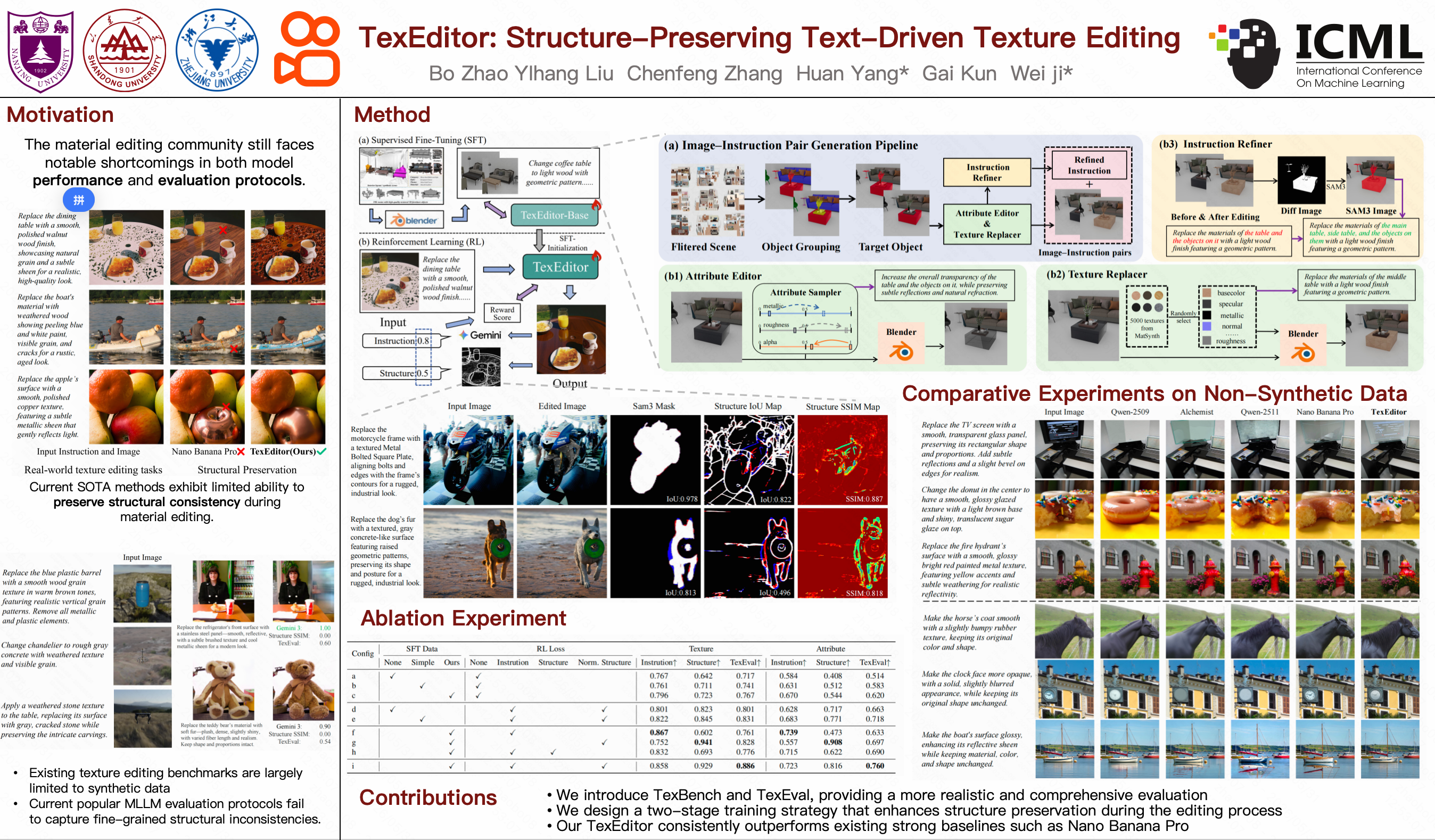
Text-guided texture editing aims to modify object appearance while preserving the underlying geometric structure. However, our empirical analysis reveals that even SOTA editing models frequently struggle to maintain structural consistency during texture editing, despite the intended changes being purely appearance-related. Motivated by this observation, we jointly enhance structure preservation from both data and training perspectives, and build TexEditor, a dedicated texture editing model based on Qwen-Image-Edit-2509. Firstly, we construct BlenderTex, a high-quality SFT dataset generated with Blender, which provides strong structural priors for a cold start. Secondly, we introduce StructureNFT, a RL–based approach that integrates structure-preserving losses to transfer the structural priors learned during SFT to real-world scenes. Moreover, due to the limited realism and evaluation coverage of existing benchmarks, we introduce TexBench, a general-purpose real-world benchmark for text-guided texture editing. Extensive experiments on existing Blender-based texture benchmarks and our TexBench show that TexEditor consistently outperforms strong baselines such as Nano Banana Pro. In addition, we assess TexEditor on the general-purpose benchmark ImgEdit to validate its generalization.
Lay Summary
Editing images with text has become increasingly powerful, but it still struggles with a common and important case: changing how an object looks without changing its shape. For example, a user may ask an image editor to make a table look like polished wood, a boat look like old painted wood, or an apple look like copper. Ideally, only the surface appearance should change. In practice, current models often accidentally reshape the object, remove details, or regenerate parts of the scene. This paper introduces TexEditor, a model designed to make texture edits while keeping the original object structure intact. To teach this behavior, we build TexBlender, a training dataset made with 3D scenes where the texture changes but the object shape stays exactly the same. We then further train the model on real images using feedback that rewards both correct editing and shape preservation. We also introduce TexBench, a real-world benchmark for evaluating texture editing, and TexEval, an automatic evaluation method that checks both whether the instruction is followed and whether the object structure is preserved. Experiments show that TexEditor produces more faithful texture edits than strong existing models, including commercial systems, while better maintaining object geometry.