
Cascaded Flow Matching for Heterogeneous Tabular Data with Mixed-Type Features
Abstract
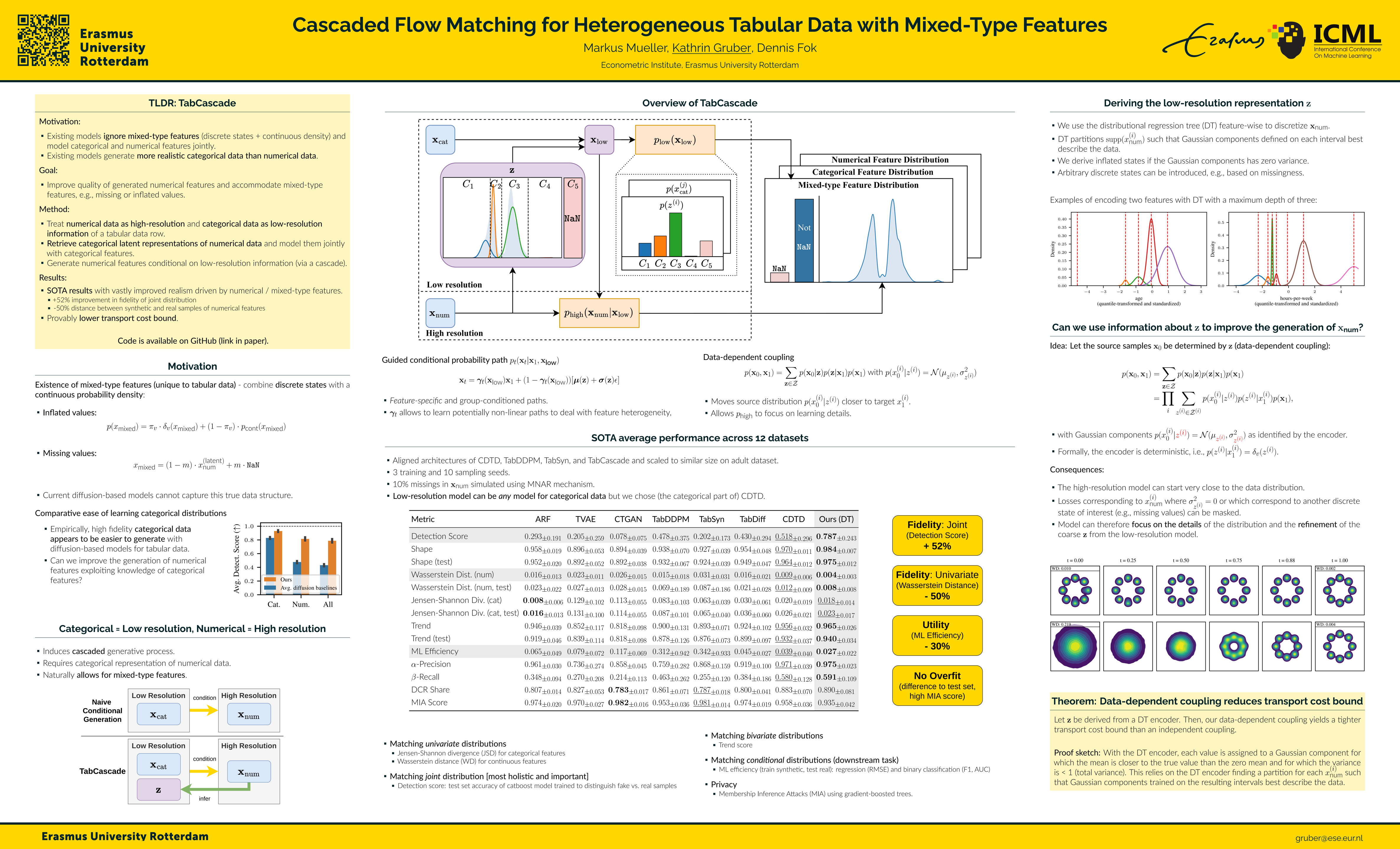
Advances in generative modeling have recently been adapted to tabular data containing discrete and continuous features. However, generating mixed-type features that combine discrete states with an otherwise continuous distribution in a single feature remains challenging. We advance the state-of-the-art in diffusion models for tabular data with a cascaded approach. We first generate a low-resolution version of a tabular data row, that is, the collection of the purely categorical features and a coarse categorical representation of numerical features. Next, this information is leveraged in the high-resolution flow matching model via a novel guided conditional probability path and data-dependent coupling. The low-resolution representation of numerical features explicitly accounts for discrete outcomes, such as missing or inflated values, and therewith enables a more faithful generation of mixed-type features. We formally prove that this cascade tightens the transport cost bound. The results indicate that our model generates significantly more realistic samples and captures distributional details more accurately, for example, the detection score improves by 51.9%. Code is available at https://github.com/muellermarkus/tabcascade.
Lay Summary
Many real-world data tables — medical records, employment data, surveys — contain features that don't fit neatly into either "numbers" or "categories." A working-hours column might be exactly zero for unemployed people and a real number for everyone else. A value might also simply be missing, where the missingness is meaningful (eg. absence of a treatment). When researchers want to share such data without exposing private information, they often turn to AI models that generate realistic synthetic copies. However, existing models cannot deal with these special features: zeros become small numbers, missing values get filled in, and the resulting data no longer reflects reality. To solve this, we built TabCascade, a generative model that works in two stages. The first stage sketches the broad structure of the data, detecting and treating discrete states like "zero" or "missing" as categories in their own right. The second stage fills in numerical details where necessary. The approach borrows from how cascaded models generate images — first the rough composition, then the fine detail — adapted for the messy reality of tables. TabCascade is the first generative model that faithfully preserves these mixed features, giving researchers and practitioners more realistic synthetic data. This is particularly useful in healthcare, psychology, and the social sciences, where missingness and zero-inflation carry real meaning.