
Temporal-Aware Reasoning Optimization for Video Temporal Grounding
Abstract
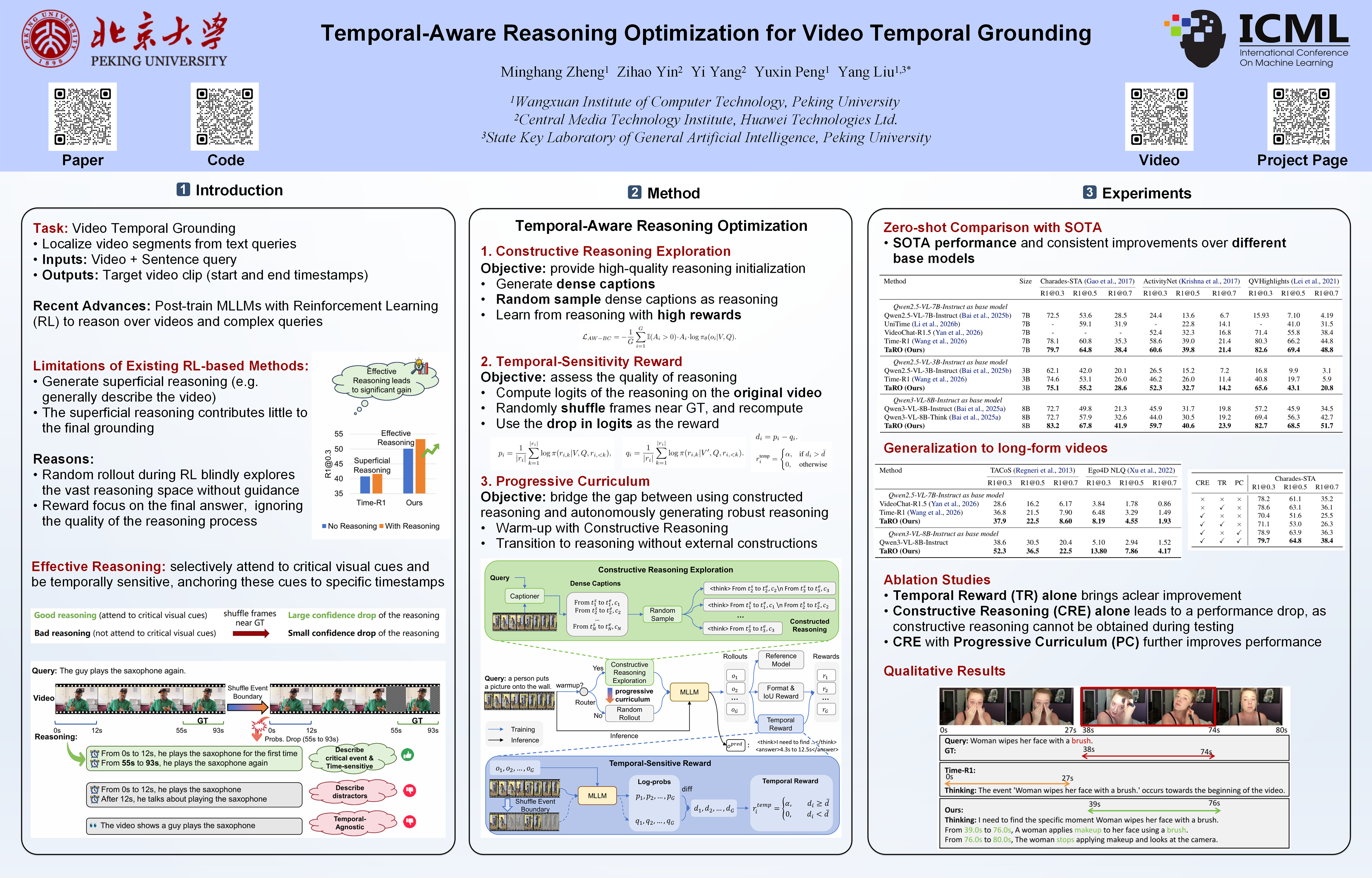
Multi-modal Large Language Models (MLLMs) have achieved remarkable progress in video temporal grounding with reinforcement learning for generating reasoning paths. However, existing models often produce superficial reasoning, which offers limited guidance for precise temporal localization. This limitation stems from (1) inefficient random exploration and (2) reward functions that focus solely on the answer correctness while ignoring reasoning quality. To address these issues, we propose TaRO (Temporal-Aware Reasoning Optimization), a framework that explicitly enhances the model’s ability of thinking with time. First, we introduce a Constructive Reasoning Exploration that leverages pre-generated dense captions to construct reasoning paths grounded in explicit visual cues and timestamps, enabling efficient exploration of high-quality time-aware reasoning. Second, to evaluate reasoning quality, we design a Temporal-Sensitivity Reward. High-quality reasoning should be anchored to specific events and timestamps. If the event boundary under thinking is disrupted, such reasoning should become invalid, leading to a drop in the logit of the reasoning path. We utilize this drop as a critique of reasoning quality. Finally, TaRO follows a progressive curriculum, which starts by utilizing this reward to select better constructed reasoning paths, and evolves to a free exploration phase where the model autonomously generates effective reasoning. Experiments demonstrate that TaRO achieves state-of-the-art performance on VTG benchmarks. Code is available at https://github.com/oceanflowlab/TaRO.
Lay Summary
Modern AI systems can answer questions about videos, but they still struggle to precisely identify when an event happens in a long video. For example, if asked “when does the person start cooking?”, current systems often rely on shallow guesses instead of carefully understanding the timing and sequence of events. In this work, we introduce a new training framework called TaRO that teaches AI models to think with time. Instead of randomly exploring videos, our method first provides the model with simple event descriptions and timestamps as guidance, helping it learn which moments in a video are truly important. We also design a new training signal that checks whether the model’s reasoning actually depends on the correct temporal order of events. If changing the order of key moments causes the model to become less confident, this indicates that the reasoning is genuinely grounded in the video. Experiments on multiple video understanding benchmarks show that our approach significantly improves the accuracy of locating events in videos, especially in complex and long-form videos. Our method also helps models produce more interpretable reasoning by explicitly connecting their predictions to specific events and timestamps.