
Revisiting Uncertainty: On Evidential Learning for Partially Relevant Video Retrieval
Abstract
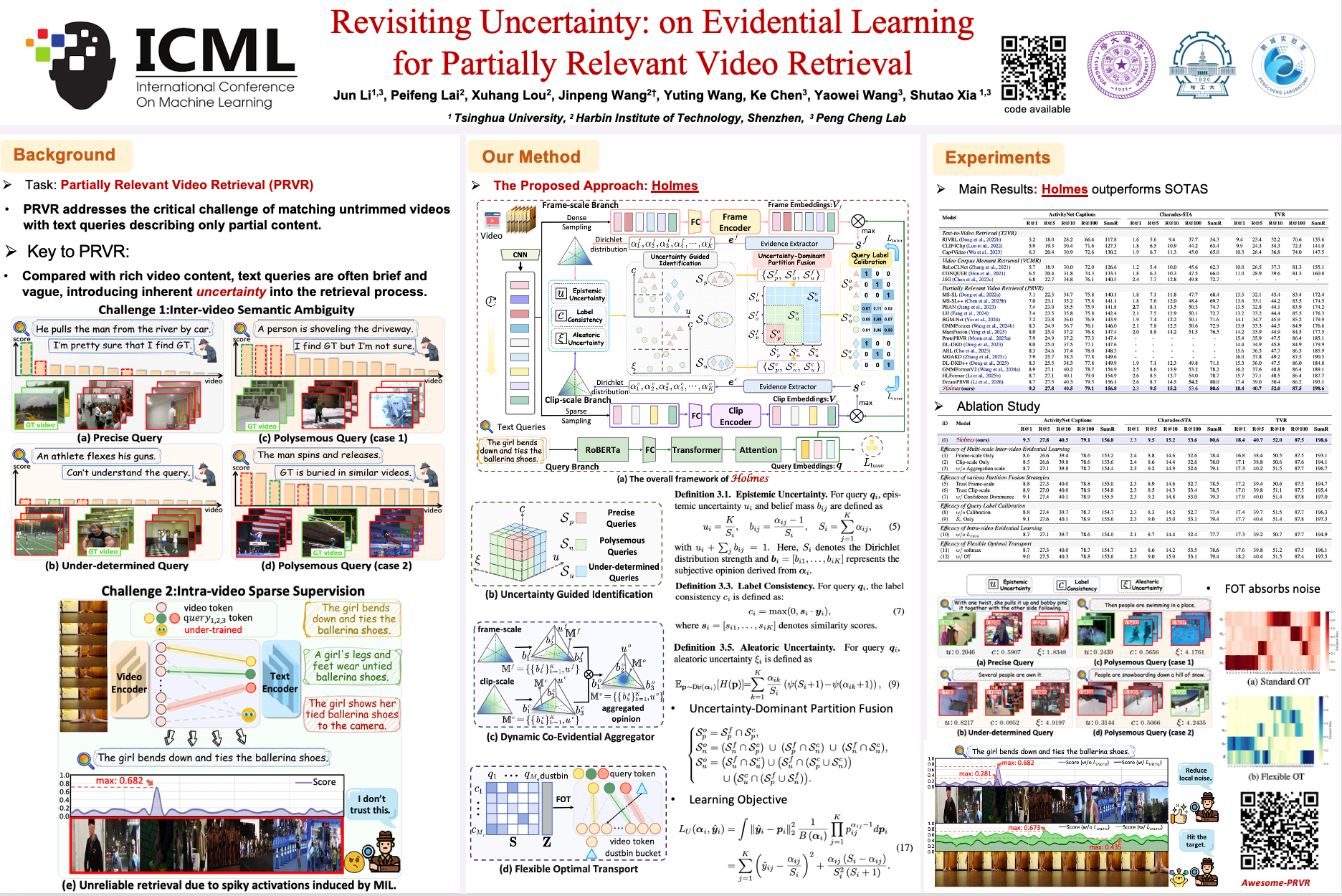
Partially relevant video retrieval aims to retrieve untrimmed videos using text queries that describe only partial content. However, the inherent asymmetry between brief queries and rich video content inevitably introduces uncertainty into the retrieval process. In this setting, vague queries often induce semantic ambiguity across videos, a challenge that is further exacerbated by the sparse temporal supervision within videos, which fails to provide sufficient matching evidence. To address this, we propose Holmes, a hierarchical evidential learning framework that aggregates multi-granular cross-modal evidence to quantify and model uncertainty explicitly. At the inter-video level, similarity scores are interpreted as evidential support and modeled via a Dirichlet distribution. Based on the proposed three-fold principle, we perform fine-grained query identification, which then guides query-adaptive calibrated learning. At the intra-video level, to accumulate denser evidence, we formulate a soft query-clip alignment via flexible optimal transport with an adaptive dustbin, which alleviates sparse temporal supervision while suppressing spurious local responses. Extensive experiments demonstrate that Holmes outperforms state-of-the-art methods. Code is released at https://github.com/lijun2005/ICML26-Holmes.
Lay Summary
Searching for a specific scene in a long, untrimmed video using a short text description is incredibly challenging. These brief queries are often vague, causing AI systems to get confused and distracted by irrelevant video clips. To tackle this, we developed a framework called Holmes that acts like a digital detective. Instead of blindly guessing, Holmes explicitly measures its own uncertainty to diagnose whether a search query is precise, confusing, or matches multiple possible scenes. We also designed a flexible matching method equipped with an adaptive "dustbin" to automatically filter out noisy, irrelevant video segments. This allows the AI to accumulate solid evidence from only the most relevant clips rather than getting fooled by local noise. Holmes significantly improves the accuracy of video retrieval over existing methods. More importantly, by teaching AI to understand its own uncertainty and discard unreliable evidence, our research paves the way for more trustworthy and transparent video search tools that can better handle messy, real-world data.