
Multimodal Crystal Flow: Any-to-Any Modality Generation for Unified Crystal Modeling
Abstract
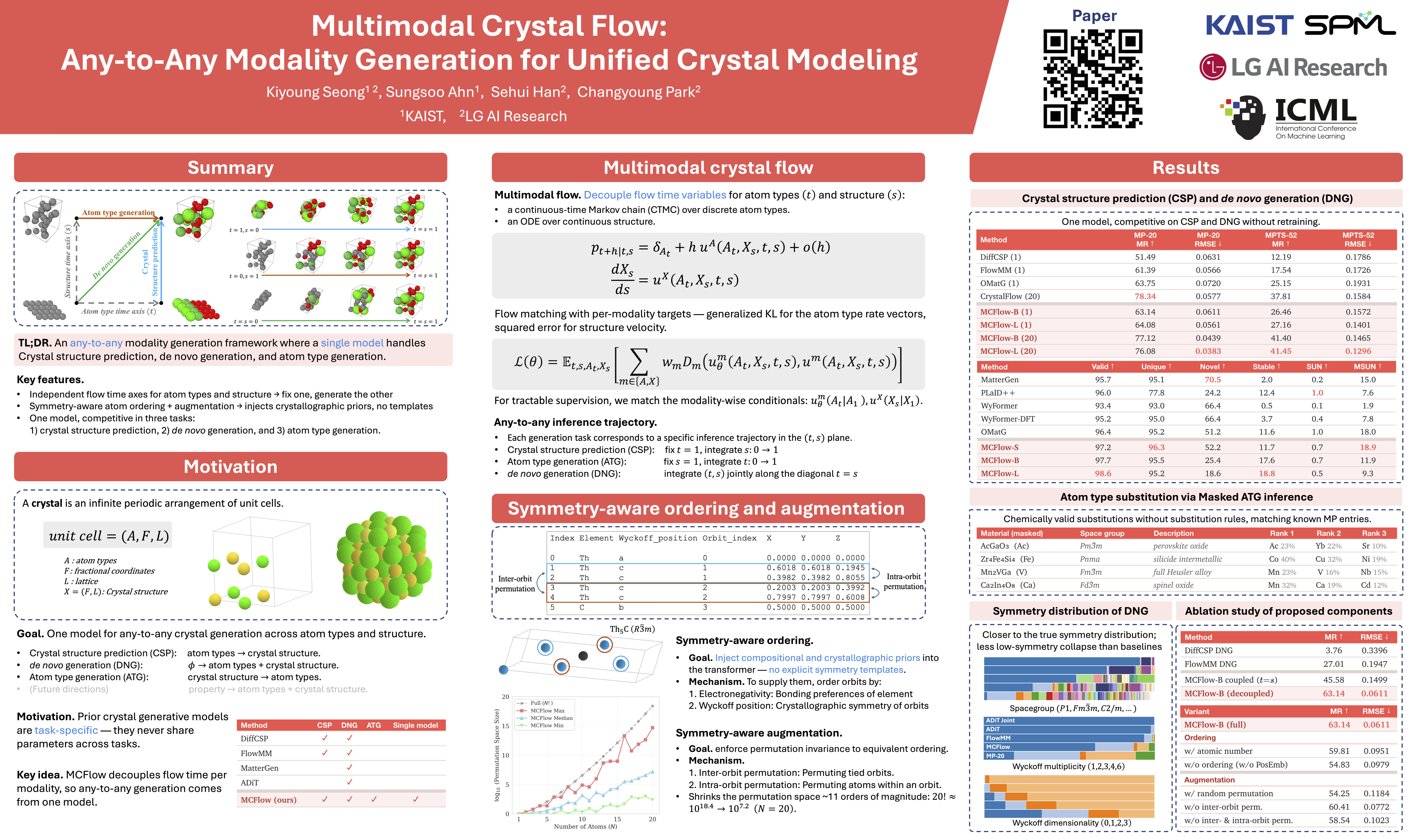
Crystal modeling spans a family of conditional and unconditional generation tasks, including crystal structure prediction (CSP) and de novo generation (DNG). While recent deep generative models have shown promising performance, they remain largely task-specific, lacking a unified framework that shares crystal representations across tasks. To address this limitation, we propose Multimodal Crystal Flow (MCFlow), a unified multimodal flow model that realizes multiple crystal generation tasks as distinct inference trajectories via independent time variables for atom types and crystal structures. To enable multimodal flow in a standard transformer model, we introduce a composition- and symmetry-aware atom ordering with hierarchical permutation augmentation, injecting compositional and crystallographic priors without explicit structural templates. Experiments on the MP-20 and MPTS-52 benchmarks show that a single MCFlow model is competitive with task-specific baselines across CSP, DNG, and structure-conditioned atom type generation.
Lay Summary
Crystalline materials underlie technologies from batteries to catalysts, and discovering new ones is a central goal of materials science. AI has recently begun to accelerate candidate search, but "designing a crystal" can mean several different things: predicting how a given set of atoms will arrange themselves into a stable structure, proposing an entirely new material from scratch, or predicting which atoms fit a given structure. Until now, each of these tasks has required its own specialized AI model. We introduce Multimodal Crystal Flow (MCFlow), a single AI model that handles all of these tasks at once. The key idea is to treat a chemical composition and its structure as separate components that can be generated independently: the user specifies whichever part is already known, and the model produces the rest. The model is also designed to respect the natural symmetry of atoms, following crystallographic rules without explicit constraints. By unifying tasks that were previously kept separate, MCFlow provides a more flexible framework for crystal generation.