
Learning Junta Distributions, Quantum Junta States, and QAC$^0$ Circuits
Abstract
Lay Summary
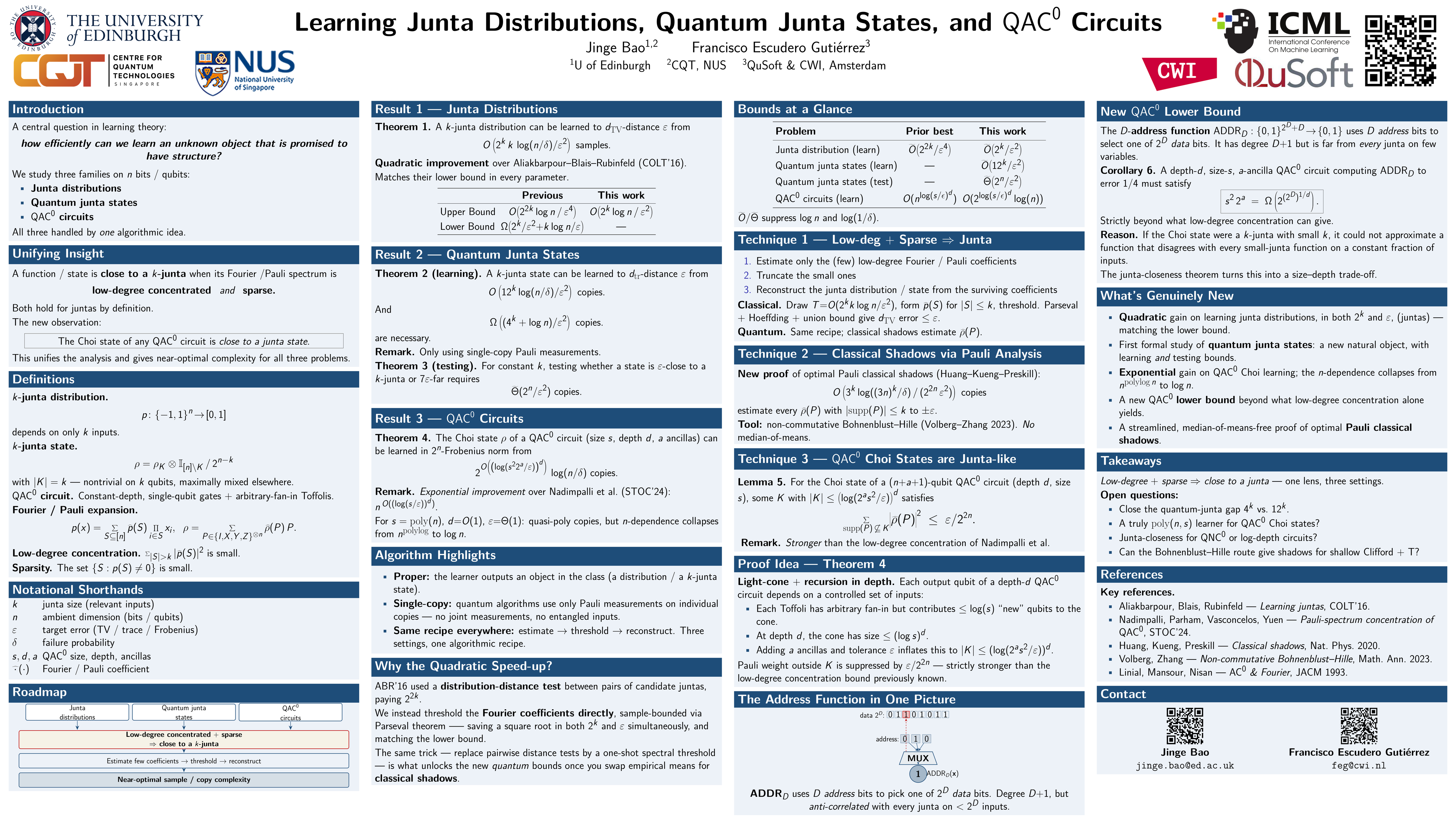
Modern learning algorithms often face very large systems where most variables are irrelevant, and the challenge is to identify and learn only the few that matter. This paper studies the challenge for classical probability distributions, quantum states, and a standard model of shallow quantum circuits. We focus on ``juntas'': objects that may involve many bits or qubits, but whose behavior is actually controlled by only a small hidden subset. We show how to learn such distributions with the optimal number of samples, improving the best previous guarantee. We also introduce and analyze a quantum version, where only a few qubits carry useful information while the rest behave like pure noise. Our methods reveal that certain shallow quantum circuits have a similar “few relevant parts” structure, which lets us learn them more efficiently than before. The key idea is to look for simple, sparse patterns in the mathematical fingerprints of these objects, rather than treating the whole system as equally important. These results sharpen our understanding of when high-dimensional classical and quantum systems can be learned efficiently, and they provide new tools for studying the limits of shallow quantum computation.