
Calibrating Decision Robustness via Inverse Conformal Risk Control
Abstract
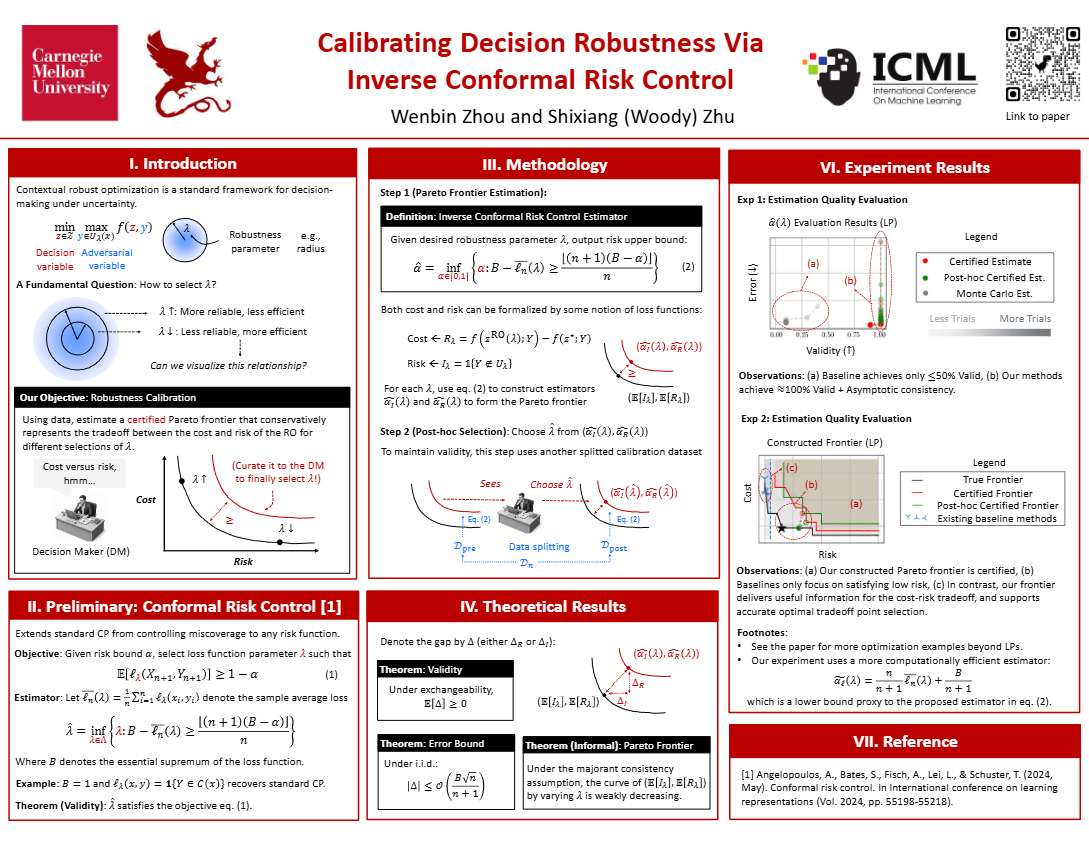
Robust optimization safeguards decisions against uncertainty by optimizing against worst-case scenarios, yet their effectiveness hinges on a prespecified robustness level that is often chosen ad hoc, leading to either insufficient protection or overly conservative and costly solutions. Recent approaches using conformal prediction construct data-driven uncertainty sets with finite-sample coverage guarantees, but they still fix coverage targets a priori and offer little guidance for selecting robustness levels. We propose a new framework that provides distribution-free, finite-sample guarantees on both miscoverage and regret for any family of robust predict-then-optimize policies. Our method constructs valid estimators that trace out the miscoverage--regret Pareto frontier, enabling decision-makers to reliably evaluate and calibrate robustness levels according to their cost--risk preferences. The framework is simple to implement, broadly applicable across classical optimization formulations, and achieves sharper finite-sample performance. This paper offers a principled data-driven methodology for guiding robustness selection and empowers practitioners to balance robustness and conservativeness in high-stakes decision-making.
Lay Summary
Many real-world decisions must be made under uncertainty. For example, power grid operators must prepare for uncertain electricity demand, businesses must manage uncertain inventory needs, and investors must make decisions without knowing future market behavior. A common strategy is to make decisions “robust” by preparing for worst-case scenarios. However, choosing how conservative a decision should be is difficult: being too optimistic can lead to failures, while being too conservative can create unnecessary costs. This paper introduces a new framework that helps decision-makers systematically balance this trade-off between safety and cost. Instead of requiring users to choose a fixed robustness level ahead of time, our method estimates how different robustness choices affect both risk and performance. Specifically, it provides mathematical guarantees on two quantities: (1) how often the decision may fail to protect against unexpected outcomes, and (2) how much additional cost is incurred by being conservative. By evaluating these trade-offs across many robustness settings, the method constructs a “Pareto frontier” that helps users identify the most desirable balance between protection and efficiency. Our approach builds on conformal prediction, a modern statistical framework for uncertainty quantification with rigorous finite-sample guarantees. The proposed method is broadly applicable to many optimization problems and remains computationally efficient. Experiments on several classical optimization tasks show that the framework can reliably guide robustness selection and avoid overly conservative decisions while maintaining strong protection against uncertainty.