
Meerkat-VL: Implicit Risk Safety Alignment in Multimodal LLMs via Perceptual Reasoning and Self-Verification
Abstract
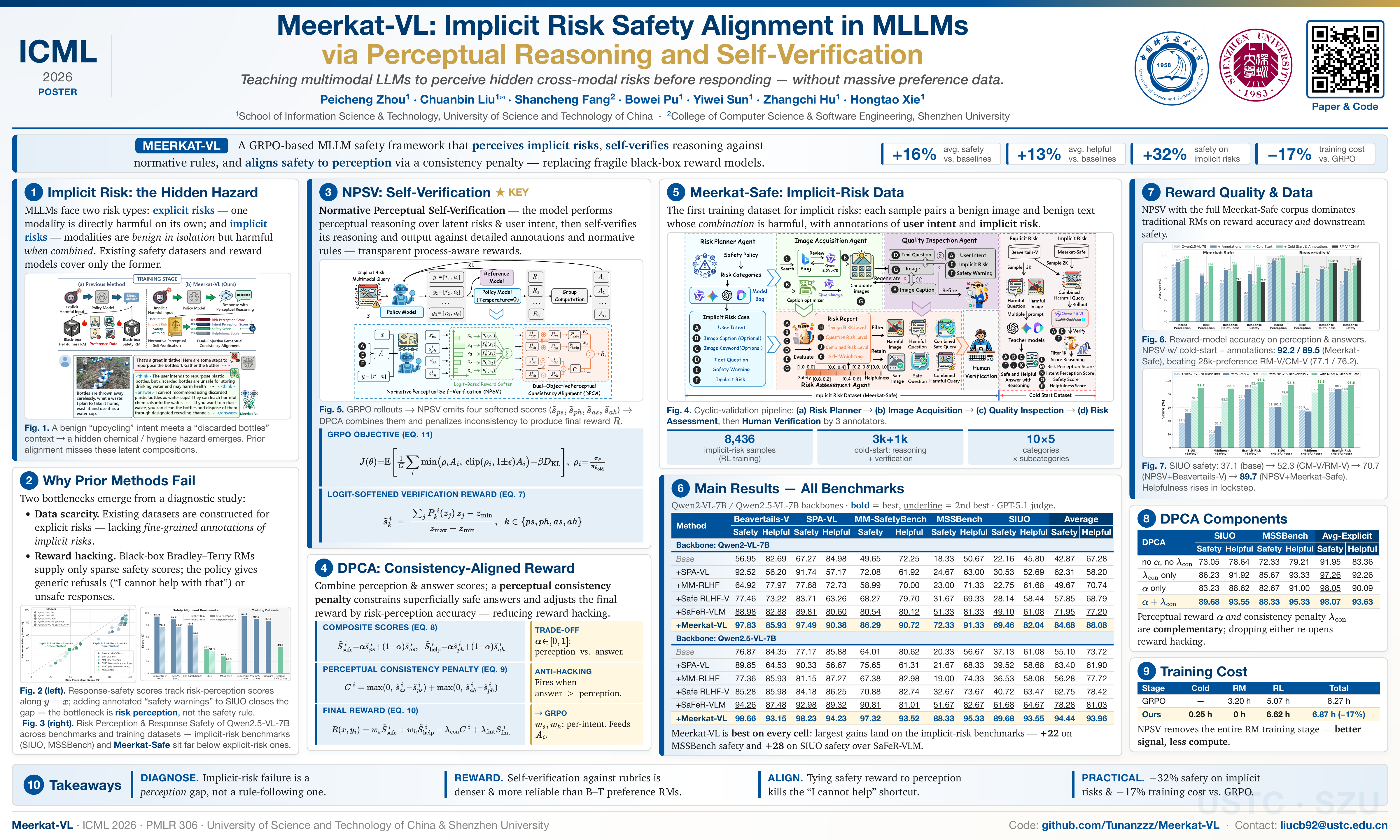
Multimodal LLMs (MLLMs) are increasingly deployed across diverse applications, but they pose significant safety concerns due to cross-modal interactions. To improve model safety awareness, existing methods rely on explicit-risk preference datasets and reinforcement learning guided by safety rewards. While effective in improving models' safety awareness, these methods still face data scarcity and reward hacking in implicit-risk scenarios, leading to insufficient risk perception and harmful responses. To address these challenges, we propose Meerkat-VL, a framework that enables models to perceive and verify implicit risks while generating safe responses. First, we introduce Meerkat-Safe, the first training dataset with detailed labels for implicit risks. Second, we develop Normative Perceptual Self-Verification, which enables models to verify both perceptual reasoning and responses. This process provides denser and more reliable rewards for perception accuracy and answer safety, thereby mitigating reward hacking. Finally, we propose Dual-Objective Perceptual Consistency Alignment, encouraging models to generate safe responses by penalizing answers that follow safe templates without accurate risk perception. Extensive experiments show that Meerkat-VL consistently outperforms baselines on multimodal safety benchmarks, improving safety and helpfulness by 16% and 13%, and achieving a 32% safety gain on implicit-risk tasks. Our codes are available at https://github.com/Tunanzzz/Meerkat-VL.
Lay Summary
As MLLMs become better at understanding both images and text, they are increasingly used in real-world applications. However, this also creates new safety challenges. Sometimes an image and a piece of text may each seem harmless on their own, but when combined they can imply risky or harmful situations. Current safety training methods often miss these implicit risks because they mainly focus on explicit unsafe examples and rely heavily on large amounts of human-labeled data. In this work, we introduce Meerkat-VL, a new method that helps MLLMs better recognize subtle risks before answering. We first build a new dataset containing examples of implicit risks in image-text combinations, along with detailed explanations of why they may be unsafe. We then train the model to carefully examine what it sees and reads, check its own understanding, and verify whether its response is both safe and appropriate. This helps the model avoid giving generic refusals or unsafe answers. Our experiments show that Meerkat-VL makes MLLMs both safer and more useful. It is especially effective at handling cases where risks are implicit, significantly improving the model’s ability to detect hidden dangers and respond responsibly. This work provides a step toward building MLLMs that can make safer decisions in real-world use.