
HALO: A Unified Vision-Language-Action Model for Embodied Multimodal Chain-of-Thought Reasoning
Abstract
Lay Summary
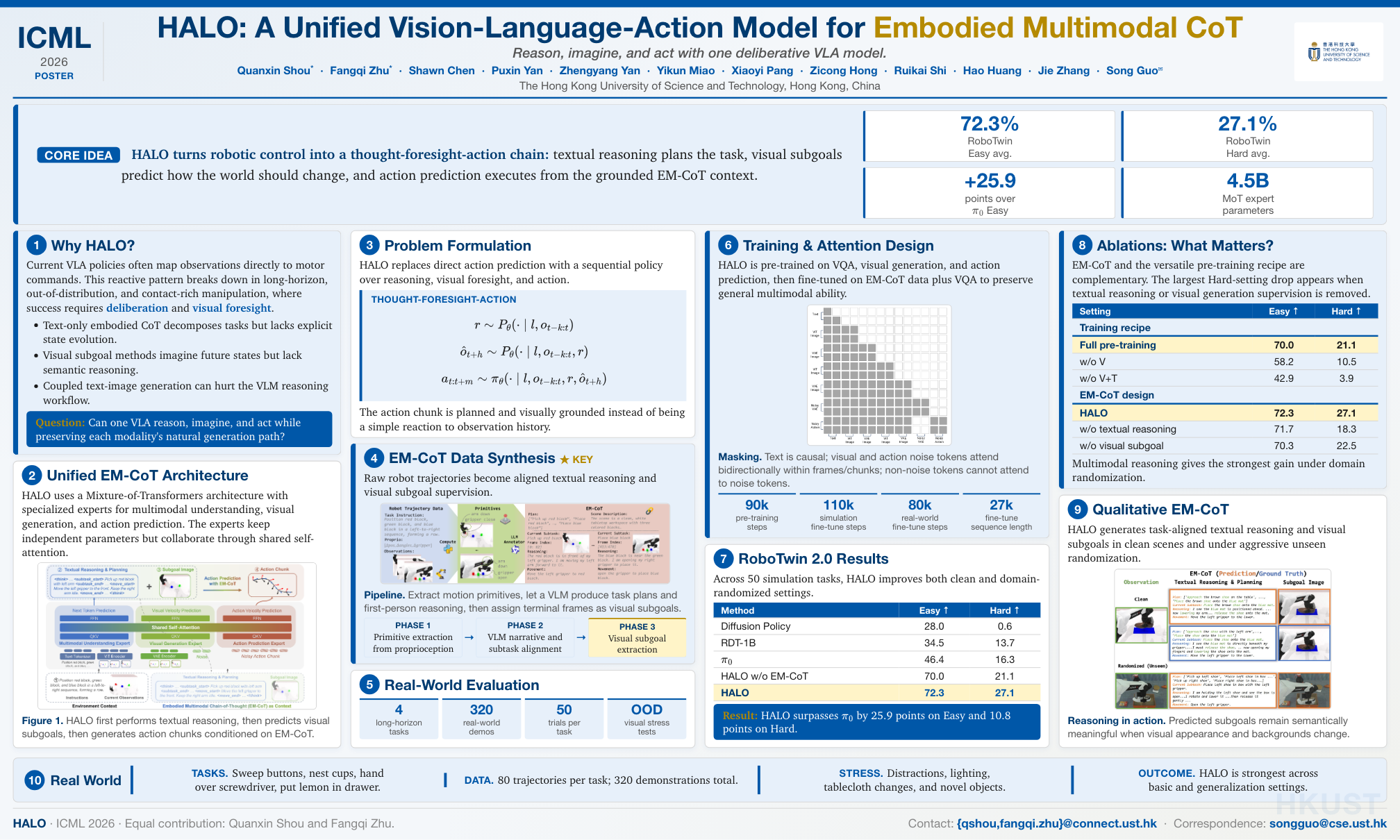
Most robotic systems today map raw visual inputs directly to motor commands, which tends to break down when facing novel objects, unfamiliar layouts, or tasks requiring sustained reasoning across many steps. We introduce HALO, a unified VLA model that replicates the human cognitive sequence of thinking, imagining, and then acting. Before generating any physical movement, HALO first produces a textual reasoning trace articulating the current subtask and its role in the broader plan, then generates a visual prediction of what the scene should look like once that subtask is complete, and only then commits to a concrete sequence of actions. This is realized through a mixture-of-experts architecture that assigns language understanding, image generation, and action control to three specialized modules sharing a common attention mechanism, alongside an automated pipeline that annotates raw robot demonstrations with reasoning traces and goal images at scale. Experiments in both simulated and real-world environments show that grounding actions in explicit multimodal reasoning leads to substantially more robust behavior, particularly in out-of-distribution scenarios involving unfamiliar objects, lighting changes, or visual distractions.