
World-R1: Reinforcing 3D Constraints for Text-to-Video Generation
Abstract
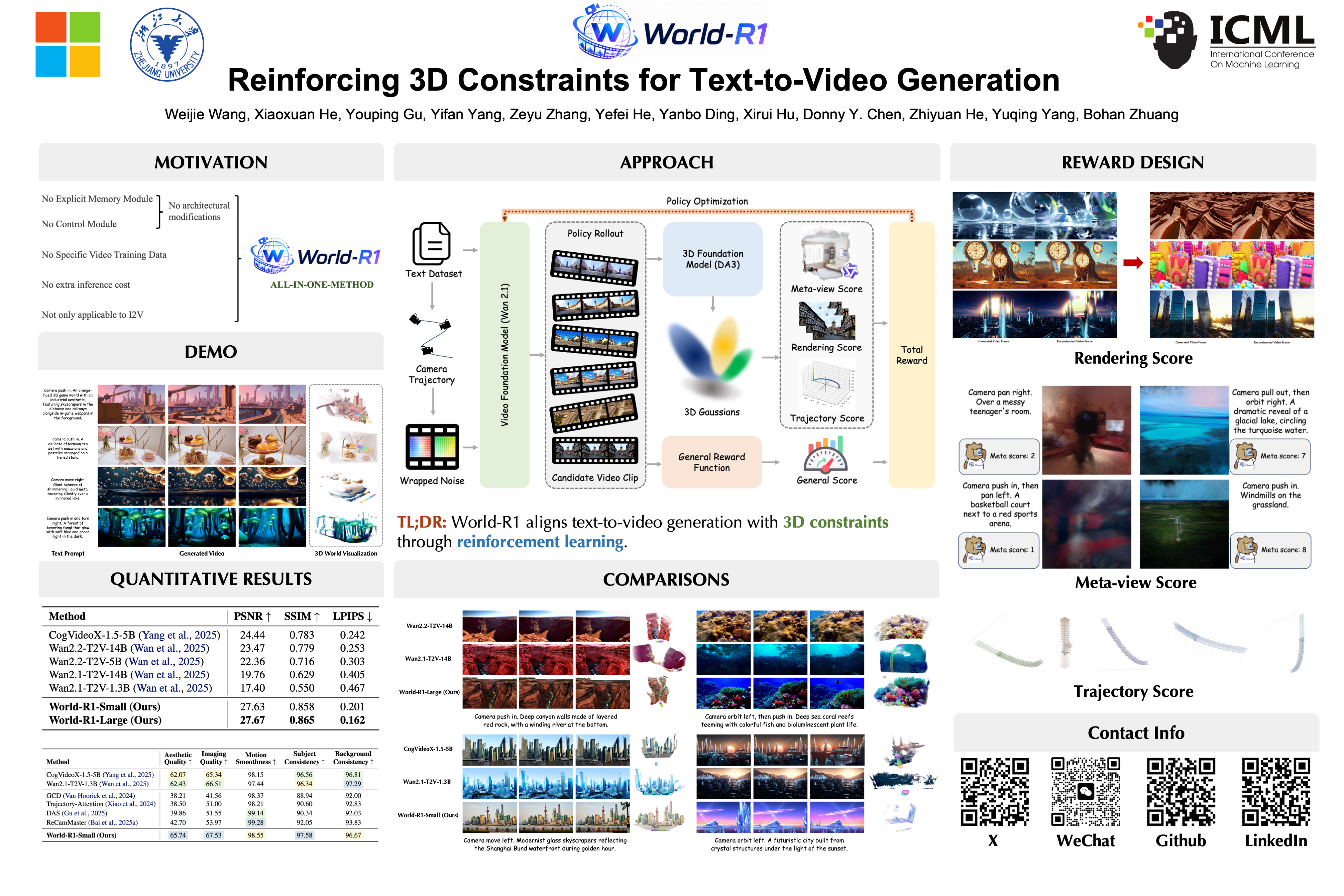
Recent video foundation models demonstrate impressive visual synthesis but frequently suffer from geometric inconsistencies. While existing methods attempt to inject 3D priors via architectural modifications, they often incur high computational costs and limit scalability. We propose World-R1, a framework that aligns video generation with 3D constraints through reinforcement learning. To facilitate this alignment, we introduce a specialized pure text dataset tailored for world simulation. Utilizing Flow-GRPO, we optimize the model using feedback from pre-trained 3D foundation models and vision-language models to enforce structural coherence without altering the underlying architecture. We further employ a periodic decoupled training strategy to balance rigid geometric consistency with dynamic scene fluidity. Extensive evaluations reveal that our approach significantly enhances 3D consistency while preserving the original visual quality of the foundation model, effectively bridging the gap between video generation and scalable world simulation.
Lay Summary
Today’s AI video tools can make realistic-looking clips, but they often do not understand the physical layout of the scene. When the camera moves, objects can bend, disappear, or change shape in ways that would be impossible in the real world. We introduce World-R1, a way to teach existing video generators to keep scenes more physically consistent without rebuilding the generator from scratch. Instead of asking the system only whether a video looks good, we also check whether the video could plausibly describe one coherent 3D world and whether the camera movement follows the intended path. The model then learns from this feedback using text descriptions of scenes. In our experiments, World-R1 makes videos that remain more stable across camera motion while keeping the visual quality of the original video model. This can make generated videos more useful for simulation, robotics, autonomous driving, and immersive content creation, where believable physical structure matters.