
CyberJurors: A Multi-Agent Simulation Task for E-Commerce Disputes Verdict
Abstract
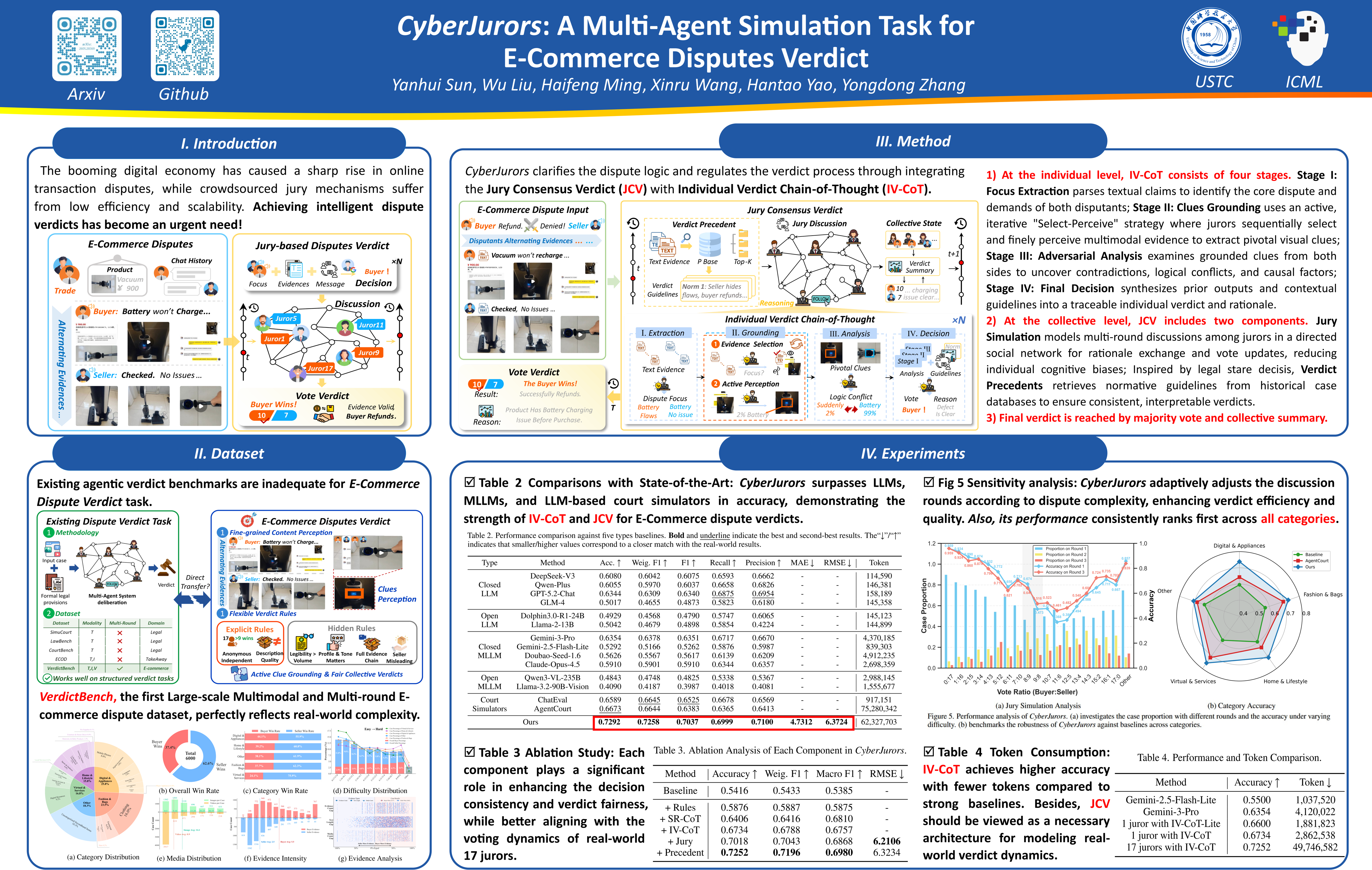
E-commerce platforms have begun recruiting crowdsourced jurors to adjudicate massive volumes of transaction disputes. Unlike formal legal judgment, E-commerce dispute verdicts require grounding pivotal clues from redundant, multi-round, multimodal evidence and making decisions under flexible platform-specific conventions. These characteristics render existing methods insufficient for this scenario. To bridge this gap, we introduce a pioneering task, E-commerce Dispute Verdicts (EDV), and present VerdictBench, a multimodal benchmark comprising 6,000 real-world cases designed to reflect crowdsourced jury decisions. Building upon this, we propose CyberJurors, a multi-agent framework to clarify the dispute logic and regulate the verdict process. At the individual level, Individual Verdict Chain-of-Thought decomposes the EDV task into four structured reasoning stages, enabling fine-grained clue perception and clarifying causal logic between pivotal clues and the dispute focus. At the collective level, Jury Consensus Verdict simulates multi-round discussion and voting among jurors, while incorporating verdict precedents to mitigate cognitive biases toward either disputant. Experiments on VerdictBench show that CyberJurors outperforms state-of-the-art LLMs, MLLMs, and court simulators, while achieving stronger alignment with real-world jury voting patterns. Code and dataset are available at https://github.com/YanhuiS/CyberJurors and https://huggingface.co/datasets/piggi/VerdictBench.
Lay Summary
Online shopping platforms now rely on crowdsourced jurors to resolve large numbers of buyer-seller disputes. But because these jurors are volunteers with limited time, handling a single case can take several days, making the process hard to scale. This creates a clear need for AI systems that can help make dispute decisions faster and more consistently. These disputes are difficult because the key clues are often buried in long, messy evidence, and the decision rules are more flexible than in formal legal settings. To study this problem, we built VerdictBench, the first benchmark of 6,000 real-world E-commerce disputes with multi-round text, image, and video evidence, along with final decisions from 17 jurors. To address these challenges, we develop CyberJurors, a system that simulates a jury instead of relying on a single model. One part of the system examines the evidence step by step to find the most important clues, while another part simulates discussion among jurors and uses similar past cases to reduce bias toward either side. CyberJurors matches real jury decisions more closely than existing AI systems, improving accuracy by up to 9.48%. This suggests a practical path toward faster, more transparent, and more reliable dispute resolution for online platforms.