
ReCoG: Relational and Compact Context Graph Learning for Few-shot Molecular Property Prediction
Abstract
Lay Summary
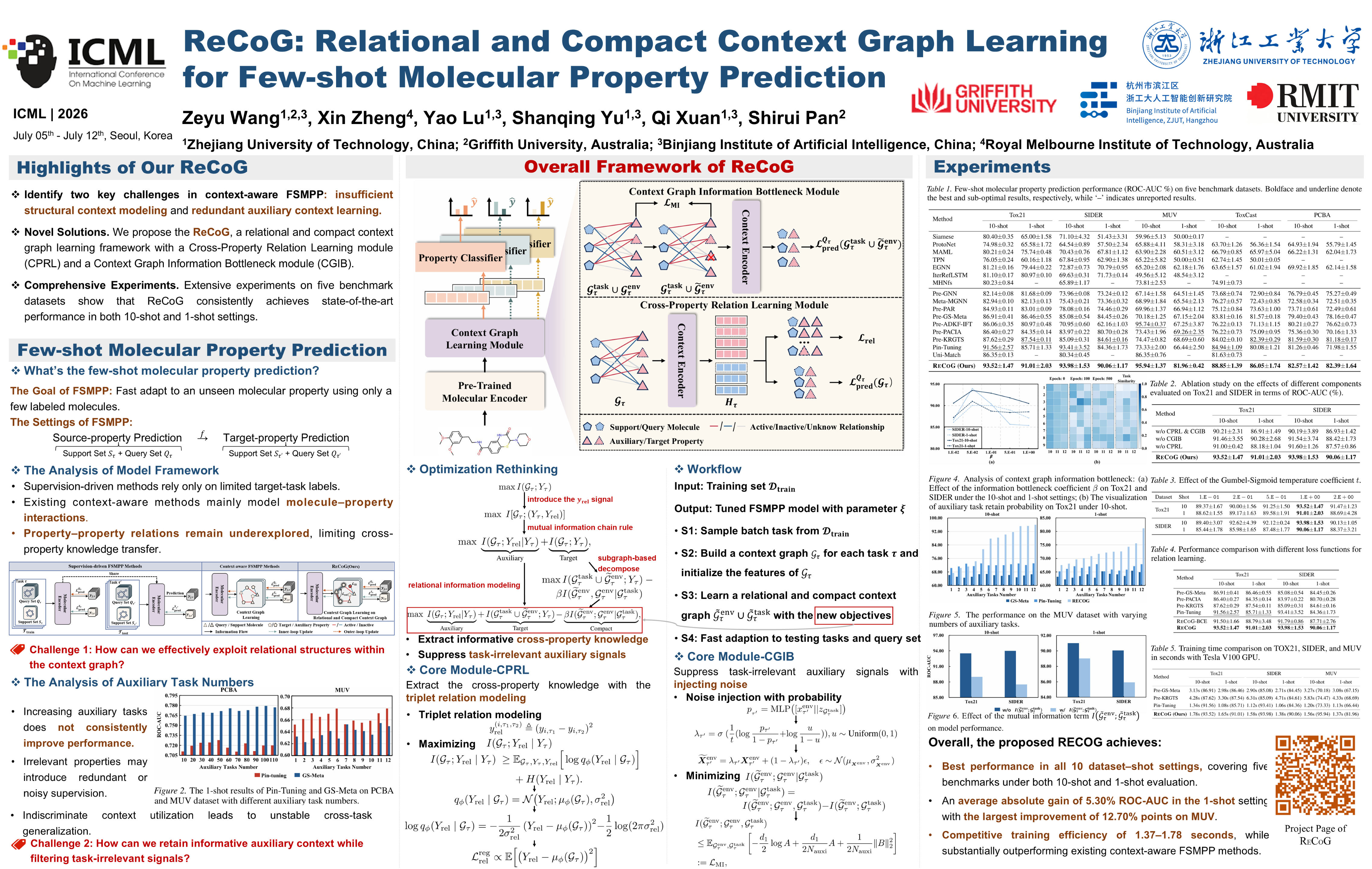
Few-shot molecular property prediction aims to predict important properties of molecules when only a small number of labeled examples are available. This problem is important because obtaining reliable molecular labels often requires costly and time-consuming laboratory experiments, especially in drug discovery and materials design. Existing methods try to use information from related molecules and property tasks, but they may either fail to capture useful relationships or introduce irrelevant auxiliary information. In this work, we propose RECOG, a framework that builds a more informative context graph to model relationships among molecular property tasks and then filters out unnecessary information through a compact learning mechanism. By jointly learning useful relations and removing redundant signals, RECOG can produce more effective molecular representations and improve prediction performance under limited-data settings. This may help researchers screen promising molecules more efficiently before conducting expensive experiments.