
Interpretable Functional Koopman Learning with Non-Markovian Closure for Spatiotemporal Systems
Abstract
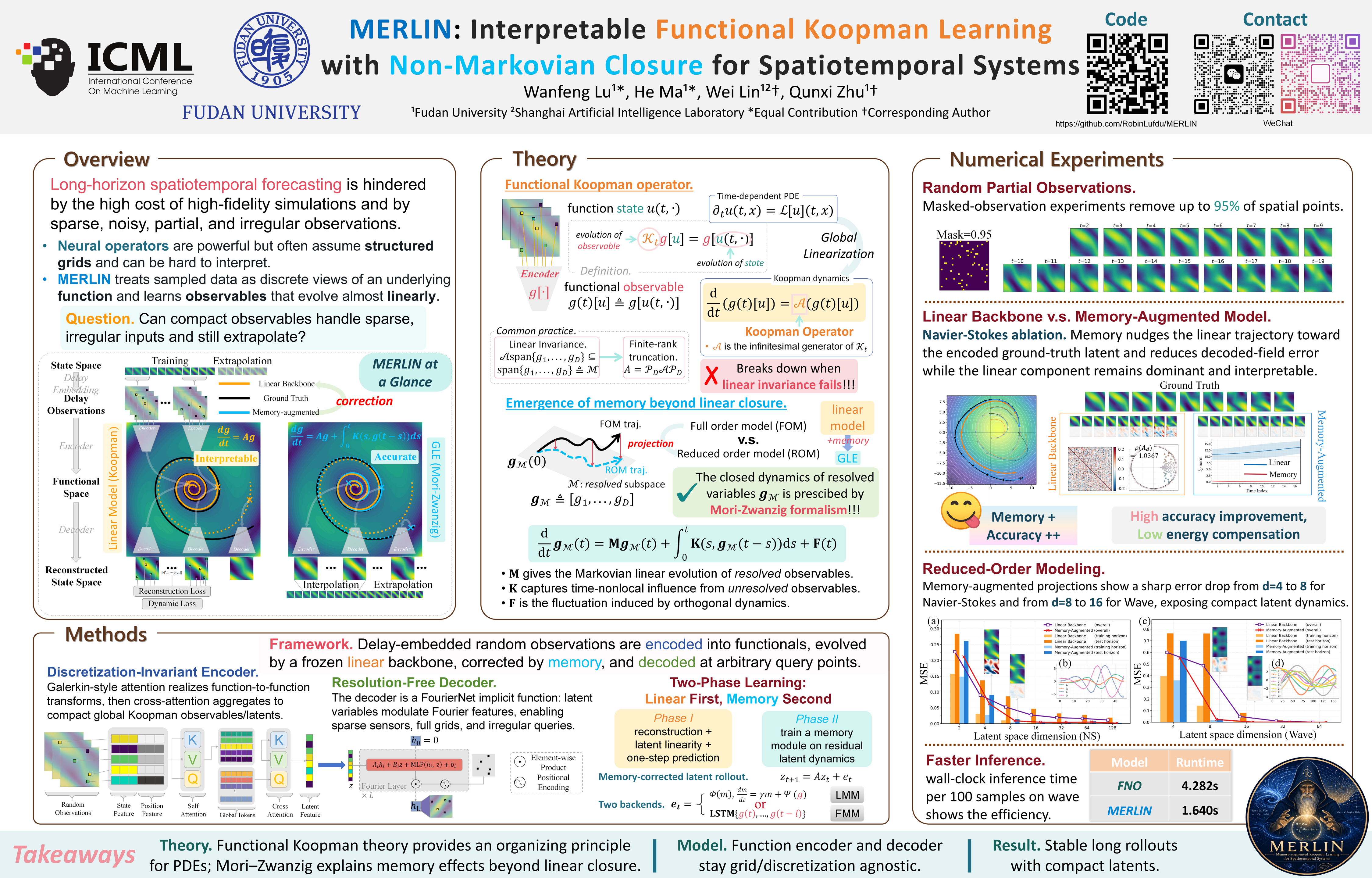
Precise prediction of spatiotemporal dynamics over predictive horizons is constrained by the computational cost of high-fidelity solvers and the sparsity, noise, and irregularity of data. We introduce MERLIN, a Koopman-based framework that lifts dynamics to the evolution of learned observation functionals with near-linear progression, enabling full-field reconstruction at arbitrary resolutions. Theoretically, we develop a functional Koopman theory for PDEs and compensate for the loss of finite-dimensional linear invariance via the Mori–Zwanzig formalism, which augments the linear backbone with non-Markovian memory terms to improve predictive accuracy. Practically, MERLIN employs discretization-invariant function encoders that map partial, irregular observations to observables, and resolution-free function decoders that reconstruct states at arbitrary query points. Training under linear constraints yields an interpretable, low-dimensional model that captures principal modes, supports reduced-order modeling, and—augmented with memory correction—delivers stable long-horizon rollouts even in ultra-low-dimensional latent spaces.