
Knowledge Diversion for Efficient Morphology Control and Policy Transfer
Abstract
Lay Summary
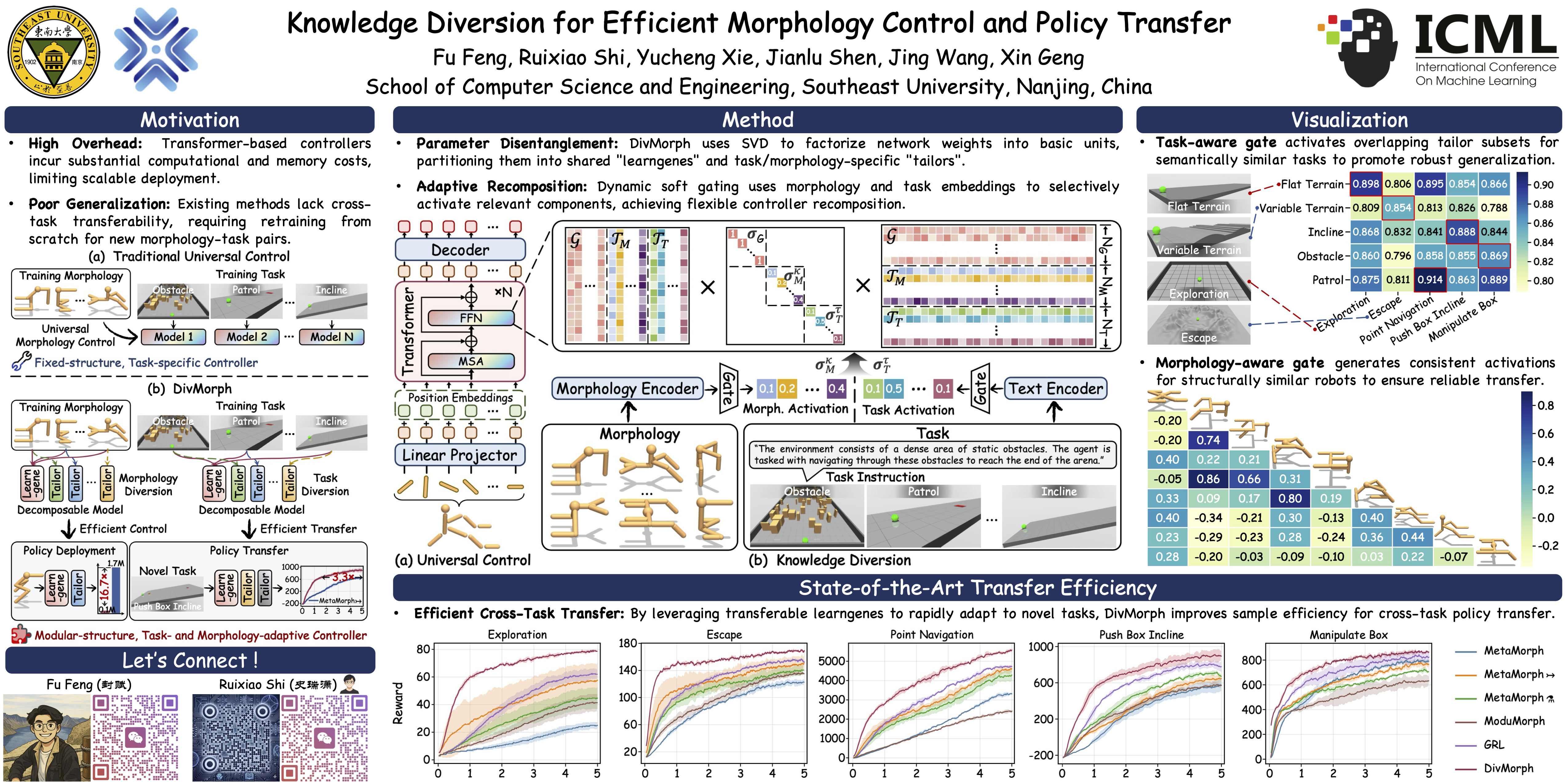
Modern robots come in many different forms, ranging from simple walking robots to complex systems with many limbs. Building a single control system that can operate across these diverse robot bodies and also adapt to new tasks remains a major challenge in robotics. Current methods often rely on large neural networks that are costly to deploy and usually need to be retrained from scratch whenever the robot encounters a new task. To address this problem, we propose DivMorph, a training framework designed to learn reusable and modular control knowledge. Rather than learning one large controller for all situations, DivMorph breaks the controller into smaller functional components. These components can then be flexibly combined according to the robot’s body structure and the task it needs to perform. During training, the framework automatically learns which knowledge should be shared across different robots and which parts should remain specialized for particular morphologies or tasks. This modular design enables robots to reuse previously learned skills more efficiently, making adaptation to new tasks faster and reducing the computational cost of deployment. As a result, DivMorph can generalize more effectively to unseen tasks while requiring much smaller models for individual robots. Experiments on a wide range of robotic control benchmarks demonstrate that our method substantially improves transfer efficiency and significantly reduces model size compared with existing approaches.