
LAMP: Data-Efficient Linear Affine Weight-Space Models for Parameter-Controlled 3D Shape Generation and Extrapolation
Abstract
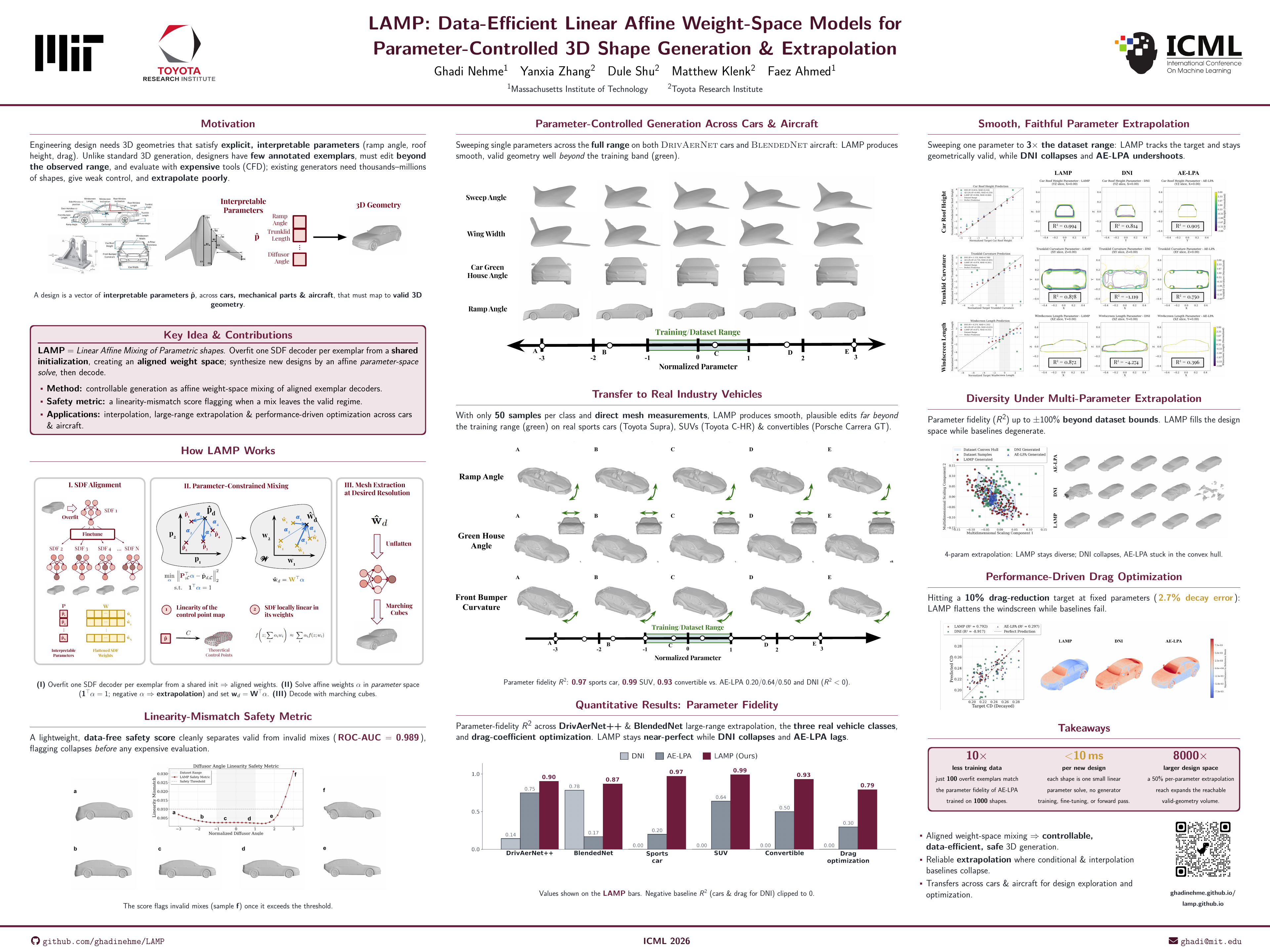
Generating high-fidelity 3D geometries under explicit parameter constraints is central to engineering design, yet current methods often require large datasets and fail to provide reliable control beyond the training distribution. We introduce LAMP, a data-efficient framework for controllable and interpretable 3D generation that aligns signed distance function (SDF) decoders by overfitting each exemplar from a shared initialization, then generates new designs by solving a parameter-constrained affine mixing problem in the aligned weight space. To improve reliability, we propose a linearity-mismatch safety metric that detects when mixed decoders leave the valid local regime. We evaluate LAMP on DrivAerNet++, BlendedNet, and additional industry-level vehicle families, including sports cars, SUVs, and convertibles. LAMP enables controlled interpolation with as few as 50 samples, safe extrapolation up to 100\% beyond training ranges, and performance-guided optimization under fixed parameters, outperforming conditional autoencoder and Deep Network Interpolation (DNI) baselines in extrapolation, data efficiency, and parameter fidelity. Our results demonstrate that LAMP advances controllable, data-efficient, and safe 3D generation for design exploration, dataset generation, and performance-driven optimization.
Lay Summary
Designing 3D objects like cars often requires controlling specific engineering parameters, such as shape dimensions or aerodynamic properties. However, most AI methods for generating 3D designs need large datasets and often struggle when asked to create shapes outside the range they were trained on. We introduce LAMP, a method for generating controllable 3D designs using only a small number of examples. Instead of training one large model from scratch, LAMP learns a separate compact representation for each example shape, starting from the same initial model. It then creates new designs by carefully mixing these learned representations while satisfying user-specified parameter constraints. LAMP also includes a safety check that warns when a generated design may be unreliable because it is too far from the valid design space. We test LAMP on several vehicle datasets, including cars, SUVs, sports cars, and convertibles. Our results show that LAMP can generate accurate, controllable, and diverse 3D designs with far fewer examples than existing methods.