
Geometry-Aware Image Flow Matching
Abstract
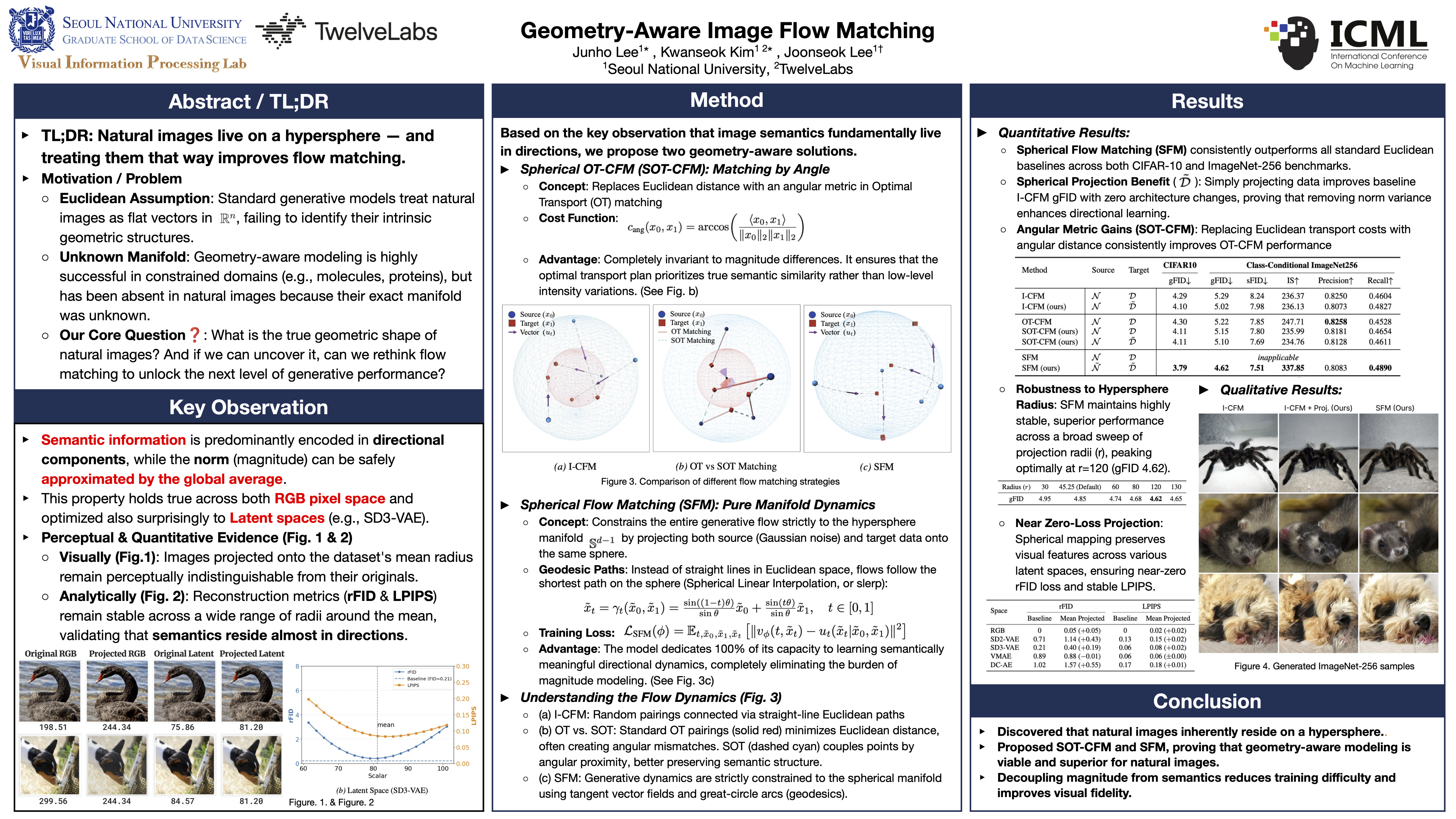
Recent advances in generative models highlight the power of geometry-aware modeling in manifold-constrained settings. Yet, for natural images, the field remains confined to Euclidean assumptions, failing to exploit the potential of intrinsic geometric structures within the data. In this work, we investigate the geometry of natural images and observe that semantic information is predominantly encoded in directional components, while norm components can be approximated by the global average. This property holds across both RGB and latent spaces, suggesting that natural images can be effectively modeled on a hypersphere. Building on this finding, we introduce Spherical Optimal Transport Flow Matching (SOT-CFM), which utilizes angular distance, and Spherical Flow Matching (SFM), which constrains dynamics directly on the manifold. Our experiments demonstrate that these geometry-aware methods achieve superior performance against Euclidean baselines. Ultimately, this work provides a novel perspective that bridges the gap between Riemannian manifold-based modeling and natural image generation.
Lay Summary
When we look at a photo of a dog, what makes it recognizably a dog? Intuitively, it is the shape, texture, and structure — not the overall brightness. Modern AI image generators, however, treat images as points floating freely in a high-dimensional space, forcing the model to simultaneously learn both "what the image looks like" and "how bright it is overall," which makes learning harder than it needs to be. We discovered that overall brightness carries almost no semantic information. What truly matters is the direction the image points to in that space — and this holds even in the compressed internal representations used by state-of-the-art generators. Swapping an image's brightness for the dataset average leaves it visually indistinguishable. This insight led us to redesign image generation around a sphere: rather than scattered points in an unbounded space, images naturally live on the surface of a high-dimensional sphere. We generate images by following the shortest curved paths on this sphere, allowing the model to focus entirely on learning meaningful visual structure instead of wasting capacity on brightness. Our approach produces sharper, more semantically consistent images, converges faster during training, and establishes a principled geometric foundation for future geometry-aware generative models.