
Steady-State Behavior of Constant-Stepsize Stochastic Approximation: Gaussian Approximation and Tail Bounds
Abstract
Lay Summary
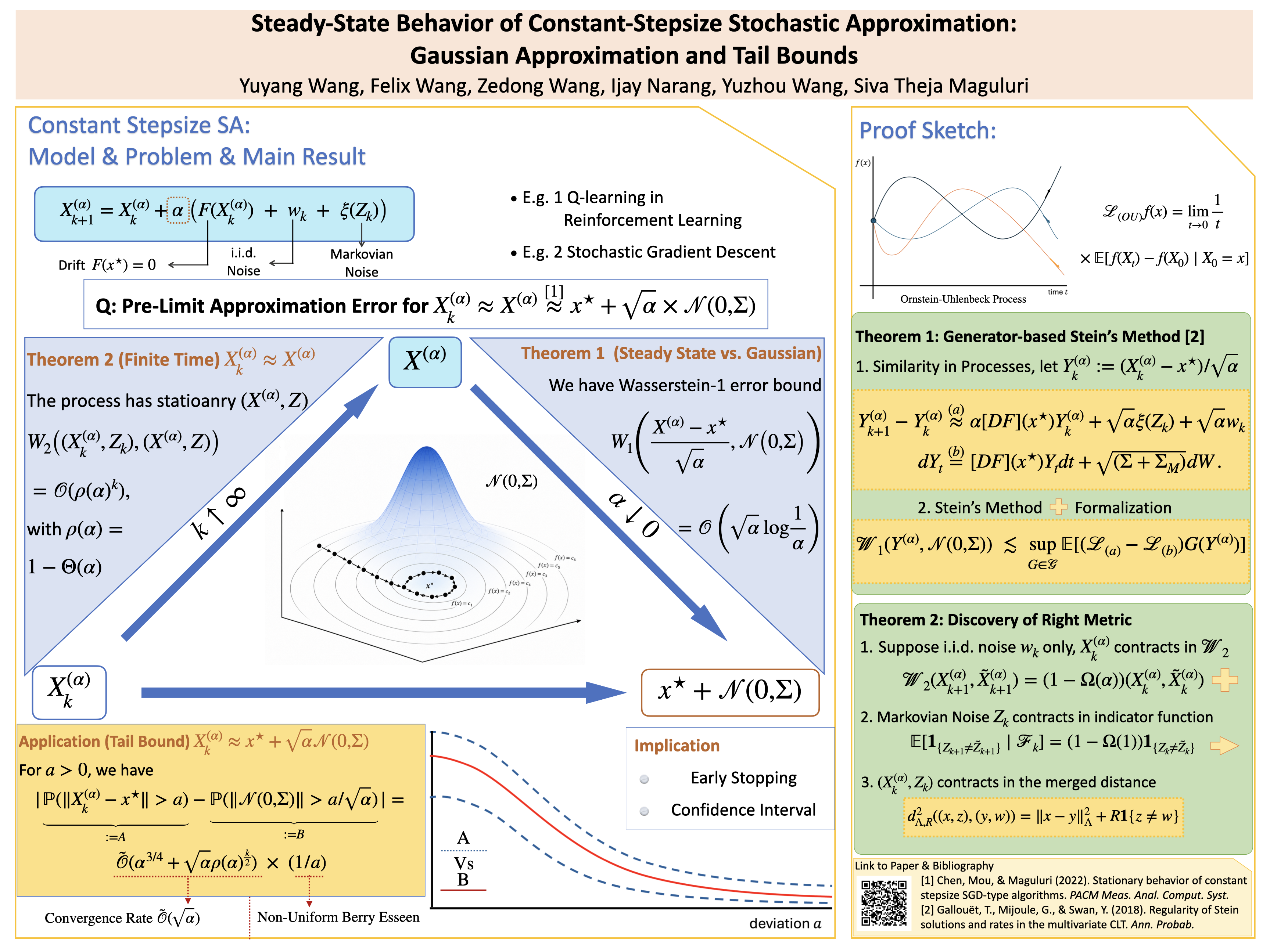
Many machine-learning algorithms use a fixed learning rate because it is fast in practice. But with a fixed rate, the algorithm does not stop exactly at the best solution and instead keeps randomly fluctuating around it. Existing theory says these fluctuations should look like a Gaussian bell curve when the learning rate is very small, but it does not say how accurate this is for practical learning rates. We give explicit mathematical guarantees that measure how close these fluctuations are to the Gaussian prediction, including how the error depends on the learning rate and problem dimension. Our results help researchers understand when Gaussian error estimates are reliable, how large fluctuations can be, and how fixed learning rates affect long-run uncertainty in learning algorithms.