
Provably Protecting Fine-Tuned LLMs from Training Data Extraction while Preserving Utility
Abstract
Lay Summary
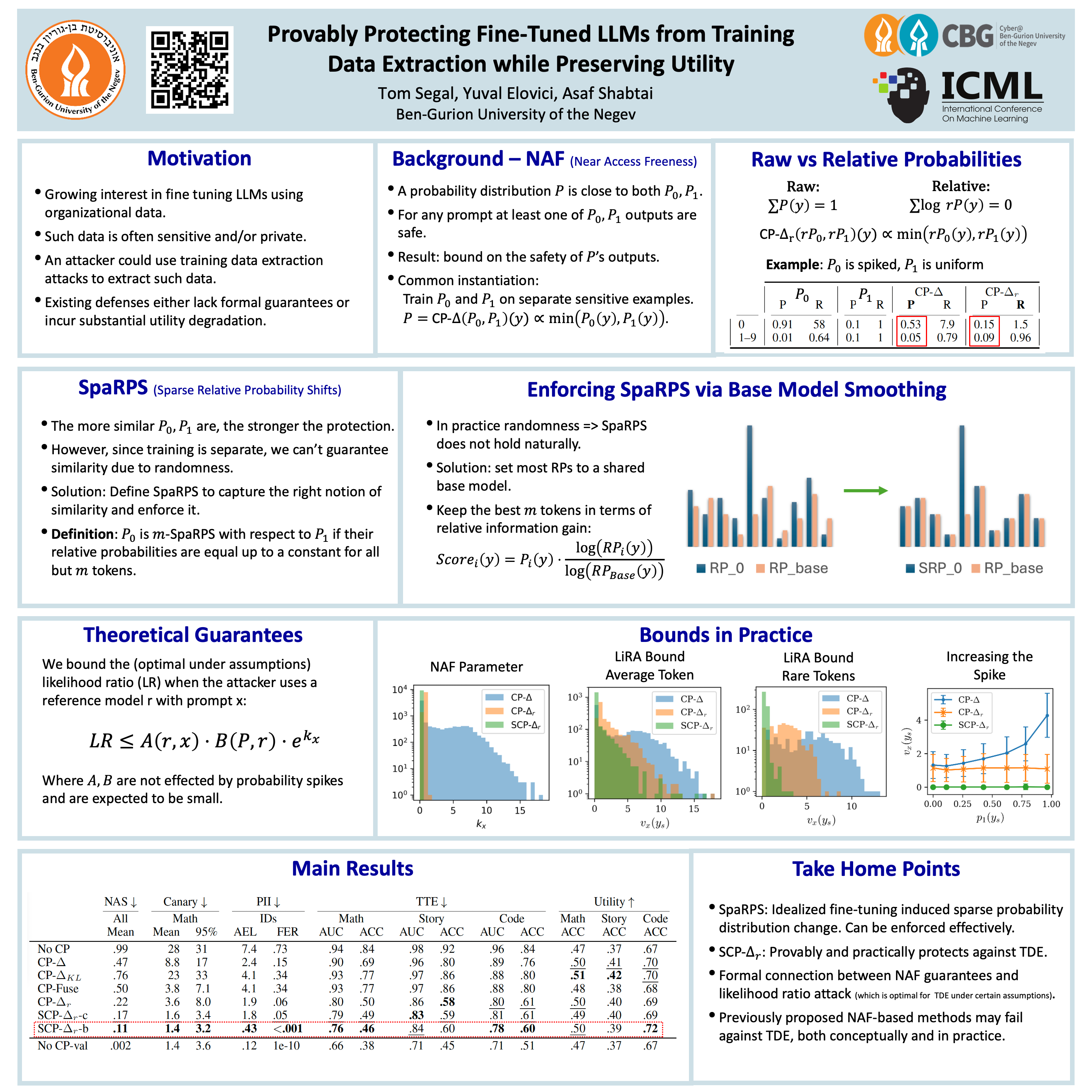
Large Language Models (LLMs) are often customized using private data through a process called fine-tuning. However, attackers can sometimes trick these models into revealing parts of their training data, including confidential information. Existing defenses either provide weak privacy guarantees or significantly reduce performance. Our work builds on a privacy framework called Near Access Freeness (NAF). NAF-based methods split sensitive data into separate parts and train different models on each part. The models’ outputs are then combined in a way that reduces the chance of revealing private information. However, previous NAF-based methods do not work well for LLMs because fine-tuning causes widespread changes in output probabilities, making the models appear more different than they really are. We discovered that most of these changes are not important for the model’s behavior. Our method smooths away unnecessary probability shifts while preserving the most important ones. To do this effectively, we operate on the models’ relative preferences between possible next words rather than their raw probabilities. Our approach provides strong mathematical guarantees against training data extraction attacks while preserving the model’s reasoning and language capabilities. This could help organizations safely fine-tune LLMs on sensitive data such as private documents, medical information, or proprietary code.