
Cross-Chirality Generalization by Axial Vectors for Hetero-Chiral Protein-Peptide Interaction Design
Abstract
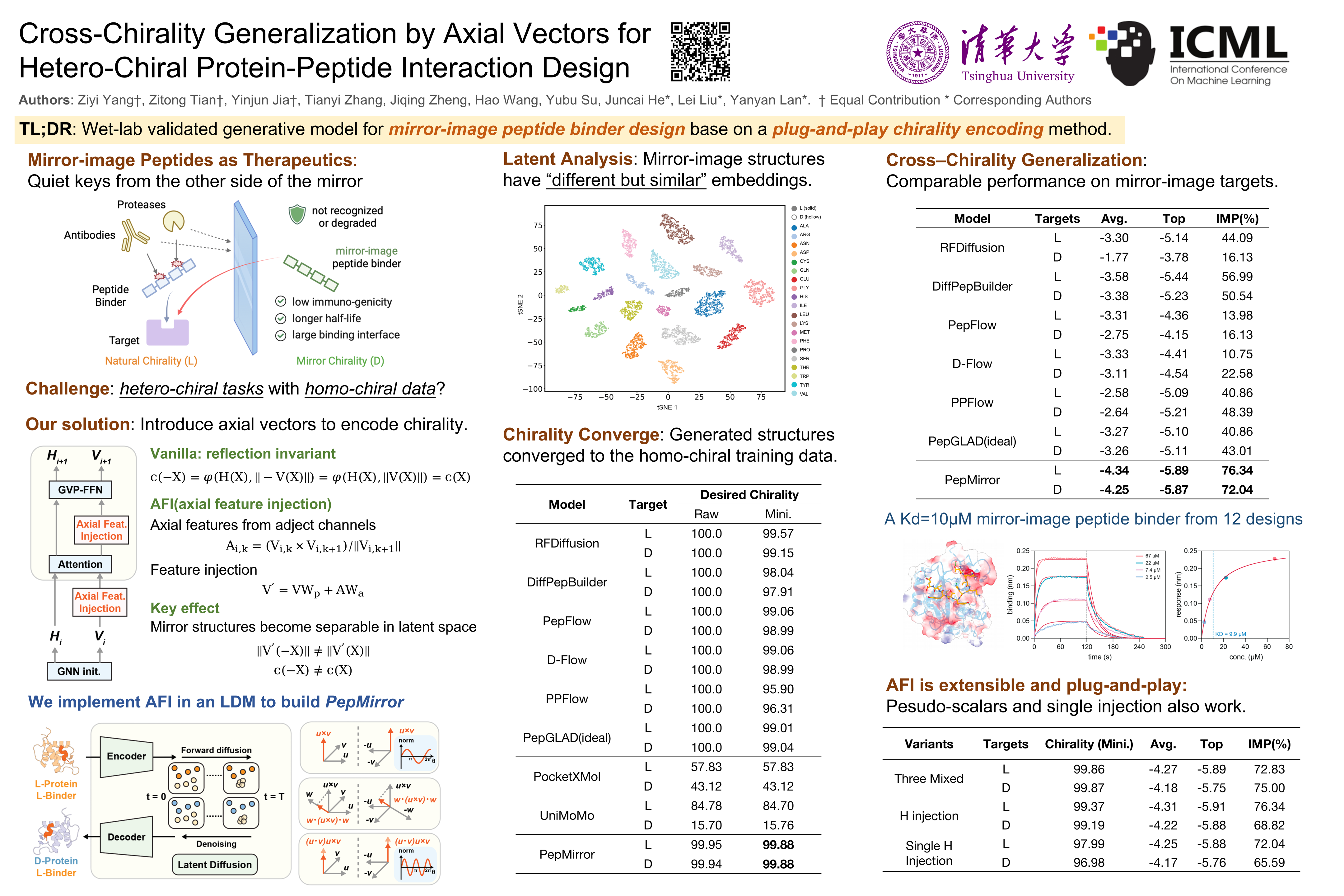
D-peptide binders targeting L-proteins have promising therapeutic potential. Despite rapid advances in machine learning-based target-conditioned peptide design, generating D-peptide binders remains largely unexplored. In this work, we show that by injecting axial features to E(3)-equivariant (polar) vector features, it is feasible to achieve cross-chirality generalization from homo-chiral (L-L) training data to hetero-chiral (D-L) design tasks. By implementing this method within a latent diffusion model, we achieved D-peptide binder design that not only outperforms existing tools in in silico benchmarks, but also demonstrates efficacy in wet-lab validation. To our knowledge, our approach represents the first experimentally validated AI generative model for the de novo design of D-peptide binders, offering new perspectives on handling chirality in protein design. Codes are available at https://github.com/YZY010418/PepMirror
Lay Summary
All Earth lives use only L amino acids to build proteins. Consequently, their mirror-image counterparts, D peptides, become ideal next-generation drugs, because they resist rapid breakdown in the body and barely trigger immune reactions since these two systems work in an all-L world. However, traditional way for D-peptide drug screening has been prohibitively expensive because the mirror-image of target proteins have to be chemically synthesized, which is impractical for most targets. Existing AI excels at designing L-peptides, but cannot reliably distinguish mirror-image molecules, leading to reduced performances in terms of chirality control and cross-chirality generalization. Here, we solved this by adding a simple plug-and-play geometric feature—axial vectors—to standard protein design models, enabling AI to tell L and D amino acids apart, and transfer knowledge from L-protein interactions to D-peptide design. Our model, PepMirror, outperforms existing methods and, for the first time, generates lab-validated de novo D-peptide binders. This work unlocks a fast, low-cost path to D-peptide drug discovery and provides a general strategy for handling chirality in protein design.