
Dataset Distillation Efficiently Encodes Low-Dimensional Representations from Gradient-Based Learning of Non-Linear Tasks
Abstract
Lay Summary
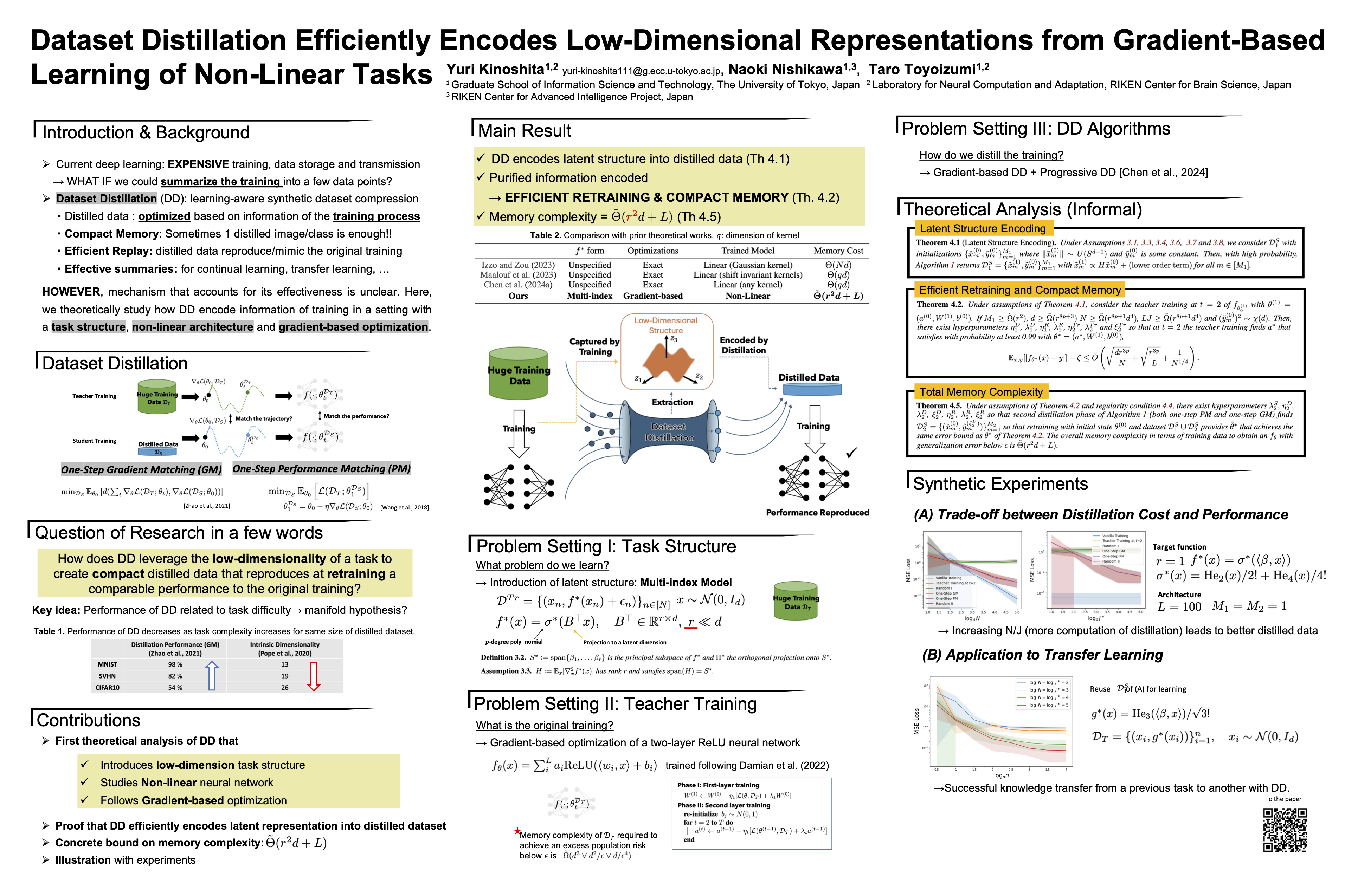
Training modern artificial intelligence (AI) often requires very large datasets, which can make learning expensive in time, storage, and energy. A promising idea called dataset distillation tries to replace a large dataset with a much smaller set of artificial examples that still teaches an AI model the same task. Although this method often works well in practice, researchers have not fully understood why such tiny datasets can contain enough useful information. In this work, we study this question mathematically for a common type of neural network and training procedure. We focus on tasks where the important information relies only on a few aspects of the raw data. We show that dataset distillation can efficiently capture this low-dimensional structure and store it as synthetic examples, so that only a few such examples are needed for the model to generalize well to new data. This helps explain when and why dataset distillation works, and may guide the design of cheaper, more efficient ways to train AI systems.