
DecomPose: Disentangling Cross-Category Optimization Contention for Category-Level 6D Object Pose Estimation
Abstract
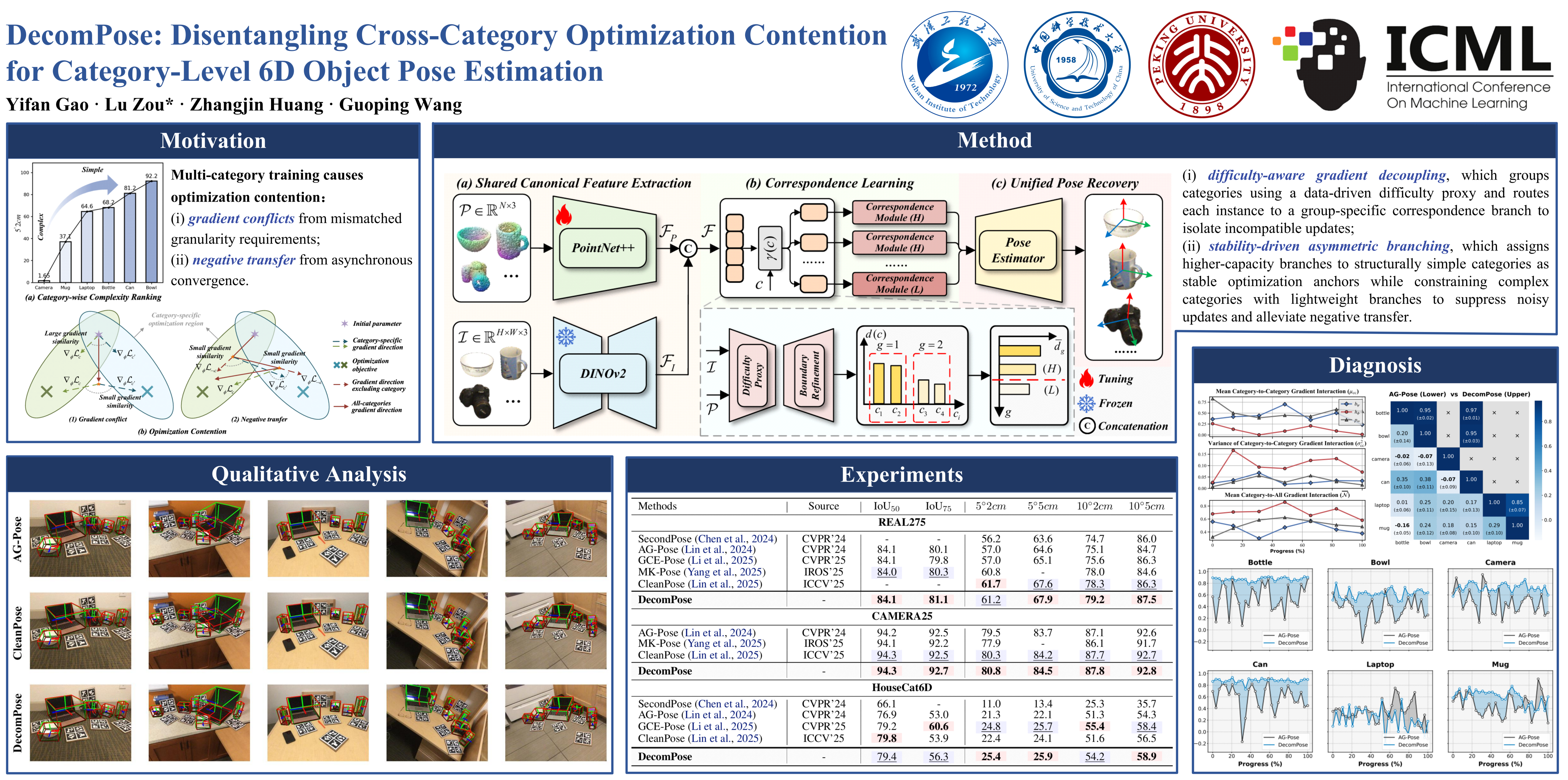
Category-level 6D object pose estimation is typically formulated as a multi-category joint learning problem with fully shared model parameters. However, pronounced geometric heterogeneity across categories entangles incompatible optimization signals in shared modules, resulting in gradient conflicts and negative transfer during training. To address this challenge, we first introduce gradient-based diagnostics to quantify module-level cross-category contention. Building on results of diagnostics, we propose DecomPose, a difficulty-aware decomposition framework that mitigates optimization contention via: (1) difficulty-aware gradient decoupling, which groups categories using a data-driven difficulty proxy and routes each instance to a group-specific correspondence branch to isolate incompatible updates; and (2) stability-driven asymmetric branching, which assigns higher-capacity branches to structurally simple categories as stable optimization anchors while constraining complex categories with lightweight branches to suppress noisy updates and alleviate negative transfer. Extensive experiments on REAL275, CAMERA25, and HouseCat6D demonstrate that DecomPose effectively reduces cross-category optimization contention and delivers superior pose estimation performance across multiple benchmarks.
Lay Summary
When computers learn to estimate the 6Dof object pose from images, they are often trained to handle many kinds of objects at once. But objects such as bottles, cameras, or laptops can have very different shapes. We wanted to understand whether forcing one model to learn all of them together might actually make learning harder. We found that different object categories can push the model in conflicting directions during training. In other words, what helps the model improve on one category may hurt its performance on another. This makes it difficult for a single shared model to work well across all categories. To address this, we developed DecomPose, a method that separates object categories into different learning branches based on how difficult they are to learn. Easier and more stable categories are given stronger branches, while harder categories are handled in a way that reduces noisy updates and harmful interference. Tests on several widely used benchmarks showed that DecomPose improves object pose estimation accuracy across different datasets. This suggests that breaking a complex learning problem into better-balanced parts can help computer vision systems become more accurate and reliable.