
SWE-MiniSandbox: Container-Free Reinforcement Learning for Building Software Engineering Agents
Abstract
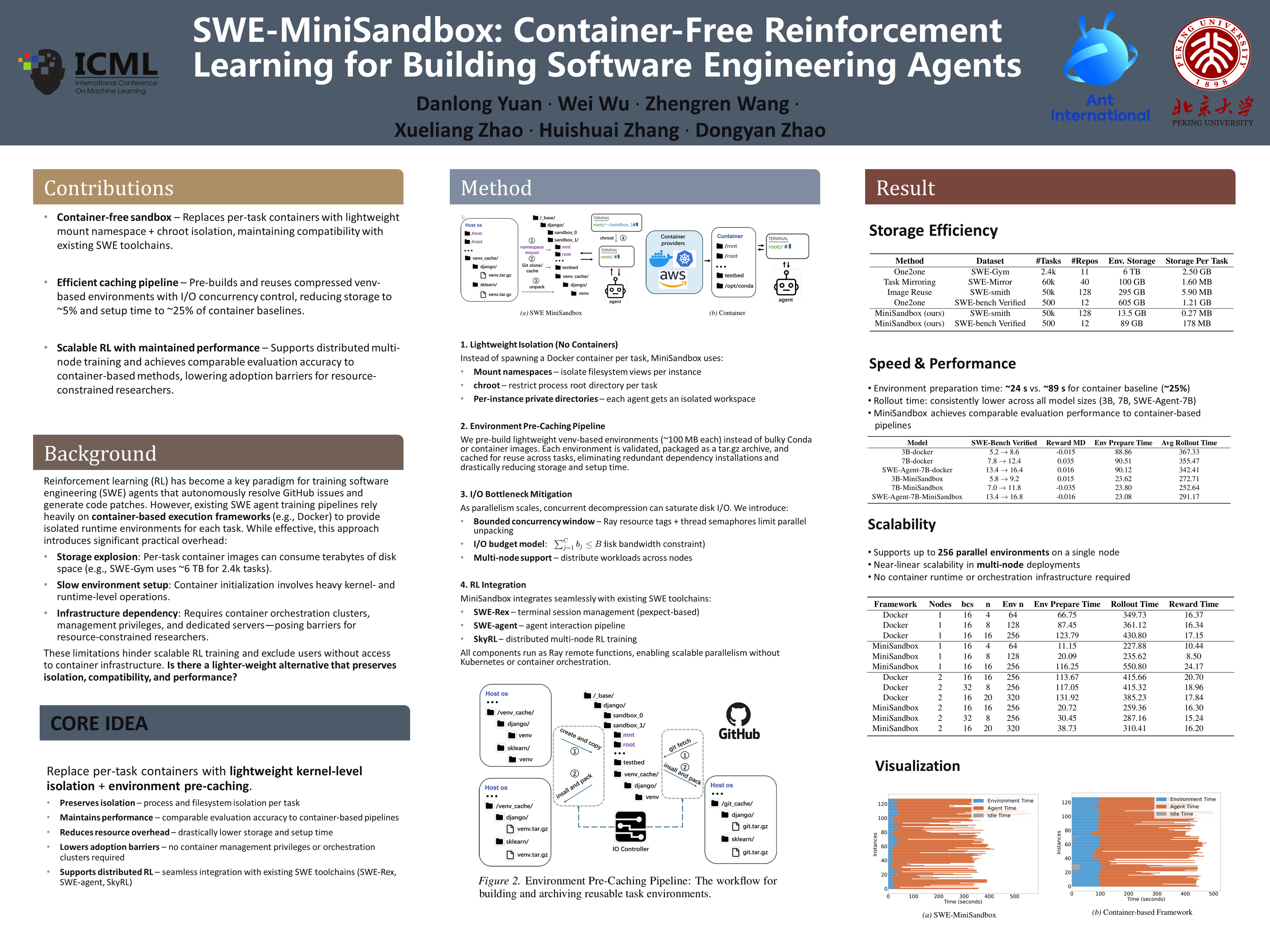
Reinforcement learning (RL) has become a key paradigm for training software engineering (SWE) agents, yet its practical accessibility and scalability is often constrained by container-based execution frameworks used for environment isolation. As the number of task instances increases, pre-cached container images introduce substantial storage overhead, limiting large-scale training under limited cotainer resources, and excludes users without container management privileges. We introduce SWE-MiniSandbox, a lightweight, container-free method that enables scalable RL training of SWE agents without sacrificing isolation. Instead of relying on per-instance containers, SWE-MiniSandbox executes each task in an isolated workspace backed by kernel-level mechanisms, substantially reducing system overhead. It leverages lightweight environment pre-caching techniques to eliminate the need for bulky container images. As a result, our approach lowers disk usage to approximately 5\% of that required by container-based pipelines and reduces environment preparation time to about 25\% of the container baseline. Empirical results demonstrate that SWE-MiniSandbox achieves evaluation performance comparable to standard container-based pipelines. Consequently, by removing the dependency on heavy container infrastructure, SWE-MiniSandbox offers a practical and accessible foundation for scaling RL-based SWE agents, particularly in resource-constrained research environments.
Lay Summary
Training AI agents to write and fix code usually requires creating a separate “sandbox” — a safe, isolated environment — for each programming task. Most approaches rely on heavy software containers, which consume significant storage and are difficult to run on machines without container-management privileges. We developed a new method called SWE-MiniSandbox that removes the need for containers entirely. Instead, it uses built-in operating system features to keep each task isolated, while preparing environments much faster and using less disk space. This makes it practical for researchers without special computing privileges to train capable coding agents at a larger scale. By lowering hardware barriers, our work helps democratize AI for software engineering, enabling more people to contribute to building and improving this technology.