
NeuroMamba: A Universal Spatiotemporal Module for Robust Perception in Degraded Sensory Streams
Abstract
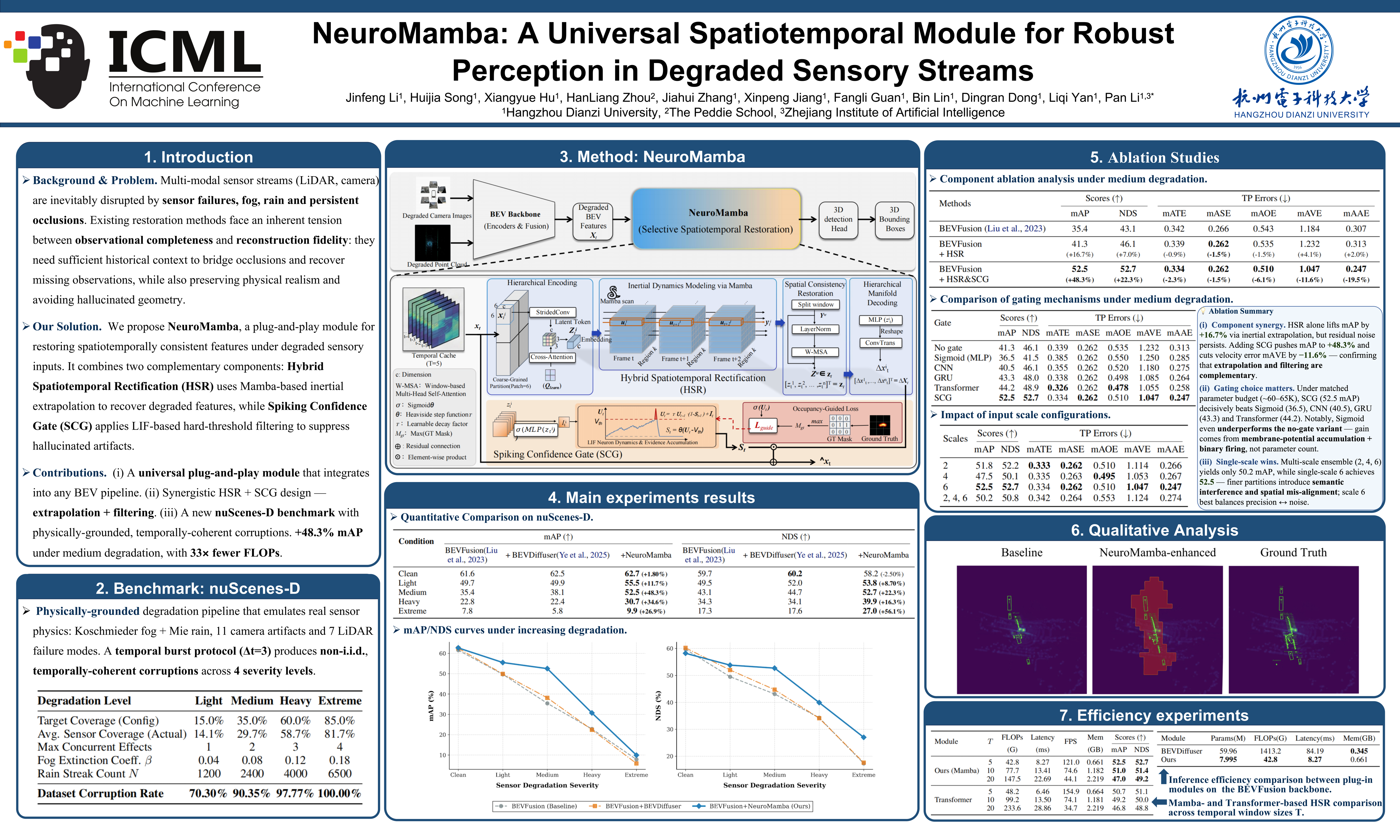
In open-world intelligent systems, processing continuous sensory streams disrupted by heterogeneous degradation sources presents a fundamental challenge: reconciling the inherent tension between observational completeness and reconstruction fidelity. Methods that prioritize completeness by bridging long-term occlusions often introduce spurious artifacts, while approaches that focus on aggressive noise suppression inevitably disrupt temporal continuity and erase valid structures. To address this challenge, we propose NeuroMamba, a universal plug-and-play module that enhances spatiotemporal consistency in degraded streams. NeuroMamba tackles the dual objectives through two synergistic components. First, we introduce a regional Hybrid Spatiotemporal Rectification (HSR) module, which leverages Mamba-based inertial modeling of linear complexity to recover short-horizon temporal dependencies and infer missing modalities under partial observability. Second, we design a Spiking Confidence Gate (SCG) that enforces reconstruction fidelity under occupancy-guided supervision. Implemented as a hard-thresholding spiking gate unit based on leaky integrate-and-fire (LIF) neurons, SCG distinguishes valid geometric features from sensor noise based on accumulated temporal evidence. Extensive experiments on the nuScenes robustness benchmark demonstrate that NeuroMamba effectively reconciles the trade-off between completeness and fidelity, outperforming the performance of existing approaches in restoring high-fidelity spatiotemporal features from severely incomplete and degraded observations.
Lay Summary
Modern autonomous systems such as self-driving cars, robots, and surveillance networks rely on cameras and laser-based sensors to perceive their surroundings. In real-world conditions, these sensors often fail: cameras can be blocked by rain or fog, laser signals can be distorted, and transmission delays can cause missing frames. Even a few seconds of degraded sensor data may lead to serious downstream errors. This work introduces NeuroMamba, a plug-and-play module that helps perception systems remain reliable when sensor data degrades. It does two things. First, it recovers missing or corrupted spatiotemporal features by using recent motion patterns and contextual information. Second, it filters out unreliable reconstructions through a brain-inspired mechanism that activates only after enough evidence has accumulated over time, much like biological neurons. As a result, brief noise fluctuations are less likely to be mistaken for real objects. We test NeuroMamba on a widely used self-driving dataset with simulated bad weather and sensor failures of varying severity. When attached to existing perception systems, NeuroMamba consistently improves their detection accuracy under difficult conditions, making the underlying systems more reliable when their sensors degrade.